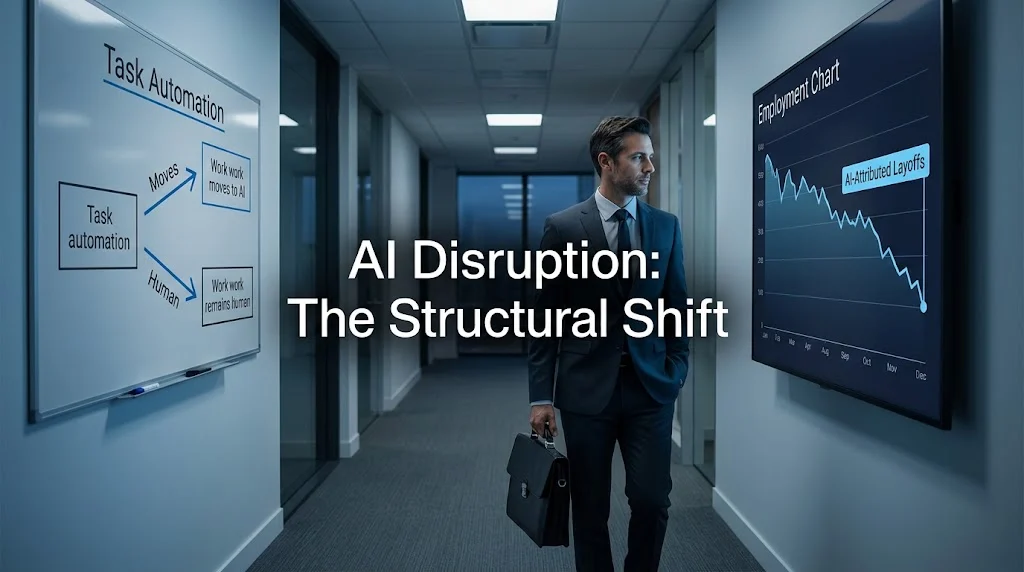
AI disruption describes the structural changes artificial intelligence is forcing across labor markets, industries, and business models. In 2026, nearly 200,000 US jobs have been attributed to AI since 2023, private equity’s software bets are unraveling, and white-collar entry-level roles face the sharpest exposure.
At-a-Glance: Key Takeaways
- Nearly 192,000 US jobs lost to AI since 2023, with more than 60% occurring in 2026 alone .
- White-collar and entry-level roles face the highest exposure, reversing the historical pattern where automation hit manual labor first .
- Private equity’s software bet is breaking. Apollo cut software exposure by half in 2025; lenders are scrutinizing portfolios for AI vulnerability .
- AI enablers win; skills-based services lose. Forrester’s disruption model identifies infrastructure, data/AI, and security as the only clear growth categories .
- Reskilling frameworks are failing. Jobs shift faster than training cycles, and continuous reskilling is functionally a social insurance problem .
- Policy is lagging badly. The gap between AI development and regulatory response has been described as “turtle and rocket” .
What Is AI Disruption?
AI disruption refers to the structural changes that artificial intelligence is forcing across economies, industries, and labor markets. It is not simply about job replacement. It encompasses the reshaping of business models, the redistribution of value, and the redefinition of what work looks like.
The disruption is distinct from previous technology waves in one critical way: it is hitting cognitive and white-collar work first. From the mid-19th century through the late 20th, automation primarily displaced manual and routine tasks. Blue-collar jobs suffered while white-collar work grew. That pattern has reversed. AI handles copywriting, data analysis, software development, and customer service tasks with increasing competence, exposing jobs that were once considered immune to automation .
The term also captures the financial dimension. AI-native firms can offer quicker, cheaper solutions than established SaaS providers, undermining business models that once seemed defensible. Private equity portfolios built on “sticky” software revenues now face valuation scrutiny as lenders and investors reassess AI vulnerability .
The Labor Market Shift
Which Jobs Are Most Exposed
Research from the Kellogg School analyzed nearly 200 years of technology and employment data. Their conclusion: AI is “turning back the clock” on the historical relationship between technology and work. White-collar occupations, which tend to be higher-paying and require more education, face declining relative demand. Blue-collar jobs, where hands-on skills remain paramount, are picking up a larger share of workers .
The most vulnerable roles share three characteristics: low-level tasks, no requirement for collaboration, and no in-person presence. Modular work that is done the same way across companies is easiest to automate .
The Numbers
Data from Challenger, Gray & Christmas shows the acceleration is real:
| 2023 | 4,200 |
| 2024 | 12,700 |
| 2025 | 54,800 |
| 2026 (Jan-Sep) | 120,100 |
| Total | ~192,000 |
May 2026 alone saw 38,600 AI-attributed layoffs, the highest single month on record .
Major companies announcing AI-linked cuts include HSBC (20,000), Amazon (16,000), Standard Chartered (7,000+), and Block (4,000+, nearly half its workforce) .
The Entry-Level Squeeze
The disruption falls disproportionately on entry-level workers. IMF research found hiring demand has fallen by about 10% in jobs where AI is most useful. But the picture is nuanced: employers still want people in these jobs. They just want workers who can use AI to do more .
The pathway to skills and upward mobility is being dismantled. Employment in AI-vulnerable occupations is already 3.6% lower after five years, hitting entry-level workers hardest .
Industry-Level Disruption
Software and Private Equity
The most dramatic disruption is unfolding in software. Apollo Global Management cut its direct lending funds’ software exposure almost by half in 2025, from about 20% at the start of the year .
The threat comes from AI-native competitors. Anthropic’s Claude Code and similar “vibe-coding” tools allow users with no coding experience to build software, dramatically lowering the barrier and undermining rigid, one-size-fits-all SaaS products .
Private credit’s exposure may be understated. Barclays estimates business development companies have around 20% of portfolios in software, but analysts note that software exposure is “meaningfully higher than it looks” because deals are classified by industry vertical .
Forrester’s AI Disruption Model applied to 200+ technology markets found that only three categories are positioned for clear growth: infrastructure providers, data and AI providers, and cybersecurity/identity providers. Transformation services, software development, creative services, localization, and training face the greatest disruption .
Business Model Transformation
The disruption extends beyond job loss to fundamental business model changes. Traditional software companies benefited from “sticky” revenues and predictable subscription cash flows. AI-native firms offer more flexible, cheaper alternatives. As one investor put it, the private equity model of “buying a software business, improving margins and adding leverage” assumes the underlying product remains relevant long enough for financial engineering to work. AI has changed that assumption .
Why Reskilling Isn’t Working
The standard policy response to technological disruption is reskilling. But the framework is failing for structural reasons.
Technology is projected to transform 1.1 billion jobs over the next decade, with 59% of workers globally needing retraining by 2030. The IMF has warned that reskilling “may be a less reliable solution when the target occupations themselves are on a shrinking horizon” .
The World Economic Forum’s analysis notes that 30% of employees will need to find other jobs after training, or fall between the cracks without it. The cost is neither predictable nor even: workers in earning transitions lose $1.1 trillion in annual income in the US alone, roughly 5% of GDP .
Continuous reskilling at population scale is functionally a social insurance problem. Most social protection systems were built for an era of stable careers: train once, work, contribute taxes, retire. AI is collapsing that architecture. With global sovereign debt approaching 100% of GDP, funding continuous reskilling through existing systems is not feasible .
What Survives and What Thrives
The AI Enablers
Forrester’s analysis identifies three categories positioned for growth as enterprises scale AI deployments :
- Infrastructure providers: Cloud platforms, data centers, storage
- Data and AI providers: AI models, platforms, data management, governance solutions
- Cybersecurity and identity: Zero Trust, AI agent security
These markets benefit because organizations are moving from experimentation to enterprise-scale deployment. AI infrastructure is the picks-and-shovels play.
The Human Skills That Matter
As AI makes high-quality output abundant, value shifts from production to judgment. The ability to interpret, evaluate, and make decisions becomes scarce. So Yeon Chun of INSEAD argues that “visibility increasingly decides whose work is recognised” when people have less time and trust to judge output .
Phanish Puranam identifies “meta-skills” as the critical differentiator: analogical reasoning, metacognitive regulation, higher-order thinking, and social coordination. These don’t directly produce output. Instead, they accelerate learning and enable adaptation when tasks evolve. The danger of over-relying on AI tools is that meta-skills atrophy, making workers more efficient in the short term but “fragile and commoditised over time” .
New Forms of Work
AI is also creating new employment models. The “One-Person Company” (OPC) is emerging as a new form of employment, beginning with a single founder and gradually adding people as the business grows. Singapore’s president highlighted this model as blurring the distinction between employee and entrepreneur .
The IMF’s research on “Small AI” shows how accessible tools can augment rather than replace workers. An illiterate farmer in India can use a basic 3G phone to identify crop diseases. Healthcare workers in Indonesia can conduct preliminary patient assessments before referring to remote doctors. These applications give workers capabilities once available mainly to large institutions .
The Policy Gap
The gap between AI development and regulatory response is stark. University of Chicago panelists described the contrast as “turtle and rocket” .
Stanford Law’s Nate Persily noted that “every time a government drafts a law, it seems to be outdated two months later.” He remains optimistic about long-term job creation but acknowledges that government has a role in easing the transition .
California Governor Newsom signed an executive order in 2026 directing state agencies to develop workforce protections amid AI-driven job shifts. The order focused on reskilling, job placement, and ensuring workers are not left behind in the transition to an AI economy .
Brookings’ framework suggests an “all-of-the-above” approach: brakes, buffers, steers, and shifts. The challenge is not designing policy in theory but implementing it effectively. As the analysis notes, “delivery failures, which the public experiences directly, are many, varied, and relentlessly amplified in our politics” .
Common Mistakes and Cautions
Assuming job loss is the whole story. AI disruption restructures tasks within jobs, redistributes value, and creates new categories of work. Focusing only on layoffs misses the bigger picture.
Expecting reskilling to solve displacement. Jobs shift faster than training cycles. Reskilling helps individuals but does not address the structural problem.
Underestimating the financial dimension. The disruption is not just about workers. Private equity portfolios, software valuations, and debt markets are all being reshaped.
Ignoring the entry-level crisis. The pathway from education to employment is being dismantled. Entry-level roles are disappearing first, which means the next generation faces the steepest climb.
Assuming AI adoption is evenly distributed. The NBER’s survey of 750 executives found substantial heterogeneity. Larger companies anticipate AI-driven workforce reductions; smaller firms expect modest gains .
Frequently Asked Questions
How many jobs has AI actually eliminated?
Nearly 192,000 US jobs have been attributed to AI since 2023, with 120,100 in 2026 alone. May 2026 was the highest single month, with 38,600 AI-related layoffs. These figures come from Challenger, Gray & Christmas and represent only jobs where AI was explicitly cited as the reason .
Which jobs are most at risk from AI?
White-collar, entry-level roles face the highest exposure. Jobs that are low-level, don’t require collaboration or in-person presence, and are done the same way across companies are most vulnerable. This reverses the historical pattern where automation hit manual labor first .
Is AI creating new jobs?
Yes, but not at the same pace or in the same categories. New roles include AI operations, AI compliance, human-AI interaction specialists (prompt librarians, AI personality coaches), and AI-augmented versions of existing roles. The One-Person Company model is also emerging as a new form of employment .
Why isn’t reskilling solving the problem?
Jobs shift faster than training cycles can follow. The IMF warns that reskilling is unreliable when target occupations are shrinking. Continuous reskilling at scale is a social insurance problem, and most systems were built for stable careers, not continuous transition .
What industries are most disrupted by AI?
Software and SaaS are the most exposed. AI-native firms offer cheaper, more flexible alternatives, undermining established business models. Transformation services, technology implementation, software development, creative services, localization, and training also face significant pressure. Infrastructure, data/AI, and cybersecurity are the only clear growth categories .
Conclusion
AI disruption is not a future scenario. It is the present reality. Nearly 200,000 US jobs have been attributed to AI since 2023, with the pace accelerating dramatically in 2026. Private equity’s software bets are unraveling. White-collar entry-level roles face the sharpest exposure.
What matters most is understanding the shape of the disruption. This is not a simple story of machines replacing humans. It is a restructuring of tasks within jobs, a redistribution of value across industries, and a redefinition of what work means. The IMF describes it as a “slow-moving tsunami” . The Kellogg research shows it is reversing a 50-year trend in the relationship between technology and white-collar employment .
AI disruption may create new opportunities for workers who develop meta-skills, exercise judgment, and build credibility. It may devastate those in routine cognitive roles that don’t require collaboration or presence. It may enrich infrastructure providers while hollowing out skills-based services.
Before reacting, evaluate your own exposure. Which tasks in your job are modular, low-level, and done the same way across companies? Which require judgment, collaboration, and contextual reasoning? The answer determines your vulnerability. And for policymakers, the WEF’s framing is essential: this is not a jobs crisis, it is a livelihood crisis. The unit of analysis must shift from protecting roles to securing sustainable human livelihoods .