“AI babys” refers to AI-powered tools and devices designed to assist with childcare tasks such as monitoring, cry detection, and educational companionship. These systems range from smart baby monitors with safety alerts to conversational AI that entertains children, though experts caution they cannot replace human caregiving or emotional connection.
At-a-Glance: Key Takeaways
- AI babys include two main categories: monitoring tools like CuboAi and Maxi-Cosi that watch for safety issues, and conversational AI like ChatGPT that engages children directly .
- Safety monitoring features can detect covered faces, rollovers, and crying, sending real-time alerts to parents .
- Conversational AI is not designed for young children. OpenAI’s terms specify ChatGPT is not intended for users under 13 .
- Experts warn of developmental risks when children form attachments to AI companions, including reduced social skills and delayed critical thinking .
- No AI tool replaces human caregiving. Research on child development emphasizes the importance of physical presence, emotional nuance, and real-world interaction .
- Privacy varies significantly across devices. Some offer local storage and end-to-end encryption; others process data in the cloud .
What Are AI Babys?
The term “AI babys” describes AI-powered systems used to assist with childcare. It covers a broad spectrum of technologies, from smart baby monitors that analyze sleep patterns to conversational AI that keeps children entertained.
The concept gained viral attention in 2025 when a parent posted on Reddit about letting ChatGPT occupy their four-year-old son for two hours. The child generated a 10,000-word conversation transcript about Thomas the Tank Engine . The story sparked debates about whether AI should serve as a childcare solution.
Today, the market has matured. Dedicated AI baby monitors from companies like CuboAi and Maxi-Cosi now include features specifically designed for infant safety. Meanwhile, general-purpose AI assistants remain accessible on any smartphone, raising questions about appropriate boundaries.
How AI Babys Work
AI babys operate through two distinct technical approaches.
Monitoring and Safety Systems
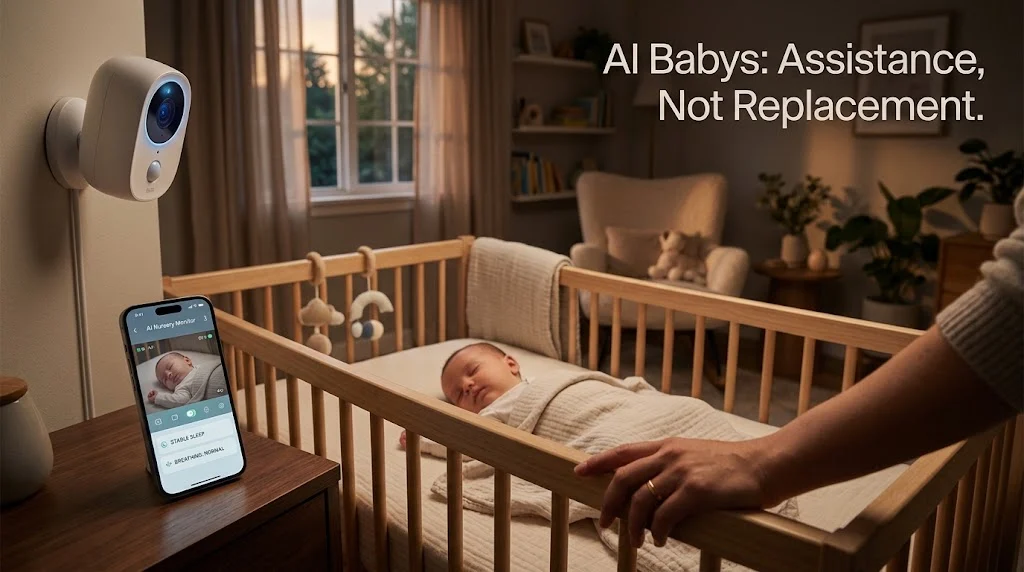
Smart baby monitors use computer vision and audio analysis to interpret what is happening in a crib or room. These systems typically run on-device or through cloud APIs that process video feeds and audio signals in real time.
Key technical components include:
- Computer vision models trained to detect faces, postures, and potential hazards like covered mouths or nose .
- Audio classification algorithms that distinguish crying from other sounds and may even categorize cry types .
- Alert systems that push notifications to parent devices when anomalies occur .
Conversational AI Companions
General-purpose AI assistants like ChatGPT and Google Gemini use large language models to generate conversational responses. When parents hand a child a phone, the AI responds to whatever the child says, creating an interactive experience without human oversight .
Dedicated AI toys, such as those from Ahmi or various educational devices, combine conversational AI with age-appropriate content and parental controls .
Key Features of AI Babys
Safety Monitoring
Modern AI baby monitors offer features that go beyond passive video streaming. Covered-face detection alerts parents when a baby’s mouth or nose is obstructed . Rollover detection notifies parents if a baby turns onto their stomach during sleep .
Danger zone alerts allow parents to define virtual boundaries. If a toddler moves into a restricted area, the system triggers an alert .
Cry Analysis
Some monitors and apps classify cries by type. Maxi-Cosi’s See Pro uses CryAssist technology to categorize cries as sleepy, fussy, gassy, agitated, or hungry . BabyNena offers similar functionality, classifying cries into categories like hungry, sleepy, and discomfort .
Sleep and Development Tracking
AI-powered apps log sleep patterns, feeding schedules, and developmental milestones. Some generate personalized sleep routines or provide weekly guidance based on a child’s age .
Interactive Learning
Devices like Ahmi position themselves as early learning companions, blending monitoring with age-based educational content for children from birth to age six .
Main Use Cases
Newborn Monitoring
Parents of infants use AI monitors primarily for sleep safety. Covered-face and rollover alerts provide an extra layer of awareness during nighttime hours when parental vigilance naturally fluctuates .
Toddler Supervision
As children become mobile, danger zone detection helps parents keep track of curious toddlers who might wander into unsafe areas .
Educational Engagement
Some families use AI devices to supplement learning. Age-appropriate content delivery and interactive storytelling appeal to parents seeking educational screen time alternatives .
Temporary Distraction
The most controversial use case involves handing a child a phone with a conversational AI to occupy them. Parents report children staying engaged for extended periods, though experts strongly caution against unsupervised use .
Benefits
Consistent alertness. AI monitoring systems never sleep, never get distracted, and provide continuous observation .
Objective data. Sleep tracking and cry analysis offer patterns that tired parents might miss .
Educational content. For older toddlers and preschoolers, AI learning devices can reinforce early literacy and numeracy skills .
Reduced parental burden. For parents juggling work, chores, and childcare, AI tools can provide moments of relief without hiring additional help .
Limitations and Risks
Developmental Concerns
Research from Cambridge University found that AI toys often fail to respond appropriately to children’s emotional expressions. A child saying “I love you” to an AI toy might receive a generic electronic response .
Professor Ying Xu from Harvard’s Graduate School of Education notes that children may anthropomorphize AI, believing it has agency and genuine interest in them. This can complicate their understanding of human relationships .
Social Skill Impact
A Chinese parent reported that after three months of AI companion use, her four-year-old became reluctant to attend school, preferring AI conversations over playing with peers. The child struggled with eye contact and reading facial expressions .
Cognitive Development
Child development experts emphasize that children need physical play, face-to-face interaction, and the cognitive challenge of processing real-world ambiguity. AI’s constant availability and patient responses may reduce children’s tolerance for frustration and their motivation to think independently .
Privacy and Data Concerns
Conversational AI platforms may retain user data. While some baby monitors emphasize local storage and encryption, others process data in the cloud . Parents should review privacy policies carefully, as SOC 2 certification does not automatically mean zero data retention.
Age Restrictions
OpenAI’s terms specify ChatGPT is not intended for users under 13. Children between 13 and 18 should use it only with parental permission . Most AI tools lack child-specific safety design.
Privacy and Security Considerations
Data Processing Locations
Maxi-Cosi’s See Pro states that only cry sounds are transmitted to the cloud for analysis, and everyday conversation stays within the home . Aqara’s Y200 includes local storage via a 128GB SD card and supports Apple HomeKit end-to-end encryption .
Encryption Standards
CuboAi lists CTIA Cybersecurity Certification, AES-256 encryption, and two-factor authentication as security features .
Questions Parents Should Ask
- Does the device process audio/video locally or in the cloud?
- What data is retained and for how long?
- Can I delete my child’s data?
- Does the manufacturer sell or share data with third parties?
Alternatives and Competitors
| Platform/Tool | Target User | Key Strength | Pricing Transparency | Core Limitation |
| CuboAi | Parents of infants/toddlers | Covered-face and rollover detection; pediatrician-developed | Device cost plus optional subscription | Premium features require subscription |
| Maxi-Cosi See Pro | Parents wanting cry translation | CryAssist cry categorization | Clear product pricing | Cloud processing for cry analysis |
| Aqara Y200 | HomeKit users | Local storage; HomeKit integration | Clear product pricing | Limited to Aqara ecosystem features |
| Ahmi | Parents seeking one device for ages 0-6 | Combines monitoring with learning content | $299 full price; $50 reservation | Newer product; limited track record |
| ChatGPT / Gemini | General users (13+) | Free or low-cost access; versatile | Freemium model | Not designed for children; no safety features |
| BabyNena | Parents wanting cry analysis | Free tier available | Freemium | App-based only; no monitoring hardware |
Who Should Consider AI Babys
AI monitoring tools may suit parents of newborns who want an additional safety layer during sleep. Families with toddlers may benefit from danger zone alerts.
AI learning devices might appeal to parents seeking structured educational content with parental controls.
Conversational AI should not serve as a babysitter for young children. Experts consistently recommend supervision and limited use. If parents choose to let older children interact with AI, active involvement and clear boundaries are essential .
Technical Considerations
On-Device vs. Cloud Processing
On-device AI offers privacy advantages and lower latency. Cloud-based systems can handle more complex analysis but introduce data transmission concerns. Maxi-Cosi uses cloud processing specifically for cry detection while keeping other audio local .
AI Detection Accuracy
Covered-face and rollover detection require proper camera positioning. CuboAi’s documentation specifies the camera should be placed directly above the crib with a full view for accurate detection . Incorrect setup can cause false alerts or missed events.
Subscription Dependency
Many AI baby monitors require subscriptions for advanced features. CuboAi offers CuboAi Care tiers with monthly and annual pricing . Parents should evaluate total cost of ownership beyond the initial hardware purchase.
API and Model Dependencies
Devices using third-party AI models may face changes when providers update or deprecate APIs. This can affect feature availability or performance over time.
Common Mistakes Parents Make
Leaving a child unsupervised with conversational AI. ChatGPT is not designed for young children and lacks safety guardrails appropriate for kids .
Assuming “AI” means “safe.” Not all AI features are equally reliable. Detection accuracy varies based on setup, lighting, and positioning .
Ignoring subscription costs. The sticker price of a smart monitor may not include ongoing fees for premium features .
Over-relying on alerts. AI monitors supplement but do not replace parental attention. False negatives and false positives can occur.
Skipping privacy policy reviews. Parents should understand what data their child’s device collects and where it goes.
Real-World Examples
The ChatGPT babysitting experiment. A Reddit user described letting ChatGPT entertain their four-year-old for two hours. The child believed the AI was a real person who shared his love of trains. The parent expressed concern about competing with the AI’s infinite patience .
The astronaut ice cream moment. A father used ChatGPT to roleplay as an astronaut and told his son the astronaut had sent ice cream from space. The child was delighted, but later confusion arose when he believed the astronaut was real .
The three-month AI companion experiment. A Chinese parent documented her four-year-old’s declining interest in school after three months of AI interaction. The child said playing with AI was “more fun” than friends .
Latest Developments
Mattel and OpenAI partnership. Mattel has announced a collaboration with OpenAI, signaling that major toy companies are exploring AI integration .
CES 2026 launches. Ahmi debuted an AI early learning device combining monitoring and educational content for children from birth to age six .
Aqara Y200 release. Aqara launched an AI baby monitoring kit in early 2026, featuring covered-face detection and local storage .
Growing regulatory attention. China’s Youth Research Center found that over 60% of minors have used AI, but fewer than 35% of families have usage rules in place .
Frequently Asked Questions
What is an AI babysitter?
An AI babysitter refers to AI-powered tools used to watch or entertain children. This includes smart baby monitors with safety alerts and conversational AI that engages children in dialogue. Neither type replaces human supervision.
Can AI replace a human babysitter?
No. AI lacks the ability to respond to emergencies, provide physical comfort, or offer the emotional nuance children need for healthy development. AI is a supplement, not a substitute .
Is ChatGPT safe for young children?
OpenAI’s terms specify ChatGPT is not intended for users under 13. The platform lacks child-specific safety features, and conversations can drift into inappropriate territory. Supervised use is recommended if parents allow access at all .
What safety features do AI baby monitors offer?
Common features include covered-face detection, rollover alerts, cry detection, danger zone monitoring, and temperature/humidity sensors. Effectiveness depends on proper camera placement and setup .
Do AI baby monitors require subscriptions?
Many do. CuboAi, for example, offers basic features with the device but requires a subscription for premium capabilities like extended storage and advanced AI detection . Parents should factor ongoing costs into purchasing decisions.
Conclusion
AI babys represent a growing category of childcare technology, from smart monitors that watch for safety hazards to conversational AI that entertains and educates. These tools offer genuine benefits: consistent alertness, objective data, and moments of relief for exhausted parents.
What matters most is understanding what AI can and cannot do. Monitoring devices can supplement parental vigilance, but detection accuracy varies and setup matters. Conversational AI can engage children, but it cannot provide the emotional reciprocity, physical presence, and real-world social interaction that healthy development requires.
AI babys may suit parents of infants seeking additional sleep safety assurance or families wanting structured educational content. They do not suit parents looking to fully offload childcare responsibilities.
Before choosing any AI childcare tool, evaluate the privacy policy, subscription requirements, detection accuracy claims, and age appropriateness. Most importantly, remember that no algorithm can replace a parent’s presence.