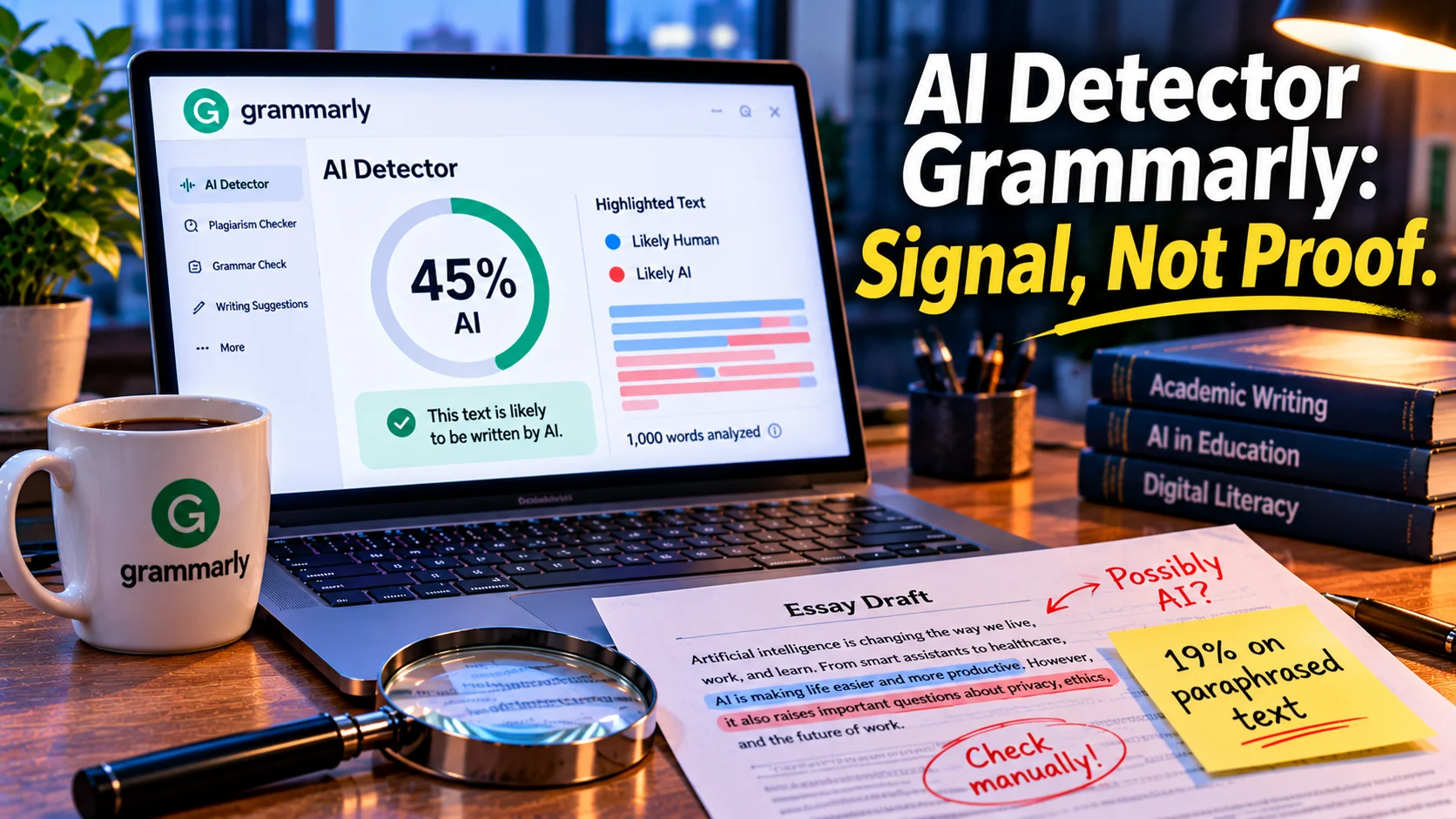
Grammarly’s AI detector is a free tool that estimates what percentage of a text was likely generated by AI, offering three free checks per day with a 1,500-word limit. While Grammarly claims industry-leading accuracy and ranked first on the RAID benchmark, independent research shows performance drops sharply on paraphrased text, and the company itself states no detector is 100% accurate.
At-a-Glance: Key Takeaways
- Grammarly offers three free AI checks per day, with a 1,500-word limit per scan and no account required for the first scan .
- Paid plans start around $12 per month, unlocking higher limits alongside Grammarly’s broader writing tools .
- Grammarly claims 99% accuracy and ranked #1 on RAID’s quality benchmark, but these are company claims, not independent validation .
- Independent research found Grammarly’s accuracy dropped to 19% on obfuscated text, compared to near-perfect performance from Copyleaks and Originality.ai .
- Grammarly flags its own enhancements as AI. Research shows that texts edited with Grammarly’s writing aids can trigger false positives in Turnitin and GPTZero .
- No detector is definitive. Grammarly’s own FAQ states its tool cannot conclusively determine whether AI was used and should be part of a holistic approach .
What Is Grammarly’s AI Detector?
Grammarly’s AI detector is a feature within the Grammarly writing platform that analyzes text and returns a percentage score estimating how much of it was likely AI-generated. It is separate from Grammarly’s plagiarism checker and grammar suggestions.
The tool was built on the same linguistic infrastructure Grammarly has developed since 2009, using machine learning models trained on tens of thousands of texts, including both human-written and AI-generated content created before 2021 . Grammarly positions the detector as part of its broader “responsible AI” ecosystem, offering not just detection but also rewriting suggestions and authorship tracking to help users demonstrate their writing process .
The search intent is primarily commercial investigation. Users want to know if the detector works, what the free tier includes, and whether the score can be trusted for academic or professional decisions.
How Grammarly’s AI Detector Works
Grammarly’s detector segments text and analyzes each section for language patterns associated with AI generation. According to Grammarly’s documentation, the model looks for :
- Sentence structure and predictability: AI text often follows consistent patterns, while human writing is more varied.
- Repetition and uniformity: AI models frequently repeat phrases; humans introduce natural variation.
- Metadata traces: Some AI tools embed hidden markers, though this is less relevant for text pasted into a detector.
- Comparison with known AI outputs: Some detectors compare text against databases of known AI content, though this method is less effective for advanced models.
The output is a percentage score. A 50% score means the model identified roughly half of the analyzed text as likely AI-generated. It does not mean there is a 50% chance the text was AI-generated.
The Free Tier
Grammarly’s free AI detector allows three checks per day, with a 1,500-word limit per scan. No account is required for the first scan, though subsequent scans require a free Grammarly account via Google, Apple, or email . The tool accepts pasted text or uploaded documents.
The Paid Ecosystem
Grammarly’s paid plans start around $12 per month and unlock higher AI detection limits alongside the platform’s broader features: grammar checking, plagiarism detection, AI rewriting, and authorship tracking . The detector itself is not the primary selling point of the paid plans; it is one feature among many.
The Accuracy Question
Grammarly makes strong accuracy claims. Its marketing states “99% accurate” and the company announced it ranked #1 on RAID’s quality benchmark, an evaluation using over 670,000 texts . RAID is a recognized benchmark, but Grammarly’s announcement is a company claim about its own product on a benchmark it chose to highlight.
Independent research paints a more nuanced picture.
The Obfuscation Problem
A 2026 study in the Journal of Advances in Information Technology tested nine detectors, including Grammarly, against texts from ChatGPT, DeepSeek, Gemini, and Grok, as well as human-written samples. The key finding: while commercial tools like Copyleaks and Originality.ai achieved near-perfect detection rates, free tools including Grammarly performed less reliably, with some as low as 63.0% .
More critically, when texts were paraphrased or rewritten to mimic non-native English speakers, Grammarly’s detection accuracy fell to 19.0%. Turnitin dropped to 45.7%. Only Copyleaks, GPTZero, and Sapling maintained strong performance under obfuscation .
This matters because obfuscation is trivial. A student using a paraphrasing tool can reduce Grammarly’s detection to near-random performance.
The False Positive Problem with Grammarly Itself
A 2025 study in the International Journal of Educational Technology in Higher Education found that widely used writing aids, including Grammarly, can trigger false positives in AI detection tools. The authors applied Grammarly and other tools to texts written before consumer AI existed and found that Grammarly’s subtle readability enhancements increased false positives, especially for non-native speakers .
This creates an uncomfortable loop: using Grammarly to improve your writing can make other detectors flag your work as AI-generated. And Grammarly’s own detector may flag text that was polished with Grammarly’s suggestions.
What Grammarly Itself Says
Grammarly’s own FAQ is candid about the limitations: “No AI detector is 100% accurate. This means you should never rely on the results of an AI detector alone to determine whether AI was used to generate content. AI detectors can indicate characteristics found in human-written text as well as characteristics commonly found in AI-generated writing… But, they cannot definitively conclude whether or not AI was used” .
The company recommends using detection as “just one part of a holistic approach to evaluating writing originality” .
How Grammarly Compares to Other Detectors
Editorial interpretation: Grammarly’s detector is convenient and free, but it is not the most accurate tool available. Its strength is integration with Grammarly’s broader writing ecosystem. Its weakness is vulnerability to paraphrasing and a documented tendency to flag polished human writing.
Who Should Use Grammarly’s AI Detector
Students checking their own work before submission can use the free tier to get a rough signal. The tool can flag sections that read as formulaic or generic, prompting revision. But the score should not be treated as proof of anything.
Writers and professionals can use the detector as a gut check on tone and authenticity. Grammarly’s integration with rewriting suggestions means the score can lead directly to improvements.
Educators should not use Grammarly’s detector as primary evidence for misconduct. The false-positive rate, particularly for non-native writers and those who use Grammarly’s own suggestions, makes it unreliable for enforcement.
Anyone needing high-stakes accuracy should look to Originality.ai or Copyleaks, which perform better under obfuscation, or use multiple detectors and human judgment together.
Common Mistakes and Cautions
Treating the percentage as proof. Grammarly’s own FAQ states the tool cannot definitively conclude AI use. A high score means the text triggered patterns, not that it was generated by AI .
Ignoring the obfuscation problem. Paraphrasing can reduce Grammarly’s detection to 19% accuracy . The score is not robust against simple evasion.
Forgetting that Grammarly’s own suggestions can trigger detection. Research shows texts edited with Grammarly can be flagged by Turnitin and GPTZero . Using Grammarly to polish your writing may make it look more AI-like to other detectors.
Assuming the free tier is unlimited. Three checks per day and 1,500 words per scan. For longer documents or repeated checks, the paid plan is required .
Relying on the RAID ranking as independent validation. RAID is a legitimate benchmark, but Grammarly’s announcement of its own #1 ranking is a company claim . Look at the methodology and independent replications.
Frequently Asked Questions
Is Grammarly’s AI detector free?
Yes, with limits. The free tier offers three AI checks per day with a 1,500-word limit per scan. No account is required for the first scan. Paid plans starting around $12 per month unlock higher limits and the full Grammarly feature set .
How accurate is Grammarly’s AI detector?
Grammarly claims 99% accuracy and ranked #1 on the RAID benchmark . Independent research found overall accuracy around 63%, dropping to 19% on paraphrased or obfuscated text . No detector is 100% accurate, and Grammarly itself advises against relying on the score alone .
Why does Grammarly flag my own writing as AI?
Your writing may trigger patterns associated with AI generation: formulaic structure, predictable phrasing, or low variation in sentence length. Non-native English writers are disproportionately affected. Research also shows that using Grammarly’s own suggestions can increase false positives in other detectors .
Can I use Grammarly’s AI detector for academic work?
You can use it as a self-check, but not as proof of anything. Grammarly’s own FAQ states the tool cannot definitively determine AI use. For academic submissions, use the score as one signal among many, and prioritize understanding your institution’s AI policy .
What is the best alternative to Grammarly’s AI detector?
Originality.ai and Copyleaks performed better under obfuscation in independent research . GPTZero offers a generous free tier and maintained strong performance in the same study. For institutional use, Turnitin is common but has its own accuracy limitations.
Conclusion
Grammarly’s AI detector is a convenient, free tool that integrates with a widely used writing platform. It offers three daily checks, a 1,500-word limit, and a percentage score that can prompt useful revision. Its strength is accessibility and integration. Its weakness is accuracy under real-world conditions.