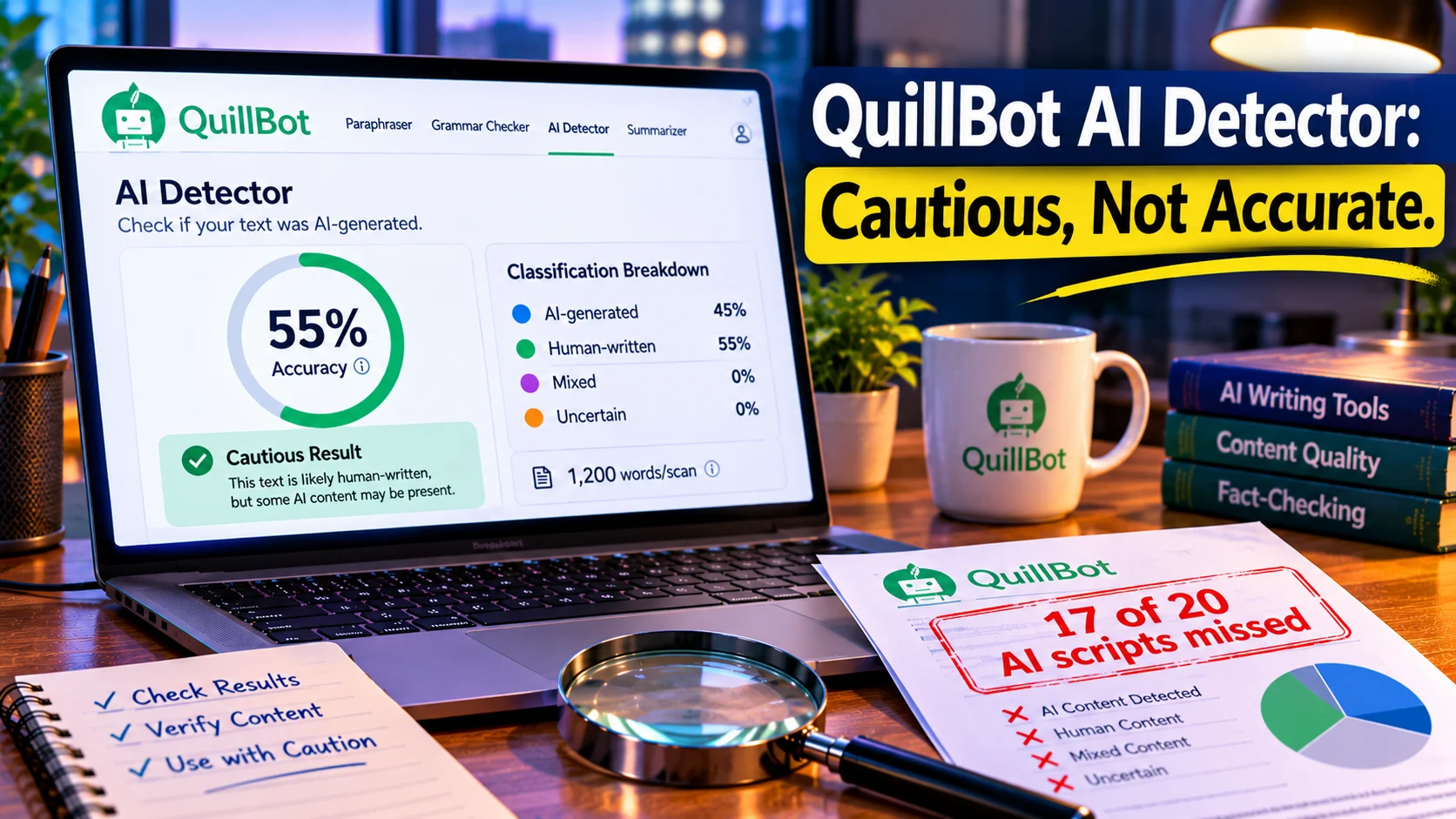
QuillBot’s AI detector is a free tool that scores text across four categories (AI-generated, AI-refined, human-written with AI refinement, or human-written), capped at 1,200 words per scan and 6 scans daily on the free plan. Independent testing found 55% overall accuracy, with the tool missing 17 of 20 AI-generated scripts while correctly passing 19 of 20 human-written ones, a trade-off that favors avoiding false accusations over catching AI use.
At-a-Glance: Key Takeaways
- The free tier caps at 1,200 words per scan and 6 scans daily, with a 4-category classification system that distinguishes pure AI, AI-refined, human with AI refinement, and pure human text .
- Independent benchmark accuracy was 55%, catching only 3 of 20 AI scripts while flagging just 1 of 20 human scripts, a design choice that minimizes false positives at the cost of detection .
- QuillBot itself acknowledges limits, stating longer texts (300+ words) are more reliable and formulaic human writing can score higher than expected for any detector .
- A ScienceDirect study found perfect specificity (no human-written published articles falsely flagged) but did not report sensitivity, meaning it may miss AI text .
- Premium ($8.33-$19.95/month) removes word and scan limits, but does not change the underlying model’s accuracy .
- Multi-language support covers English, French, Spanish, German, Dutch, and Portuguese, but accuracy varies by language .
What Is QuillBot’s AI Detector?
QuillBot’s AI detector is a free feature within the QuillBot writing suite that estimates whether text was generated by AI. Unlike standalone detectors that output a single percentage, QuillBot sorts text into four categories: AI-generated, AI-generated and AI-refined, human-written and AI-refined, and human-written .
The tool is integrated into QuillBot’s broader ecosystem, which includes a paraphraser, grammar checker, summarizer, and humanizer. This means users can detect AI patterns and then immediately paraphrase or edit the flagged text within the same interface.
QuillBot is transparent about the tool’s role. Its own FAQ states the detector “looks for writing patterns that are associated with AI” and gives a “confidence score” rather than a definitive verdict . The company frames results as signals, not proof.
How QuillBot’s AI Detector Works
The Classification System
QuillBot’s four-category output is more nuanced than binary AI-or-human scores. It attempts to distinguish between text that was entirely generated, text that was generated and then refined by a human, text that was human-written with AI assistance, and text that is purely human.
This matters because hybrid writing is increasingly common. A student who drafts with AI and edits heavily produces text that neither category fully captures. QuillBot’s attempt to split the difference is theoretically useful, but independent testing shows the categories are not reliable on hybrid content .
Free Tier Limits
The free plan covers up to 1,200 words per scan and 6 scans per day, with one explainer card per result. Premium removes both caps and adds a downloadable report. The word limit matters because QuillBot’s own guidance states longer texts (300+ words) produce more reliable scores than short inputs .
Technical Approach
QuillBot describes its detector as built on “advanced LLM-based linguistic pattern analysis,” continuously trained on large datasets and evaluated on RAID, a third-party benchmark covering ChatGPT, GPT-4, GPT-5, Claude, Gemini, Mistral, Llama, and others . The company emphasizes a “low false positive commitment,” explicitly designing the model to avoid flagging human writing.
The Accuracy Problem
Independent testing paints a mixed picture that is less flattering than QuillBot’s marketing.
The GitHub Benchmark
A July 2026 benchmark tested QuillBot alongside GPTZero and ZeroGPT against 40 scripts: 20 written by the tester before AI tools were part of his workflow, and 20 AI-generated scripts matched by topic and length. QuillBot’s results :
| Overall Accuracy | 22/40 (55%) |
| Humans Falsely Flagged | 1 of 20 |
| AI Scripts Missed | 17 of 20 |
The tool caught only 3 of 20 AI scripts. Its low false-positive rate was “purchased entirely with false negatives.” The benchmark author concluded: “It isn’t measuring anything so much as defaulting to ‘human'” .
The benchmark also found QuillBot contradicted itself internally. It displayed model-attribution tags on a script it simultaneously scored 72% human. It flagged individual sentences as “High probability AI-generated” inside a document it scored 9% AI overall. It returned 0% AI on a fully AI-generated 1,147-word script .
The ScienceDirect Study
A January 2026 exploratory study published in ScienceDirect tested several detectors on published human-written and AI-generated articles. QuillBot showed “perfect detection” for published human-written text, meaning none were falsely flagged as AI. The study concluded QuillBot is “an accessible and effective tool for distinguishing human- from AI-generated text” .
Important caveat: The study’s positive finding focused on specificity (not flagging humans). It did not report the false-negative rate, which the GitHub benchmark found to be severe.
The Journal of Advances in Information Technology
A 2026 study in the Journal of Advances in Information Technology tested nine detectors including QuillBot. Free tools like QuillBot “performed less reliably, with some as low as 63.0%” accuracy. The study also found that paraphrasing and non-native English speaker style rewriting reduced detection accuracy across most detectors .
Editorial interpretation: The evidence converges on a consistent picture. QuillBot is cautious about flagging human text, which is arguably the right ethical choice given the harm of false accusations. But it is equally poor at catching AI text. A 55% accuracy rate with 17 of 20 AI scripts missed means the tool functions more as a “human writing confirmation” than an “AI detection” system.
Where the Paywall Lands
QuillBot’s AI detector is available on the free plan with caps. Premium unlocks unlimited scans and word counts, but the underlying model does not change.
| Free | 1,200 words/scan, 6 scans/day | $0 |
| Premium | Unlimited scans, no word limit, downloadable report | $8.33/mo annual, $19.95/mo monthly |
The free tier is genuinely usable for occasional checks. The 1,200-word cap covers most short articles and essays. The 6-scan daily limit is sufficient for screening a handful of submissions. Premium is aimed at users who need volume or downloadable reports for documentation.
Important distinction: Upgrading to Premium does not make the detector more accurate. It removes usage limits and adds reporting features. The core detection model is the same.
Who Should Use QuillBot’s AI Detector
Existing QuillBot users who already use the paraphraser or grammar checker can benefit from the integrated detector for quick, low-stakes checks. The workflow of detect-then-paraphrase is convenient .
Educators screening submissions can use the free tier for an initial signal, but should treat the score as one input among many. The tool’s low false-positive rate means it is less likely to wrongly accuse students, but its high false-negative rate means it will miss AI use .
Content teams auditing freelancer submissions may find the four-category system useful for distinguishing light AI assistance from full generation, but should verify with additional evidence .
Anyone relying solely on QuillBot to catch AI use will be disappointed. The 17-of-20 miss rate means the tool is not a reliable gatekeeper.
Users needing high sensitivity should consider Originality.ai or Copyleaks, which performed better on independent benchmarks , or combine multiple detectors.
Common Mistakes and Cautions
Assuming the score is definitive. QuillBot itself frames results as confidence signals, not verdicts. A 0% score does not prove human authorship.
Ignoring the false-negative problem. The tool missed 17 of 20 AI scripts in independent testing. A “human” verdict may be wrong.
Overlooking the word limit. Free scans cap at 1,200 words. Longer documents require Premium or multiple scans.
Treating the four categories as reliable on hybrid text. Independent research shows detectors struggle with hybrid content, and QuillBot’s categories are not an exception.
Confusing detection with plagiarism checking. QuillBot’s detector checks for AI patterns, not copied sources. A text can be original but AI-generated, or human-written but copied. The tools serve different purposes .
Frequently Asked Questions
Is QuillBot’s AI detector free?
Yes, with limits. The free plan allows up to 1,200 words per scan and 6 scans per day. Premium removes these caps and adds a downloadable report .
How accurate is QuillBot’s AI detector?
Independent testing found 55% overall accuracy, with 17 of 20 AI scripts missed and 1 of 20 human scripts falsely flagged. A ScienceDirect study found perfect specificity (no false positives on published human text) but did not report sensitivity. The tool is cautious about flagging humans at the cost of missing AI .
Does QuillBot Premium make the AI detector better?
No. Premium removes word and scan limits and adds reporting features, but the underlying detection model is the same. Accuracy does not improve with payment.
What do the four categories mean?
QuillBot classifies text as AI-generated, AI-generated and AI-refined, human-written and AI-refined, or human-written. This attempts to distinguish full generation from hybrid assistance, though independent testing shows the categories are not reliable on hybrid content .
Can QuillBot detect AI in languages other than English?
Yes. The detector supports English, French, Spanish, German, Dutch, and Portuguese, though accuracy varies by language. The GitHub benchmark and other independent tests focused primarily on English .
Conclusion
QuillBot’s AI detector is a free, accessible tool with a notable ethical design choice: it prioritizes not flagging human writing over catching AI writing. Independent testing confirms this trade-off. The tool correctly passed 19 of 20 human-written scripts but missed 17 of 20 AI-generated ones.