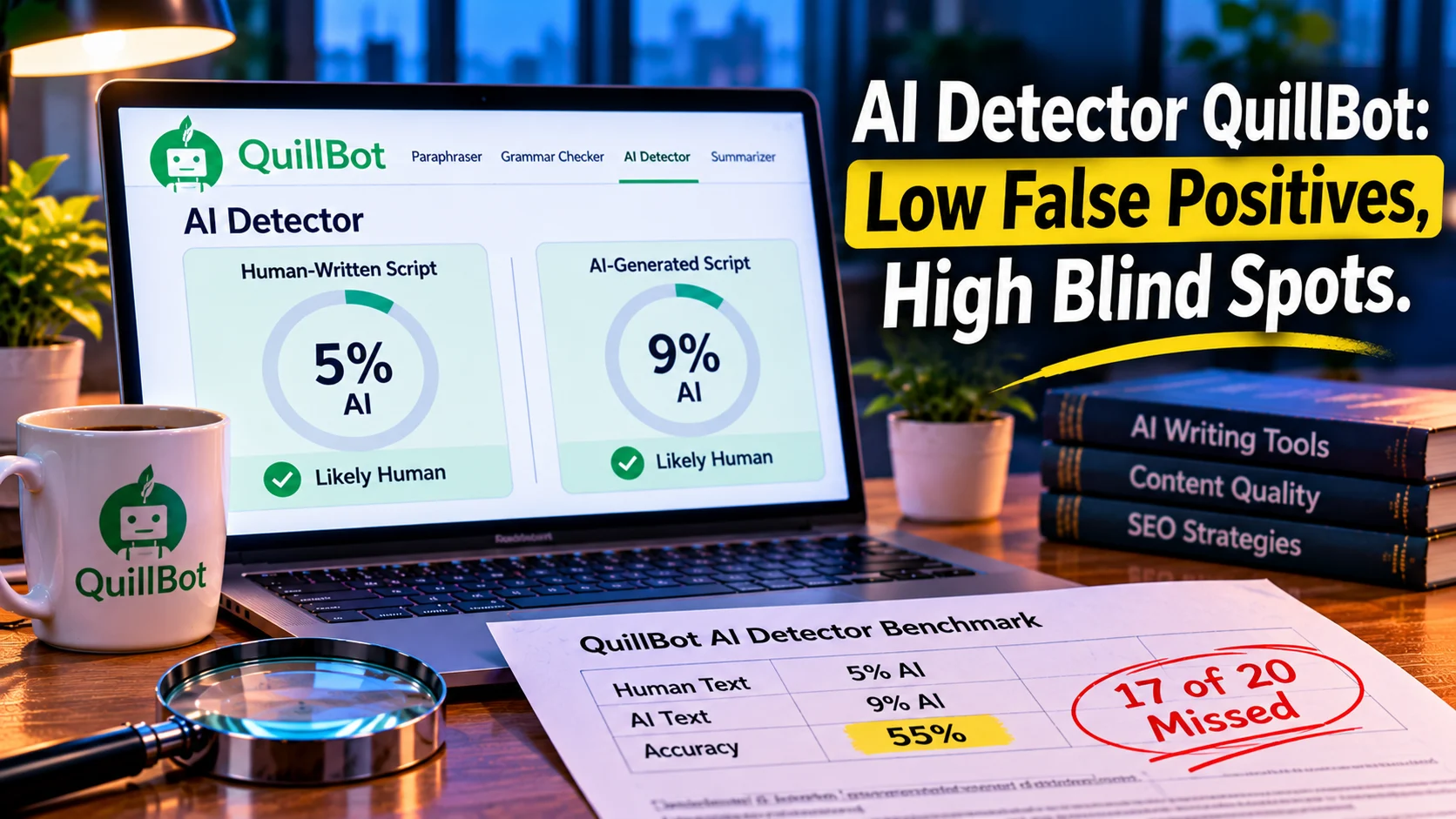
QuillBot’s AI Detector is a free tool that estimates whether text was AI-generated, but independent benchmarks reveal a critical flaw: it catches only 3 of 20 AI scripts while rarely flagging human writing. This 55% accuracy rate means the tool defaults toward “human,” producing a low false-positive rate purchased entirely with missed detections.
At-a-Glance: Key Takeaways
- QuillBot’s free detector achieved 55% accuracy in an independent benchmark, catching just 3 of 20 AI-generated scripts while falsely flagging only 1 of 20 human scripts .
- The tool defaults toward “human” classification, meaning its low false-positive rate comes at the cost of massive false negatives. It is not measuring authorship so much as failing to detect AI .
- Results vary dramatically by writing register. QuillBot flagged 0 of 6 motivational AI scripts and 0 of 1 tech explainer AI scripts, but correctly identified some consumer/exposé AI content .
- QuillBot’s own research claims strong performance, with one study finding “perfect detection” on human-written academic articles and near-perfect recognition of DeepSeek-generated text .
- The free tier allows up to 1,200 words per scan; unlimited detection requires QuillBot Premium at $4.17/month .
- QuillBot explicitly warns against sole reliance on its detector for decisions affecting careers or academic standing .
What Is QuillBot’s AI Detector?
QuillBot’s AI Detector is a feature within the QuillBot writing assistant suite, which also includes a paraphraser, grammar checker, and humanizer . The detector analyzes text and estimates the likelihood that it was generated by an AI model, producing a percentage score and highlighting specific passages.
The tool is positioned for educators, editors, employers, and content creators who need to assess whether text was machine-generated . QuillBot claims its proprietary model can identify paraphrased text, AI rewrites, and mixed human-AI writing, distinguishing itself from simpler detectors .
The free version processes up to 1,200 words per scan. Unlimited detection and access to QuillBot’s full suite require Premium at $4.17 per month .
How QuillBot’s Detector Works
QuillBot describes its detector as a custom model architecture built on a DeBERTa-v3-large dual encoder with multiple validation layers and classifiers . The system analyzes text at the sentence level rather than document-wide, aiming to identify specific AI-generated sections within mixed content.
The model is trained on diverse sources including academic writing, open-licensed content, and AI-generated text. QuillBot states it categorizes AI content across 10 specific patterns including overly formal tone, technical jargon, predictable structure, and generic language .
The output is probabilistic rather than binary. QuillBot provides confidence categories of “low,” “moderate,” and “high,” and includes four classifications that account for mixed human-AI content .
Importantly, QuillBot’s own documentation warns: “Never rely on AI detection alone for decisions impacting someone’s career or academic standing” .
The Independent Benchmark: 55% Accuracy
The most revealing evidence comes from an independent benchmark published on GitHub in July 2026 . The researcher tested QuillBot alongside GPTZero and ZeroGPT against 40 YouTube scripts: 20 written manually before AI tools were part of the workflow, and 20 AI-generated scripts matched by topic and length.
The Headline Result
For a matched pair on the same topic (a Bath & Body Works shopping-hacks video), QuillBot scored the human script at 5% AI and the AI script at 9% AI. The tool produced nearly identical scores for both, failing to discriminate .
On other pairs, the results were worse than failing to discriminate. For a Burger King script, QuillBot rated the human-written version 58 points more AI-like than the actual AI script (66% vs 8%) .
Overall Accuracy
QuillBot’s overall accuracy was 22 out of 40, or 55%. The breakdown is critical :
| Humans falsely flagged | 1 out of 20 |
| AI scripts missed | 17 out of 20 |
The researcher’s interpretation is direct: “QuillBot’s headline ‘only 1 false flag’ is not accuracy: it caught just 3 of 20 AI scripts. It isn’t measuring anything so much as defaulting to ‘human’—the low false-positive rate is purchased entirely with false negatives” .
Performance by Writing Register
QuillBot’s detection varied dramatically by content type :
| Consumer/exposé | 1 of 4 |
| Documentary | 2 of 5 |
| Finance | 0 of 4 |
| Motivational | 0 of 6 |
| Tech explainer | 0 of 1 |
The pattern suggests QuillBot responds to writing register rather than authorship. Structured, formal prose may trigger detection, while conversational or motivational content passes regardless of whether it was AI-generated.
Internal Contradictions
The benchmark also documented QuillBot contradicting itself three times during collection :
- It displayed model-attribution tags (DeepSeek, Google) on a script it simultaneously scored 72% human-written.
- It flagged individual sentences as “High probability AI-generated” inside a document it scored 9% AI overall.
- It returned 0% AI on a fully AI-generated 1,147-word script.
What Academic Research Says
Peer-reviewed studies present a more favorable picture of QuillBot’s performance, though with important caveats.
The Oral Surgery Study
A 2026 study in the International Journal of Oral and Maxillofacial Surgery tested eight free AI detectors on 24 human-written and 12 AI-generated academic articles . QuillBot showed “perfect detection” on the human-written texts, flagging none as AI. However, for the AI-generated texts, QuillBot’s performance was not reported as the best. Copyleaks achieved the highest mean score (99.6/100), followed by Sapling (95.6/100) .
The study concluded that QuillBot “appears to be an accessible and effective tool for distinguishing human- from AI-generated text” but recommended combining it with other tools like Sapling or Copyleaks .
Editorial interpretation: The study measured QuillBot’s ability to avoid false positives on human academic writing. It did not emphasize QuillBot’s ability to catch AI text. The benchmark’s finding that QuillBot misses most AI scripts is consistent with this study’s silence on its detection rate.
The DeepSeek Study
A 2026 IEEE paper found that QuillBot and Copyleaks obtained “near-perfect recognition rates for original and paraphrased DeepSeek text,” while other tools struggled . This suggests QuillBot performs better on text from some models than others.
The Fairness Audit
A 2025 study auditing four detectors, including QuillBot Premium, found that AI detectors disproportionately flagged ESL (English as a Second Language) writing with false positives . The study emphasized “the importance of such fairness audits in assessing the linguistic sensitivity in such tools” .
The Obfuscation Study
A 2026 study in the Journal of Advances in Information Technology evaluated nine detectors and found that free tools including QuillBot “performed less reliably, with some as low as 63.0%” . The study also found that paraphrasing and non-native English speaker style rewriting reduced detection accuracy across most detectors .
The Conflict Between Benchmarks and Studies
The discrepancy between the GitHub benchmark (55% accuracy) and the academic studies (strong performance) is not a contradiction. They measure different things.
The academic studies primarily assessed QuillBot’s ability to avoid false positives on human academic writing. The GitHub benchmark assessed its ability to catch AI-generated YouTube scripts. These are different tasks with different difficulty profiles.
QuillBot’s own documentation acknowledges the complexity. It states its detector is “designed to inform, not punish” and warns that “today’s writing is rarely 100% human or AI” . The tool’s four-way classification (including “mixed”) reflects this nuance.
Editorial interpretation: QuillBot’s detector appears calibrated to minimize false positives at the cost of false negatives. It will rarely flag a human writer, but it will also miss most AI-generated text. This makes it unsuitable as a sole detector but potentially useful as one signal among many, particularly when combined with tools that catch what it misses.
Pricing and Access
QuillBot’s AI Detector is available in two tiers :
| Free | Basic detection | 1,200 words per scan |
| Premium | Full access to AI Detector | Unlimited, with usage limits |
Premium costs $4.17 per month (USD, annual billing) and includes the full writing suite: paraphraser, grammar checker, humanizer, summarizer, and plagiarism checker .
The free tier’s 1,200-word limit is sufficient for short articles but may require multiple scans for longer documents.
Privacy and Security Considerations
QuillBot is a consumer writing tool, not enterprise-grade software. Available public documentation does not reference SOC 2 certification, ISO 27001, or Zero Data Retention guarantees.
What to check before uploading text:
- Whether submitted text is used for model training
- How long text is retained after scanning
- Whether the tool’s privacy policy aligns with your data governance requirements
QuillBot’s own guidance suggests using “a reputable AI detection tool” and checking for “strong privacy protections” if working with sensitive or proprietary text .
Important distinction: QuillBot explicitly states its detector “flags text that may be AI-generated” and instructs users to “use your best judgment when reviewing results” . The tool is designed to inform, not to serve as definitive evidence.
Who Should Use QuillBot’s AI Detector
Individual writers checking their own work can use the free tier as a rough signal. The tool’s tendency to default toward “human” means it is unlikely to falsely accuse you, though it may miss AI assistance you were unaware of.
Educators and editors should not rely on QuillBot alone. The 55% accuracy rate and documented failure to catch most AI scripts make it unsuitable as a sole detector. It may be useful as one signal among many, particularly combined with tools that catch AI text more reliably.
Content agencies screening submissions may find QuillBot’s low false-positive rate appealing, but should understand that it will miss most AI-generated content. A multi-tool approach is necessary for meaningful screening.
Anyone needing reliable AI detection should combine QuillBot with other tools. The academic study that found QuillBot effective on human writing recommended pairing it with Sapling or Copyleaks for AI detection .
Institutions making high-stakes decisions should follow QuillBot’s own guidance: never rely on AI detection alone for decisions affecting careers or academic standing .
Common Mistakes and Cautions
Assuming low false positives means accuracy. QuillBot’s 1-in-20 false-positive rate is impressive until you see the 17-in-20 false-negative rate. The tool is not measuring authorship; it is defaulting to “human” .
Using QuillBot as a sole detector. The tool missed 85% of AI scripts in the independent benchmark. It is not designed to be the only signal.
Ignoring register bias. QuillBot’s detection varies dramatically by writing style. Motivational and conversational content passes regardless of authorship. Formal, structured prose is more likely to be flagged .
Expecting unlimited free scans. The free tier caps at 1,200 words. Longer documents require Premium or multiple scans .
Overlooking QuillBot’s own warnings. The company states clearly that its detector should not be the sole basis for decisions affecting careers or academic standing .
Frequently Asked Questions
How accurate is QuillBot’s AI detector?
Independent benchmarking found 55% accuracy: 1 false positive out of 20 human scripts and 17 missed AI scripts out of 20 . Academic studies show stronger performance on human academic writing but do not establish reliable AI detection .
Is QuillBot’s AI detector free?
Yes, with limits. The free tier processes up to 1,200 words per scan. Unlimited detection requires QuillBot Premium at $4.17/month .
Why does QuillBot miss so much AI text?
The tool appears calibrated to minimize false positives. By defaulting toward “human” classification, it avoids flagging real writers at the cost of missing most AI-generated content .
Can QuillBot detect paraphrased AI text?
QuillBot claims its detector can identify paraphrased and rewritten AI content . Independent testing showed inconsistent results, with some AI scripts passing as human regardless of paraphrasing .
What is the best way to use QuillBot’s detector?
Use it as one signal among many. QuillBot itself warns against sole reliance for decisions affecting careers or academic standing . Pair it with detectors that catch AI text more reliably, or with human review.
Conclusion
QuillBot’s AI Detector occupies a confusing position. Its own documentation claims sophisticated detection capabilities, and some academic studies show strong performance on specific tasks. But independent benchmarking reveals a tool that catches only 15% of AI scripts while rarely flagging human writing.