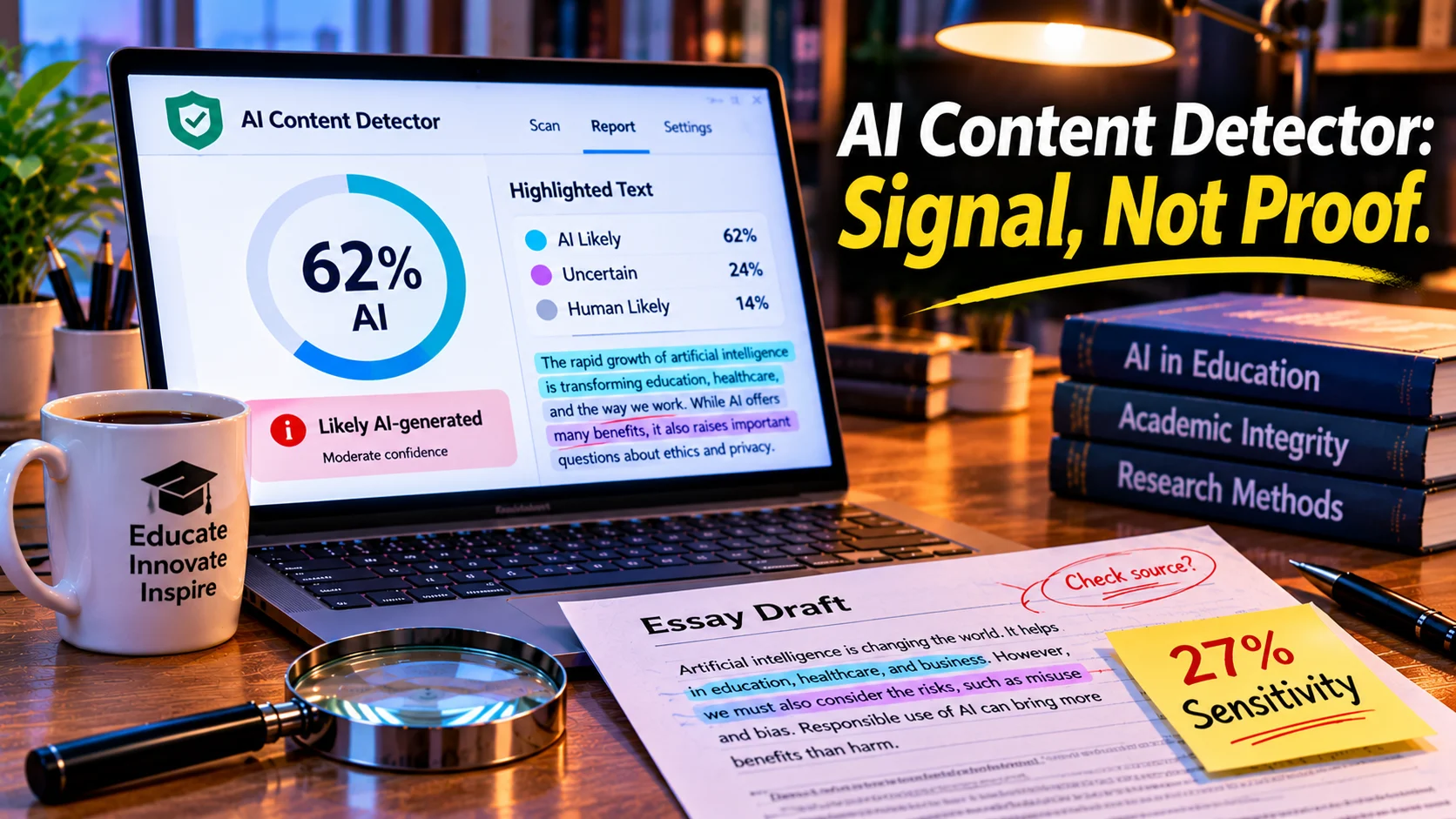
An AI content detector is a tool that estimates whether text was generated by artificial intelligence, but independent research shows its scores are unreliable. A 2026 IEEE study found false-positive rates of 15.6% to 30.6% across five major detectors, and Turnitin’s sensitivity in a separate study was just 27% . The score is a probabilistic signal, not a factual determination of authorship.
At-a-Glance: Key Takeaways
- False positives are a systemic problem. The 2026 IEEE benchmark found rates of 15.6% to 30.6% across GPTZero, Turnitin, Copyleaks, ZeroGPT, and Originality.ai, raising “substantial concerns for equitable academic integrity enforcement” .
- Turnitin’s sensitivity is poor. A Springer study of 120 scientific texts found Turnitin caught only 27% of AI-generated texts, with specificity of just 31% .
- Hybrid texts defeat every tool. All five detectors in the IEEE study dropped to 54.2%–70.8% accuracy on texts mixing human and AI writing .
- A simple vocabulary tweak breaks detection. University of Florida researchers found that asking an LLM to use more complex vocabulary rendered commercial detectors “basically useless” .
- Non-native and formulaic writers are disproportionately flagged. Structured, formal writing patterns trigger false positives at higher rates .
- Vendors publish favorable numbers. Independent research does not confirm them. ZeroGPT advertises 98.4% accuracy; independent testing placed it at 68% to 75% .
What Is an AI Content Detector?
An AI content detector is a software tool that analyzes text and assigns a probability score indicating how likely it was generated by a large language model. It is not a plagiarism checker. Plagiarism tools compare your text against existing sources. AI detectors analyze internal writing patterns and estimate whether the style matches machine generation .
The score typically appears as a percentage. A 50% score means the model identified roughly half of the analyzed text as likely AI-generated. It does not mean there is a 50% chance the author cheated.
This distinction matters because the consequences of a high score can be severe: academic misconduct investigations, delayed graduation, and reputational harm. The tools are making probabilistic judgments about style, not factual determinations about authorship.
How AI Content Detectors Work
Detectors rely on statistical signals learned from training data. Modern tools, including Turnitin, use transformer-based models trained on large corpora rather than hand-coded rules. They break submissions into overlapping segments, score each for AI likelihood, and aggregate the results into an overall percentage .
The models learn patterns from data and output scores through many learned features working together. This makes their reasoning opaque, even to the vendors selling them. A 2026 De Gruyter study noted that Turnitin’s system is proprietary, meaning its internal logic cannot be independently inspected .
The Hybrid Text Problem
The most important finding across multiple studies is that detectors fail on hybrid texts. The IEEE benchmark found all five tools dropped to 54.2%–70.8% accuracy when analyzing documents that combine human and AI writing . A Springer study on Turnitin confirmed this, with accuracy on hybrid papers at just 60% .
This is the most common real-world scenario. Students use AI for brainstorming or editing but write the final draft themselves. The detectors are built for a binary world that does not exist.
The Vocabulary Attack
University of Florida researchers discovered that a trivial modification defeats most detectors. By instructing an LLM to generate text using more complex vocabulary (a “lexical complexity attack”), they found the detectors were “more easily fooled” and became “basically useless” .
The implication is uncomfortable: detectors reward simple, predictable writing and flag sophisticated vocabulary as human. The inverse is also true. Formulaic, structured writing taught to students, particularly non-native English speakers, looks AI-generated to the model.
The Accuracy Problem in Numbers
The evidence on detector accuracy is fragmented but consistently points to unreliability.
The IEEE Benchmark
The most comprehensive recent comparison, published at an IEEE conference in May 2026, tested five detectors against 180 academic writing samples .
| Originality.ai | 84.4% (highest) | 15.6%–30.6% across tools |
| ZeroGPT | 69.4% (lowest) | 15.6%–30.6% across tools |
| Turnitin | Not highest | 15.6%–30.6% across tools |
The study’s authors concluded that false positive rates in this range “raise substantial concerns for equitable academic integrity enforcement” .
Turnitin’s Specific Weakness
A Springer study of 120 scientific texts found Turnitin’s sensitivity was just 0.27, meaning it caught only 27% of AI-generated texts. Its specificity was 0.31, meaning it correctly identified only 31% of human-written texts .
A De Gruyter study replicated Turnitin’s low false-positive rate but found its false-negative rate was “substantially higher,” particularly for GPT-5. The authors emphasized “the need for cautious interpretation of AI-detection scores, particularly as generative models continue to evolve” .
The University of Florida Study
Researchers at the University of Florida tested commercial detectors against AI-generated clones of pre-ChatGPT papers. They found false positive rates between 0.05% and 68.6%, and false negative rates between 0.3% and 99.6%. The conclusion was blunt: current detectors are “poorly suited for deployment in academic or high-stakes contexts” .
“These current tools are not reliable or robust enough to use to measure the problem,” co-author Patrick Traynor said. “We really can’t use them to adjudicate these decisions. People’s careers are on the line here” .
Vendor Claims vs. Independent Data
Vendors publish their own benchmarks. Winston AI cites a peer-reviewed study of 24 texts where it ranked first at 99% accuracy . That is a tiny sample. The IEEE study used 180 samples and found very different results.
ZeroGPT advertises 98.4% detection accuracy and a false positive rate below 1% on its homepage. Independent testing placed its performance at 68% to 75% depending on content type and length. As Quetext’s analysis noted: “Every detector vendor in this category publishes favorable internal figures, and you should discount all of them accordingly” .
Who Gets Flagged
Non-Native English Writers
A Zenodo study of authentic Filipino student essays found both ZeroGPT and Copileaks inconsistently classified the same set of texts. Five essays were labeled “AI-generated” and five “Human,” when all ten were genuinely written by students. The authors noted that non-native English writing “may have features that could lead to misclassification by the detectors” .
Stanford HAI has documented that detectors are biased against non-native English writers, flagging their work at disproportionately high rates .
Formulaic Writers
Students taught structured, formal writing patterns, including many second-language learners, produce text that triggers the same statistical signatures detectors associate with AI. The tools are not measuring authorship. They are measuring style, and style correlates with educational background.
The Vanderbilt Calculation
Vanderbilt University did the arithmetic when Turnitin reported a 1% false-positive rate. With 75,000 papers per year, that implied roughly 750 pieces of real student work wrongly flagged as AI. The university judged the tool too unreliable for assessment and switched it off.
A number that sounds trivial in a vendor brochure becomes hundreds of individuals when it meets a real cohort.
What the Score Actually Means
The score answers one question: “How closely does this text match patterns the model associates with AI generation?” It does not answer: “Did this person write this?”
Who Should Rely on AI Content Detector Scores
Institutions with clear policies and human review capacity may use scores as one signal among many. The score can start a conversation, prompt a request for drafts, or trigger a discussion about process. It should not trigger automatic penalties.
Institutions without review capacity should reconsider using detectors at all. The documented harms, including delayed investigations, stress on students, and dropped allegations, suggest the tool creates more problems than it solves when used as a primary trigger.
Educators should understand the bias against non-native writers and adjust their processes accordingly. A high score from a student who learned English later is not evidence of AI use. It may be evidence of formulaic writing instruction.
Individual writers should not treat a detector score as an objective measure of their work. The tools are probabilistic and biased. A high score means the text triggered patterns, not that the writing is not yours.
Common Mistakes and Cautions
Treating the percentage as a probability of misconduct. A 50% score does not mean 50% chance of cheating. It means the model flagged half the analyzed text. The model can be wrong, and it frequently is.
Ignoring the hybrid text problem. Every major study shows accuracy collapses when human and AI writing mix. A student who used AI for editing but wrote the final draft will produce text the detector cannot categorize .
Using the score as sole evidence. Turnitin itself states its model “may not always be accurate” and should not be the sole basis for adverse action. Independent researchers and student advocacy groups agree.
Overlooking the non-native writer bias. The false-positive rate is highest for students who learned English later. Institutions should monitor for disparate impact .
Assuming 0% means clean. The University of Florida study found false negative rates up to 99.6%. A 0% score means the model did not flag the text, not that the text is human-written .
Frequently Asked Questions
How accurate are AI content detectors?
Accuracy varies widely. The 2026 IEEE study found overall accuracy ranging from 69.4% (ZeroGPT) to 84.4% (Originality.ai), with false-positive rates of 15.6% to 30.6% . Turnitin’s sensitivity in one study was just 27% . There is no universal accuracy figure.
Why do AI content detectors flag human writing?
Detectors analyze patterns like perplexity and burstiness. Formulaic, structured, or formal writing can trigger the same patterns associated with AI generation. Non-native English writers are disproportionately affected . A high score means the text looks a certain way, not that it was generated by AI.
Can AI content detectors detect paraphrased text?
Some can, but reliability is poor. The IEEE study found all tools performed poorly on hybrid texts that mix human and AI writing, with accuracy dropping to 54.2%–70.8% . A simple vocabulary tweak rendered commercial detectors “basically useless” in University of Florida testing .
What does a 0% AI score mean?
A 0% score means the detector did not identify the text as likely AI-generated. It does not prove human authorship. False negatives are documented at rates up to 99.6% in independent testing .
Should institutions use AI content detectors?
Only with caution and human review. The false-positive rate of 15.6%–30.6% means hundreds of students could be wrongly flagged at scale . Detector scores should be one signal among many, never the sole basis for misconduct proceedings.
Conclusion
AI content detectors are probabilistic estimates of style, not factual determinations of authorship. The evidence is clear: false positives are common, hybrid texts defeat the models, and non-native writers are disproportionately flagged.