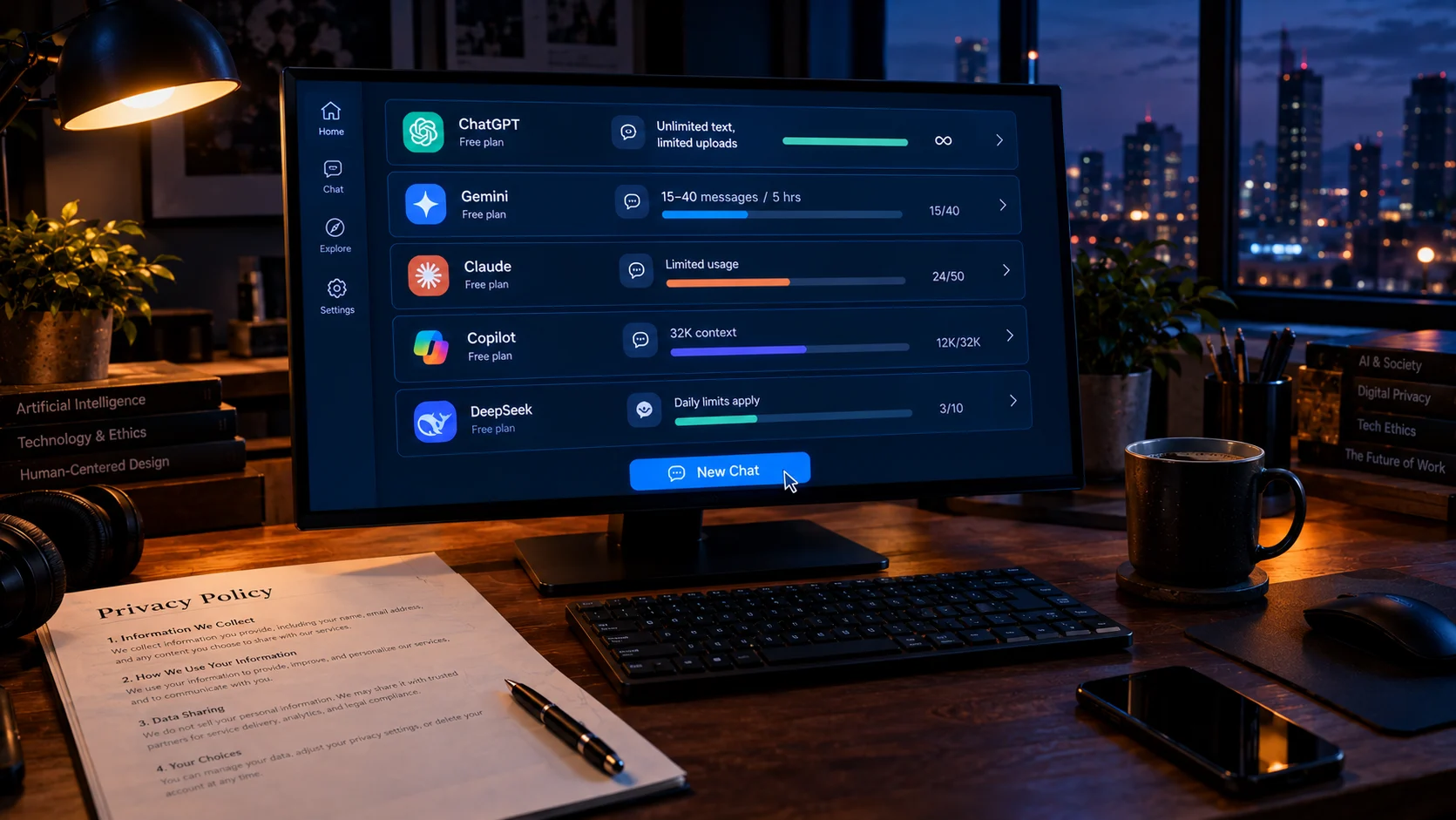
A free AI chat tool lets you converse with a large language model without paying, but free tiers in 2026 impose real boundaries on model access, context windows, and message volume. ChatGPT offers unlimited text chats on GPT-5.6 Luna, Claude gives roughly 15 to 40 messages per five-hour window on Sonnet 4.6, and DeepSeek has no paid consumer plan at all .
At-a-Glance Box
- “Unlimited” rarely means unrestricted. ChatGPT’s free tier allows unlimited text chats but caps uploads, image generation, and access to newer models .
- Claude’s free tier is generous on quality, tight on volume. Sonnet 4.6 is available, but expect 15 to 40 messages per rolling five-hour window .
- Gemini’s free tier took a hit in October 2026. Google pulled Flash and Pro models from free accounts, leaving Flash-Lite with a 32,000-token context window .
- DeepSeek is the outlier. No paid chat plan, no published message cap, and open model weights for anyone who wants to self-host .
- Copilot’s free limits are deliberately opaque. Microsoft does not publish a fixed daily question count, and limits vary by feature, entry point, and server load .
- Context windows separate the serious free tiers from the demos. ChatGPT’s free context sits at 27K tokens; Claude offers 200K; Gemini free dropped to 32K .
What “Free AI Chat” Actually Means in 2026
The search for a free AI chat tool usually starts with a simple hope: a capable assistant without a subscription. The results page delivers dozens of options, each promising free access to cutting-edge models. What most of them omit is the fine print.
Free AI chat in 2026 operates on three constraints. Model access is tiered: the best models sit behind paywalls, and free users get older or smaller versions. Usage is metered: even “unlimited” plans throttle heavy users or restrict features. Context is capped: long conversations and large documents hit walls that paid tiers do not.
None of this makes free tiers useless. It makes them specific tools with specific boundaries. This guide maps those boundaries across the major platforms, so you know what you are actually getting before you invest time.
How Free Tiers Actually Work
The Model Access Question
Every major provider reserves its flagship models for paying customers. Free users get capable but older or smaller variants.
ChatGPT’s free tier runs on GPT-5.6 Luna and GPT-5-Thinking-mini. Newer models like GPT-6.1 Sol and GPT-6 Astra require a subscription . Claude’s free tier includes Sonnet 4.6 and Haiku 4.5, but excludes Opus-tier models like Fable 5 . Gemini’s free tier lost access to Flash and Pro models in October 2026, leaving Flash-Lite as the only option .
DeepSeek is the exception. Its chat app has no paid consumer plan, and the model you use for free is the same one everyone else uses . The tradeoff is server congestion during peak hours.
Usage Limits and Rate Windows
“Unlimited” is the most misleading word in free AI marketing. ChatGPT advertises unlimited text conversations on its free tier, but the fine print ties that to abuse protection measures . In practice, heavy users hit slowdowns or temporary restrictions.
Claude’s limits are more transparent in structure but vague in numbers. Anthropic uses a rolling five-hour window that starts with your first prompt. Community estimates place free usage at roughly 15 to 40 messages per window, with capacity shrinking when demand spikes .
Copilot’s limits are the least predictable. Microsoft does not publish a fixed daily question count. Limits vary by feature, account type, and server load. Users report hitting “daily limit” messages after a handful of prompts on some days and far more on others .
Context Windows
The context window determines how much text the model can hold in a single conversation. It matters most for document analysis, long coding sessions, and extended research.
ChatGPT free offers a 27K-token context for instant responses, roughly 12 pages of input text . Claude free provides 200K tokens across all models, a significant advantage for long documents . Gemini free dropped to a 32,000-token window after the October 2026 changes, about 24,000 words . DeepSeek does not publish a specific free context limit, but its API documentation suggests generous allowances .
For short conversations and quick questions, these differences rarely matter. For anything resembling sustained work, they determine whether the tool is usable at all.
Platform-by-Platform Breakdown
| ChatGPT | GPT-5.6 Luna, GPT-5-Thinking-mini | 27K tokens | Unlimited text (with abuse protections) | No access to newer models, limited uploads |
| Claude | Sonnet 4.6, Haiku 4.5 | 200K tokens | ~15–40 per 5-hour window (community estimate) | No Opus-tier models, capacity drops at peak |
| Gemini | Flash-Lite | 32K tokens | Compute-based, 5-hour refresh | Lost Flash/Pro access in October 2026 |
| DeepSeek | Full model | Not published | None published | Server congestion, China-hosted |
| Copilot | Varies by entry point | Not published | Not published, varies daily | Opaque limits, feature-dependent |
ChatGPT: Unlimited Text, Limited Everything Else
ChatGPT’s free tier offers the most straightforward promise: unlimited text conversations on GPT-5.6 Luna. For everyday questions, drafting, and brainstorming, that covers a lot of ground.
The restrictions appear at the edges. Image generation is slower and capped. File uploads are limited. Access to newer models like GPT-6 Astra requires payment. The 27K context window suits short sessions but struggles with long documents .
For users who need a capable general assistant for casual use, ChatGPT’s free tier delivers. For anything requiring frontier model capabilities or extended context, it does not.
Claude: Quality Over Volume
Claude’s free tier provides access to Sonnet 4.6, a model that independent testing consistently ranks among the strongest available . The 200K context window is the most generous among free tiers, making Claude the best choice for analyzing long documents or maintaining extended conversations.
The constraint is volume. The rolling five-hour window and the 15 to 40 message estimate mean heavy users hit walls quickly. Claude is not designed for marathon sessions on the free tier. It is designed to demonstrate quality and encourage upgrading.
For document-heavy work where message count matters less than depth per message, Claude’s free tier is the strongest option available.
Gemini: The Free Tier That Shrank
Google’s free Gemini tier was once the most generous in the market. That changed in October 2026. Flash and Pro models moved behind the AI Plus paywall, leaving free users with Flash-Lite and a 32,000-token context window .
The practical effect is significant. Flash-Lite handles basic queries but struggles with complex reasoning, long documents, and multi-step tasks. The compute-based metering refreshes every five hours up to a weekly cap, and free users are first to be throttled when servers are busy .
Gemini’s free tier remains usable for lightweight tasks and quick questions. It is no longer a viable sandbox for serious experimentation.
DeepSeek: Free as a Business Model
DeepSeek operates differently from every other major provider. Its chat app has no paid plan. The model available for free is the same one everyone uses. There is no upsell, no premium tier, and no feature gating .
The catch is infrastructure. DeepSeek’s servers experience congestion during peak hours, producing “Server busy” responses and slower generation. The service is hosted in China, and prompts are processed under DeepSeek’s privacy policy . For users comfortable with those terms, DeepSeek offers the most unrestricted free chat experience available.
The open weights add another layer. DeepSeek publishes model weights under permissive licenses, meaning anyone with the hardware can run the model locally without touching DeepSeek’s servers . That is the only truly unlimited free path in the market.
Copilot: The Opaque Option
Microsoft’s Copilot free tier is the hardest to characterize because Microsoft does not publish clear limits. The official documentation states that daily question allowances vary by feature, entry point, account type, and server conditions .
Users report inconsistent experiences. Some days a handful of prompts trigger the limit message. Other days dozens pass without issue. The lack of transparency makes Copilot difficult to recommend for any workflow that depends on predictable access.
Copilot’s strength is its integration with Microsoft products. If you already live in Word, Excel, and Outlook, the free tier provides useful assistance within those applications. For standalone chat, the limits make it a frustrating choice.
Privacy and Data Considerations
Free AI chat tools process everything you send them. That includes prompts, uploaded files, and conversation history. What happens to that data varies by provider.
ChatGPT and Claude tie conversations to your account. Both companies publish privacy policies, but free-tier data may be used for model improvement unless you opt out. Gemini’s data handling is governed by Google’s broader privacy framework, which has faced regulatory scrutiny in multiple jurisdictions. DeepSeek’s China-based hosting raises jurisdictional questions for users handling sensitive information .
No major free AI chat tool publicly commits to Zero Data Retention. SOC 2 certification, where present, addresses organizational controls rather than whether individual prompts are stored. Assume any free-tier conversation is retained for some period unless the provider explicitly states otherwise.
Common Mistakes With Free AI Chat Tools
Confusing “unlimited” with “unrestricted.” ChatGPT’s unlimited text chats come with abuse protections and feature restrictions. Read the fine print before planning a workflow around a free tier.
Ignoring context window limits. A 27K or 32K context window fills quickly during document analysis or extended coding sessions. When the model forgets earlier parts of the conversation, the limit is the reason.
Expecting consistent access from opaque limits. Copilot’s daily allowances vary without notice. Building a process around a quota that Microsoft does not publish invites disruption.
Assuming free tiers match paid models. Gemini’s free tier lost its best models in October 2026. ChatGPT’s free tier runs older models. Claude’s free tier excludes Opus. The capability gap between free and paid is real and widening.
Overlooking data handling. Free tiers rarely offer the privacy guarantees of enterprise plans. Sensitive information should not go into a tool with an unclear retention policy.
Who Should Use a Free AI Chat Tool
Casual users with everyday questions will find ChatGPT’s free tier sufficient. Unlimited text conversations cover most general needs.
Writers and researchers working with long documents should use Claude’s free tier for its 200K context window and strong prose quality. The message limits matter less when each conversation goes deep rather than wide.
Users prioritizing unrestricted access should explore DeepSeek. The lack of a paid tier means free is not a demo; it is the product.
Anyone needing predictable volume should consider a paid plan. Free tiers are designed to demonstrate capability, not sustain workflows.
Latest Developments
The free tier landscape contracted sharply in late 2026. Google’s October 2026 decision to pull Flash and Pro models from free Gemini accounts signaled a broader trend: providers are tightening free access as inference costs remain significant .
DeepSeek continues to operate outside this trend, offering its full model for free with no paid consumer plan. Whether that model remains sustainable is unclear, but for now it represents the most generous free offering in the market .
The next shift will likely come from regulatory pressure. The EU AI Act’s transparency requirements, taking effect in 2027, may force providers to disclose more about model capabilities and data handling on free tiers. For now, users should verify limits directly on each platform before committing to a workflow.
Conclusion
A free AI chat tool is a constrained assistant, not a hidden bargain. ChatGPT, Claude, Gemini, DeepSeek, and Copilot all offer genuine access to capable models, but each imposes limits on model access, message volume, or context that determine what the tool can actually do.
What matters most is matching the free tier to your intent. For general conversation and quick questions, ChatGPT’s unlimited text chats deliver. For long documents and deep analysis, Claude’s 200K context window is unmatched. For unrestricted access without a paid upsell, DeepSeek is the outlier. And for anyone who needs predictable volume, the paid step is unavoidable.
Before committing to any free AI chat tool, verify three things directly: which model the free tier actually runs, what the published usage limits are, and how your data is handled. These details change frequently, and the free tier described in any review may not match the one you encounter at signup.