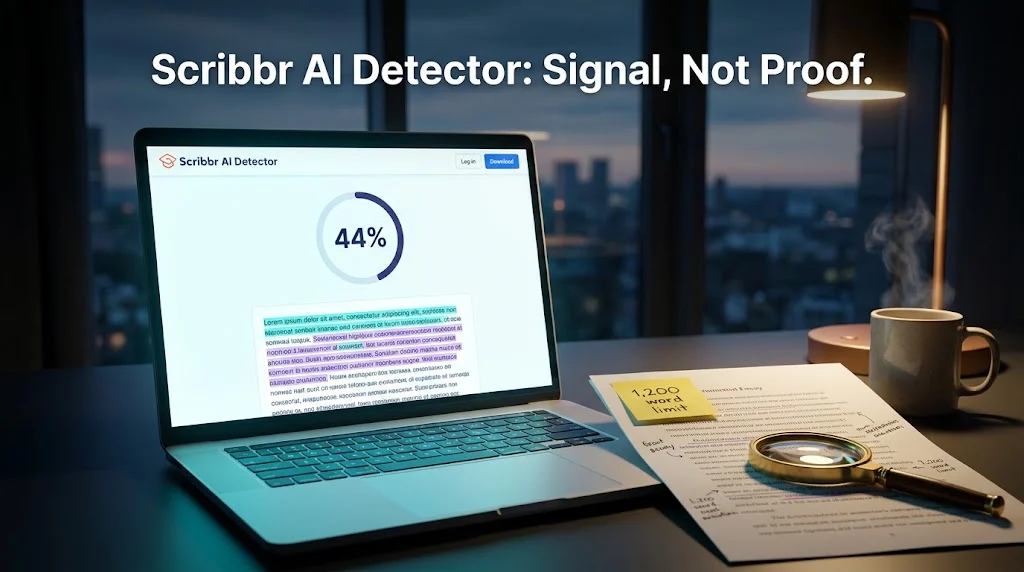
Scribbr’s AI detector is a tool that estimates the likelihood text was generated by AI, offering a free tier with unlimited checks up to 1,200 words and a premium tier bundled with plagiarism checks. Independent research found its overall accuracy at 44.0%, and Scribbr itself states no detector is 100% accurate and false positives are common.
At-a-Glance: Key Takeaways
- Scribbr offers a genuinely free tier with unlimited checks on texts up to 1,200 words, no registration required, and support for five languages .
- Independent research found 44.0% accuracy for Scribbr’s detector, lower than GPTZero (58.7%) and ZeroGPT (64.0%) in the same study .
- Scribbr itself cautions that false positives are common and no tool can confirm with absolute certainty whether text was human-written .
- The free tier detects GPT-2, GPT-3, and GPT-3.5 with average accuracy, while the premium tier claims detection of all known models including ChatGPT, Gemini, Claude, and Bard .
- Non-native English writers face disproportionate flagging, a pattern documented across AI detectors including Scribbr .
- The premium detector is bundled with the Plagiarism Checker, starting around €14.95, and includes unlimited AI analyses for seven days .
What Is Scribbr’s AI Detector?
Scribbr’s AI detector is a tool that analyzes text and assigns a percentage score indicating the likelihood it was generated by artificial intelligence. It is distinct from the Scribbr Plagiarism Checker, which compares text against existing sources. The AI detector analyzes internal writing patterns, specifically perplexity and burstiness, to identify machine-generated text .
Scribbr is an academic editing and proofreading service, and the AI detector is positioned as an academic integrity tool. The free version supports English, German, Dutch, and French, with the premium version adding Spanish. The tool is available as a standalone check or bundled with the plagiarism checker .
The critical framing from Scribbr’s own documentation is that the detector provides “a good indication (but not 100% certainty)” of AI involvement . That caveat should govern how the score is interpreted.
How Scribbr’s AI Detector Works
Scribbr’s detector is based on the same principles as all AI detectors: it measures specific text characteristics, particularly perplexity (predictability of word choices) and burstiness (variation in sentence length) . These signals help the model determine whether text is likely AI-generated.
The free detector recognizes GPT-2, GPT-3, and GPT-3.5 with average accuracy. The premium detector claims to recognize all known language models, including ChatGPT (all versions), Google Gemini, Claude, Bard, and Bing Chat . Scribbr states the premium version is more accurate and specifically designed for AI detection, making it “much more reliable for this purpose” than the plagiarism checker’s incidental AI detection .
Scribbr notes that the tool works particularly well with longer texts. It can make errors, especially if AI text has been modified or rewritten. The company explicitly states: “We cannot guarantee 100% accuracy” .
The Accuracy Problem in Numbers
The independent evidence on Scribbr’s accuracy is limited but not favorable.
The Polish Study
A 2026 study published in the Journal of Computer Sciences Institute compared four detectors: GPTZero, ZeroGPT, Copyleaks, and Scribbr. The experiment used 150 text samples in Polish and English, divided into human-written, AI-generated, and AI-paraphrased categories .
| ZeroGPT | 64.0% (highest) |
| GPTZero | 58.7% |
| Scribbr | 44.0% |
| Copyleaks | 42.7% |
The study also found that fully AI-generated texts were detected more effectively than AI-paraphrased texts. Overall accuracy was similar for Polish and English samples, at 52.7% and 52.0% respectively .
The ESL Bias Study
A separate 2025 study in the International Journal of Teaching, Learning and Education specifically audited the fairness of AI detection tools, including Scribbr, on English as a Second Language (ESL) writing. The study used 1,212 text chunks across AI-generated, published human-written, and ESL graduate student texts .
The finding was direct: “AI detectors disproportionally flagged ESL writing with false positives.” The authors emphasized the importance of fairness audits, noting that misclassification “can have academic or reputational consequences” .
Scribbr’s Own Acknowledgment
Scribbr’s help documentation states that false positives occur often, and no tool can determine with absolute certainty whether text was human-written. The company also notes that its proofreading service can inadvertently change AI detection scores: editing for clarity, grammar, and flow can make human-written text resemble AI-generated patterns .
This is a significant admission. A student who uses Scribbr’s proofreading service may see their AI score rise, even though the editing was done entirely by humans.
Free vs. Premium: What You Actually Get
| Languages | English, German, Dutch, French | Adds Spanish |
| Word limit | 1,200 words per check | Up to 100,000 words |
| Checks | Unlimited | Unlimited for 7 days |
| Model detection | GPT-2, GPT-3, GPT-3.5 (average accuracy) | All known models (higher accuracy) |
| Pricing | Free | From €14.95, bundled with plagiarism check |
| Document upload | Manual text entry | File upload |
The free tier is genuinely usable for students checking shorter assignments or paragraphs. The unlimited checks mean you can test multiple drafts without cost. The 1,200-word limit is the main constraint, as most academic papers exceed this.
The premium tier is not sold as a standalone AI detector. It is bundled with the plagiarism checker, which compares against 70+ billion sources. The pricing starts at €14.95 and includes unlimited AI analyses for seven days .
Interpreting the Score
Scribbr provides a percentage between 0 and 100. The score indicates the probability that text contains AI-generated content. It is not a plagiarism score, and the two metrics are independent .
| 0% | Detector did not flag the text. Not proof of human authorship; false negatives are documented. |
| 1-20% | Low signal. Scribbr does not suppress this range, but independent research suggests accuracy is poor across all detectors at low thresholds. |
| 20-100% | A signal for review. Scribbr’s own guidance suggests checking institutional policies, acknowledging AI use if applicable, and rewriting if AI use is prohibited. |
Scribbr’s help documentation offers practical advice for students who receive a high score: check your institution’s guidelines, acknowledge AI tool use if it occurred, and rewrite the text if AI use is not permitted. The framing is supportive rather than punitive, which is a notable contrast to how some institutions use detector scores .
Privacy and Data Handling
Scribbr’s AI detector processes text on its servers. The company does not publish specific data retention policies for the free AI detector in available documentation. The premium detector is part of the plagiarism checker infrastructure, which uses Scribbr’s proprietary software .
Important distinction: SOC 2 certification or Zero Data Retention guarantees are not referenced in available Scribbr documentation. Students submitting sensitive academic work should review the privacy policy before uploading full documents.
Who Should Use Scribbr’s AI Detector
Students checking short assignments can use the free tier’s unlimited checks on texts up to 1,200 words. This is sufficient for paragraphs, sections, or shorter essays.
Users needing multilingual support can check English, German, Dutch, and French texts on the free tier, with Spanish available on premium.
Anyone bundled with a plagiarism check should note that the premium AI detector is included with the plagiarism checker, making the combined package the practical entry point for comprehensive originality checking.
Institutions making misconduct decisions should not rely on Scribbr or any detector as sole evidence. The 44.0% accuracy figure and documented ESL bias make standalone use inappropriate for high-stakes determinations.
Writers flagged by their institution can use Scribbr’s free tier to see how another detector scores the same text. The results may differ, which is itself evidence of detector unreliability.
Common Mistakes and Cautions
Treating the percentage as proof. Scribbr itself states the detector provides “a good indication (but not 100% certainty).” The score is a signal, not a verdict.
Ignoring the ESL bias. The 2025 fairness study found disproportionate flagging of ESL writing. Students who learned English later may see higher scores on genuinely human-written text.
Assuming the free tier matches premium. The free version detects older models with average accuracy. The premium version claims higher accuracy and broader model coverage. The free score may not reflect what a university’s detector reports.
Forgetting that proofreading can change scores. Scribbr’s own documentation notes that its human proofreading service can change AI detection scores. Improved clarity and flow can resemble AI patterns.
Overlooking the word limit. The free tier caps at 1,200 words. Longer documents require the premium tier or manual segmentation.
Frequently Asked Questions
How accurate is Scribbr’s AI detector?
Independent research found 44.0% overall accuracy in a 2026 study, lower than GPTZero (58.7%) and ZeroGPT (64.0%). Scribbr itself states no detector is 100% accurate and false positives are common .
Is Scribbr’s AI detector free?
Yes, with limits. The free tier offers unlimited checks on texts up to 1,200 words, supports five languages, and requires no registration. The premium tier, bundled with the plagiarism checker, starts at €14.95 and includes document upload and unlimited analyses for seven days .
What languages does Scribbr’s AI detector support?
The free tier supports English, German, Dutch, and French. The premium tier adds Spanish .
Can Scribbr detect ChatGPT and other modern AI models?
The free detector recognizes GPT-2, GPT-3, and GPT-3.5 with average accuracy. The premium detector claims to recognize all known language models, including ChatGPT, Gemini, Claude, and Bard, with higher accuracy .
Does Scribbr’s AI detector flag non-native English writers?
Yes. A 2025 fairness study found that AI detectors, including Scribbr, disproportionately flagged ESL writing with false positives. The authors noted this can have academic or reputational consequences .
Conclusion
Scribbr’s AI detector offers a genuinely accessible free tier with unlimited checks on short texts, making it a useful tool for students seeking a second opinion. The premium tier, bundled with the plagiarism checker, provides broader language support and higher word limits.