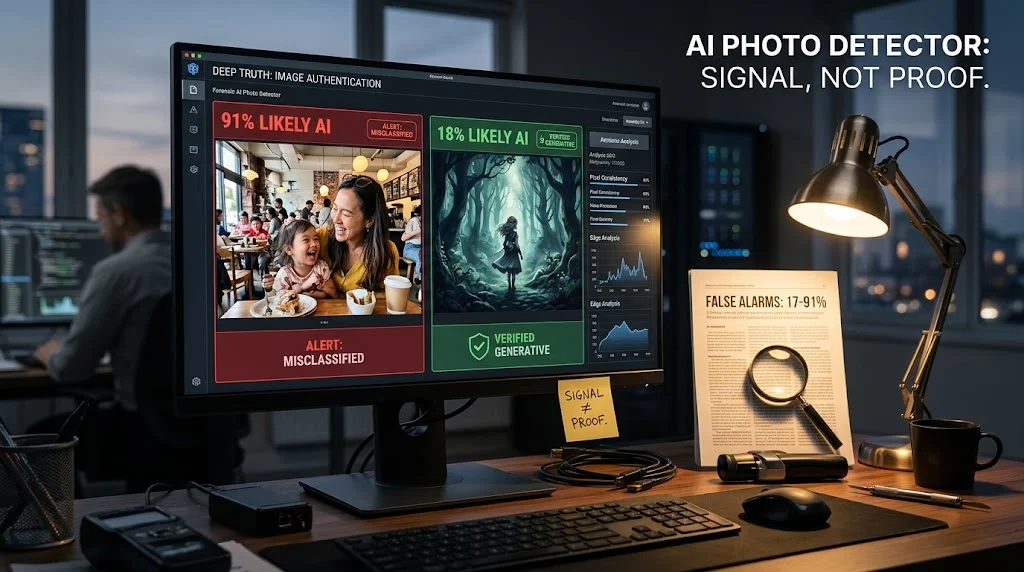
An AI photo detector is a tool that estimates whether an image was generated by artificial intelligence, but independent research shows its scores are unreliable on modern content. A 2026 LAION-Mobile study found no detector exceeded AUC 0.624 on modern AI images, while false-alarm rates on real smartphone photos ranged from 17% to 91% once thresholds were recalibrated .
At-a-Glance: Key Takeaways
- Modern AI images defeat most detectors. A benchmark of 16 detection methods found modern commercial generators like Flux Dev, Firefly v4, and Midjourney v7 achieve only 18-30% average detection accuracy .
- Real photos get flagged as fake. LAION-Mobile testing on one million smartphone images found false-alarm rates of 17-91% on real photos once thresholds were calibrated on modern content .
- No universal winner exists. Detector rankings vary wildly across datasets, with Spearman correlations ranging from 0.01 to 0.87 .
- Perturbations break detection. Glaze at medium intensity drops Hive’s detection rate from 96.83% to 69.73%, and Gaussian noise drops Optic from 98.85% to 52.63% .
- Hive leads on unperturbed images with 98.03% accuracy and 0% false positives on human artwork, but performance degrades significantly under adversarial conditions .
- Pricing varies from free to per-image API costs. Illuminarty offers free basic detection , AI or Not charges $0.02 per image , and Hive’s API starts at $3.00 per 1,000 images .
What Is an AI Photo Detector?
An AI photo detector is a software tool that analyzes an image and assigns a probability score indicating how likely it was generated by artificial intelligence. It is not a reverse image search. It does not compare your photo against existing sources. Instead, it examines internal visual patterns and estimates whether the style matches machine generation.
The score typically appears as a percentage or confidence value. A high score means the model identified patterns associated with AI generation. It does not mean the image is definitively fake. The tools are making probabilistic judgments about visual style, not factual determinations about origin.
This distinction matters because the consequences of a false flag can be severe. Marketplace sellers accused of using AI-generated product photos, journalists questioning image authenticity, and individuals caught in deepfake accusations all face reputational and financial harm from incorrect detector output.
How AI Photo Detectors Work
Modern detectors use deep learning models trained on large datasets of real and AI-generated images. They learn to identify subtle artifacts that generative models leave behind: unusual frequency distributions, inconsistent noise patterns, or telltale rendering signatures.
Some detectors, like Hive, are trained on outputs from specific generators. Hive’s model performs well on CIVITAI and SDXL images (100% detection) but struggles with Firefly (91.04%) because it has less training data for newer models .
Other approaches analyze compression history rather than synthesis. A 2026 paper found that a detector’s strongest signal was whether an image had been re-encoded into the real class’s format, not whether it was AI-generated. Once that encoding difference was equalized, the detector’s performance dropped from 0.9999 PR-AUC to 0.7254 .
The Generalization Problem
The fundamental challenge is that detectors trained on one set of generators often fail on others. A comprehensive benchmark of 16 detection methods found that training data alignment critically impacts generalization, causing up to 20-60% performance variance within architecturally identical detector families .
This means a detector that works well on Midjourney may fail on Flux. A tool trained on Stable Diffusion may not recognize DALL-E 3. There is no “one-size-fits-all” detector.
The Accuracy Problem in Numbers
The evidence on detector accuracy is fragmented but consistently points to unreliability, especially on modern content.
The LAION-Mobile Finding
The most concerning recent study, published in September 2026, introduced LAION-Mobile, a dataset of approximately one million smartphone images with EXIF metadata. The researchers evaluated twelve state-of-the-art detectors and reported three key findings :
- On modern AI content, no detector exceeded AUC 0.624, with five of twelve falling below chance.
- Real-photo false-alarm rates are an artifact of threshold calibration. Thresholds fitted on legacy GAN data made detectors look deployable (less than 11% FPR), but the same detectors flagged 17-91% of real photos once the identical criterion was refit on modern content.
- No detector both beats chance on modern AI content and keeps a deployable real-photo false-alarm rate.
The study’s conclusion is blunt: current detectors are not reliable enough for high-stakes deployment.
The Open-Source Benchmark
A February 2026 benchmark of 16 open-source detection methods across 2.6 million images found :
- No universal winner. Rankings varied from Spearman correlations of 0.01 to 0.87 across dataset pairs.
- A 37-percentage-point gap separated the best detector (75.0% mean accuracy) from the worst (37.5%).
- Modern commercial generators defeat most detectors, achieving only 18-30% average accuracy on Flux Dev, Firefly v4, and Midjourney v7.
Hive’s Performance
On unperturbed images, Hive performs well. A University of Chicago study found Hive achieved 98.03% accuracy with 0.00% false positive rate and 3.17% false negative rate on human artwork and AI-generated images .
However, the same study found Hive’s detection rate dropped to 69.73% when Glaze was applied at medium intensity, and to 67.56% at high intensity . Gaussian noise dropped Optic from 98.85% to 52.63%, and Illuminarty from 95.31% to 61.43% .
The Text-Rich Image Gap
A May 2026 benchmark called TextFake tested detectors on fabricated screenshots, documents, and news pages. Zero-shot evaluation of 14 specialized detectors and 3 frontier VLM APIs revealed that no method exceeded 80% accuracy, with some dropping over 60% from natural-image benchmarks .
The failure modes identified were dense glyphs overwhelming low-level detectors, stronger text rendering suppressing generative artifacts, and routine perturbations driving detectors toward chance-level performance .
Pricing and Access
AI photo detector pricing varies dramatically, from free consumer tools to per-image API costs.
Important privacy caveat: Hive’s terms of service state they can train AI models using images uploaded via the free web service, but not images classified through paid APIs. The University of Chicago study used a paid Hive account to ensure human artwork was not used for training . Free users should assume their uploads may be retained.
Privacy and Security Considerations
AI photo detectors process your images on remote servers. The privacy implications vary by provider.
Free tiers often have the weakest privacy protections. Hive’s free web service explicitly permits training on uploaded images. This is a significant concern for anyone uploading personal photos or sensitive content.
Paid API tiers offer stronger protections. Hive’s paid API excludes training use. AI or Not’s API and Illuminarty’s paid plans likely have similar provisions, though terms should be verified.
What to check before uploading:
- Whether your images are used for model training
- How long images are retained
- Whether you can delete your data
- The provider’s data processing agreement
Important distinction: No SOC 2 certification or similar compliance framework is typically referenced for consumer AI photo detectors. They are consumer products. Do not upload confidential or personal images without reviewing the privacy policy.
Who Should Rely on AI Photo Detector Scores
Journalists and fact-checkers can use detectors as one signal among many, but should never publish a “fake” verdict based solely on a score. The false-positive rates on real photos make sole reliance dangerous.
Marketplace platforms considering automated enforcement should be extremely cautious. A detector that flags 17-91% of real phone photos as AI-generated would wrongly penalize legitimate sellers at scale.
Researchers studying detection should note the documented failure modes and use detectors as baselines, not ground truth.
Individuals curious about an image can use free tools for casual exploration, understanding that the result is a probabilistic guess, not a fact.
Anyone making high-stakes decisions based on image authenticity should combine detector scores with provenance data (C2PA metadata), reverse image search, and human review. No single tool is sufficient.
Common Mistakes and Cautions
Treating the score as proof. A high confidence score means the model identified patterns. It does not mean the image is fake. The LAION-Mobile study found false alarms on 17-91% of real smartphone photos .
Ignoring the generator gap. A detector that works on Midjourney may fail on Flux. Modern generators achieve only 18-30% detection accuracy against most tools .
Uploading sensitive images to free tools. Hive’s free web service permits training on uploaded images. Use paid APIs or local tools for sensitive content .
Assuming text-rich images are covered. Detectors perform worst on fabricated screenshots and documents, with no method exceeding 80% accuracy in the TextFake benchmark .
Forgetting about perturbations. Glaze, Gaussian noise, and even JPEG compression can shift detection outcomes. An image that flags as AI today may not tomorrow, and vice versa .
Frequently Asked Questions
How accurate are AI photo detectors?
Accuracy varies widely and is generally poor on modern content. LAION-Mobile found no detector exceeded AUC 0.624 on modern AI images, with false-alarm rates of 17-91% on real smartphone photos . A benchmark of 16 open-source methods found modern generators achieve only 18-30% average detection accuracy .
Why do AI photo detectors flag real photos?
Detectors look for patterns associated with generation, but modern smartphone photography uses computational pipelines (multi-sensor fusion, noise suppression) that can resemble AI processing. Threshold calibration also plays a role: settings tuned for legacy GANs produce high false alarms on modern content .
Can AI photo detectors detect text-rich fakes like screenshots?
Poorly. The TextFake benchmark found no detector exceeded 80% accuracy on text-rich images, with some dropping over 60% from natural-image performance. Dense text overwhelms low-level detectors, and stronger rendering suppresses artifacts .
What is the best AI photo detector?
There is no universal winner. Hive leads on unperturbed images (98.03% accuracy, 0% FPR on human artwork) , but performance degrades under perturbations. ImageWhisperer reports 94% accuracy and 5% FPR on its curated test set, but these are vendor-reported figures . The “best” depends on the specific generator and image type.
Is there a free AI photo detector?
Yes. Illuminarty offers free basic image classification . AI or Not provides 20 free image checks and $5 in credits . Hive has a free web service, but its terms permit training on uploaded images, so avoid it for sensitive content .
Conclusion
AI photo detectors are probabilistic tools that estimate whether an image was generated by AI. They are not lie detectors, forensic examiners, or sources of ground truth. The evidence is clear: false alarms are common, modern generators defeat most models, and text-rich images remain a significant blind spot.