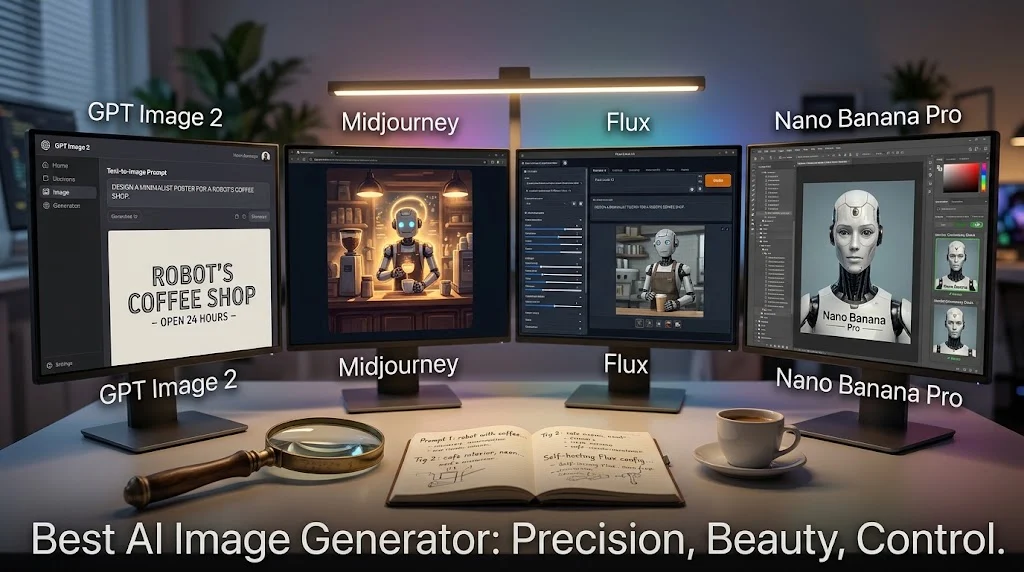
The “best” AI image generator depends on your priority. GPT Image 2 leads on prompt adherence and text rendering, Midjourney leads on aesthetic quality and artistic control, Flux leads on open-weight flexibility and local deployment, and Nano Banana Pro leads on editing consistency. No single model dominates across all benchmarks, and independent comparative testing remains limited.
At-a-Glance: Key Takeaways
- No model dominates all categories. GPT Image 2 wins on instruction-following and text rendering. Midjourney wins on aesthetics. Flux wins on openness. The “best” depends on the task.
- Prompt adherence is not the same as beauty. A model that renders your exact prompt may produce duller images than one that prioritizes visual appeal. Midjourney often prioritizes aesthetics over literal instruction.
- Open-weight models change the cost equation. Flux and Stable Diffusion variants can run locally with no per-image fees, eliminating API dependency but requiring GPU hardware.
- Editing consistency is a separate benchmark. Nano Banana Pro and GPT Image 2 lead on preserving identity and composition across edits, a capability distinct from generation quality.
- Benchmark reliability is limited. Most public leaderboards use human preference voting or vendor-selected prompts. Independent, domain-specific testing is scarce.
- Pricing ranges from free tiers to $60+/month subscriptions, with API costs varying significantly by model and resolution.
What Makes an AI Image Generator “Best”?
The search for the “best” AI image generator reveals a fragmented landscape where different models optimize for different objectives. A model trained to follow prompts precisely may produce visually bland output. A model optimized for aesthetic appeal may ignore half your instructions.
The practical question is not “which model is best” but “which model is best for this specific task.” Product photography, concept art, text-in-image design, and photorealistic portraiture each reward different model characteristics.
This article maps the major models, their strengths, their limitations, and the benchmarks that attempt to measure them. It does not declare a universal winner because the evidence does not support one.
The Major AI Image Generators Compared
| GPT Image 2 | OpenAI | API, ChatGPT | Prompt adherence, text rendering | Subscription/API costs |
| Midjourney | Midjourney | Web, Discord | Aesthetic quality, artistic style | Less literal prompt following |
| Nano Banana Pro | Gemini, API | Editing consistency, identity preservation | Ecosystem lock-in | |
| Flux | Black Forest Labs | API, open weights | Open-source flexibility, local deployment | Requires technical setup for local use |
| Seedream | ByteDance | API, platforms | Photorealism, Asian market aesthetics | Less Western documentation |
| Stable Diffusion | Stability AI | Open weights | Full control, fine-tuning, ecosystem | Quality depends heavily on checkpoints |
GPT Image 2: The Prompt-Following Leader
GPT Image 2 is OpenAI’s current image generation model, integrated into ChatGPT and available via API. Its defining characteristic is instruction-following precision.
Where It Excels
GPT Image 2 is widely regarded as the strongest model for rendering text within images, following complex multi-part prompts, and adhering to specific compositional instructions. If your prompt says “a red cube on the left, a blue sphere on the right, with the word SALE in bold sans-serif across the top,” GPT Image 2 is more likely to produce exactly that than aesthetic-focused competitors.
This makes it the preferred choice for design work, mockups, diagrams, and any task where the image must match a specification rather than evoke a mood.
Where It Falls Short
Aesthetic quality is subjective, but many users report that GPT Image 2’s output feels more “correct” than “beautiful.” Midjourney and Flux often produce more visually striking images from similar prompts. GPT Image 2 prioritizes literal accuracy over artistic interpretation.
Pricing is API-based or bundled with ChatGPT subscriptions. There is no free unlimited tier.
Midjourney: The Aesthetic Benchmark
Midjourney remains the reference point for visual quality in AI image generation. Its outputs are consistently cited as more artistic, more stylized, and more visually compelling than competitors.
Where It Excels
Midjourney excels at concept art, illustration, fashion imagery, and any task where the mood and visual impact matter more than literal prompt adherence. Its style reference and character reference features allow consistent aesthetics across generations.
The platform has evolved from Discord-only to a web interface, improving accessibility. Its community and prompt-sharing culture remain strong.
Where It Falls Short
Midjourney is less reliable at following precise instructions. Complex prompts with specific spatial arrangements or text requirements may be partially ignored in favor of aesthetic choices. Text rendering is weaker than GPT Image 2.
There is no free tier. Subscriptions start around $10/month, with higher tiers for commercial use and more generations.
Nano Banana Pro: The Editing Specialist
Nano Banana Pro (Google’s Gemini image model) has carved out a specific niche: editing and consistency.
Where It Excels
Nano Banana Pro is particularly strong at preserving character identity, maintaining composition across edits, and applying changes without regenerating the entire image. If you need to change a character’s outfit while keeping their face identical, or adjust a background without altering the subject, Nano Banana Pro is a strong candidate.
This makes it valuable for iterative workflows, storyboarding, and any task requiring visual continuity.
Where It Falls Short
As a Google product, it is tied to the Gemini ecosystem. Access is through Gemini interfaces or API. It is not available as open weights, and local deployment is not an option.
Flux: The Open-Weight Alternative
Flux, developed by Black Forest Labs, is the leading open-weight image generation model family.
Where It Excels
Flux models can be downloaded and run locally, eliminating API costs and data transmission concerns. The open-weight ecosystem includes fine-tuned variants, LoRAs, and community tools that extend capabilities significantly.
For developers, researchers, and privacy-conscious users, Flux offers control that proprietary models cannot match. The quality of Flux Pro and Flux Dev variants is competitive with closed models for many tasks.
Where It Falls Short
Local deployment requires a capable GPU and technical setup. The user experience is not comparable to ChatGPT or Midjourney’s polished interfaces. Quality varies significantly depending on which checkpoint, LoRA, and settings you use.
API access is available through providers like Replicate and Fal, but pricing varies.
Seedream and Stable Diffusion
Seedream (ByteDance) is particularly strong on photorealism and aesthetics tuned to Asian markets. It is accessible through platforms like Zorqai and other aggregators. Documentation in English is less comprehensive than Western competitors.
Stable Diffusion remains the foundation of the open-weight ecosystem. Its quality depends entirely on the checkpoint and fine-tuning used. The community has produced thousands of specialized models for anime, photorealism, product photography, and other niches. It is not a single model but a platform.
The Benchmark Problem
Evaluating image generation models is inherently difficult because quality is subjective. Public leaderboards typically rely on:
- Human preference voting (pairwise comparisons)
- Vendor-selected prompts (cherry-picked examples)
- Automated metrics (CLIP score, FID) that correlate poorly with human judgment
No independent benchmark comprehensively tests prompt adherence, aesthetic quality, text rendering, editing consistency, and domain-specific performance across all major models. The evidence is fragmented.
Editorial interpretation: Users should treat vendor benchmarks and leaderboard rankings as directional, not definitive. The best model for your use case may not rank highly on general-purpose leaderboards. Testing on your own prompts is the only reliable evaluation.
Pricing and Access
| GPT Image 2 | Limited (ChatGPT) | ChatGPT Plus/Pro | Per-image API |
| Midjourney | No | $10+/month | N/A |
| Nano Banana Pro | Limited (Gemini) | Google AI plans | Per-image API |
| Flux | Open weights (local) | API via providers | Varies |
| Seedream | Via platforms | Platform subscriptions | Varies |
| Stable Diffusion | Open weights (local) | N/A | N/A |
Privacy and Security Considerations
Privacy practices vary dramatically across image generation models.
Local deployment (Flux, Stable Diffusion): Images are generated on your hardware. No data leaves your machine. This is the gold standard for privacy.
Cloud APIs (GPT Image 2, Nano Banana Pro, Midjourney): Prompts and generated images pass through vendor servers. Data retention and training policies vary. Review each vendor’s terms before uploading sensitive content.
Important distinction: No SOC 2 certification or similar compliance framework is typically referenced for consumer image generation APIs. They are not designed for confidential or regulated content without enterprise agreements.
Who Should Use Which Model
Designers and marketers needing precise, text-accurate images should use GPT Image 2 for its prompt adherence and text rendering.
Artists and creators prioritizing aesthetic quality should use Midjourney for its visual polish and style control.
Developers and privacy-conscious users should explore Flux for local deployment and open-weight flexibility.
Users needing iterative editing with identity preservation should evaluate Nano Banana Pro for its consistency capabilities.
Users seeking photorealism with Asian market aesthetics may find Seedream valuable through aggregator platforms.
Anyone needing a general-purpose free option should start with the free tiers of ChatGPT or Gemini, understanding the limitations.
Common Mistakes and Cautions
Assuming leaderboard rank equals best for your task. A model that wins general preference voting may underperform on your specific prompts.
Confusing prompt adherence with image quality. GPT Image 2 follows instructions precisely but may produce less visually striking images than Midjourney.
Ignoring the cost of local deployment. Flux and Stable Diffusion are free to download but require GPU hardware and technical setup.
Overlooking editing consistency. Generation quality and editing quality are different benchmarks. A model that produces beautiful images may struggle to modify them consistently.
Trusting vendor benchmarks without testing. Cherry-picked examples and selected prompts do not reflect real-world performance.
Frequently Asked Questions
What is the best AI image generator overall?
There is no universal best. GPT Image 2 leads on prompt adherence and text rendering. Midjourney leads on aesthetic quality. Flux leads on open-weight flexibility. The best depends on whether you prioritize accuracy, beauty, or control.
Is Midjourney better than GPT Image 2?
They optimize for different goals. Midjourney produces more visually striking images. GPT Image 2 follows prompts more precisely and renders text better. Neither is universally “better.”
What is the best free AI image generator?
ChatGPT and Gemini offer limited free image generation. Flux and Stable Diffusion can be run locally for free if you have the hardware. There is no free unlimited cloud-based option.
Can I run AI image generators locally?
Yes. Flux and Stable Diffusion variants can run locally on a capable GPU. This eliminates API costs and data transmission but requires technical setup.
What is Nano Banana Pro best for?
Nano Banana Pro excels at editing consistency and identity preservation. It is particularly strong when you need to modify an image while keeping the subject or composition unchanged.
Conclusion
The “best” AI image generator does not exist as a universal answer. GPT Image 2 leads on precision. Midjourney leads on beauty. Flux leads on openness. Nano Banana Pro leads on editing consistency. Seedream and Stable Diffusion serve specific niches.