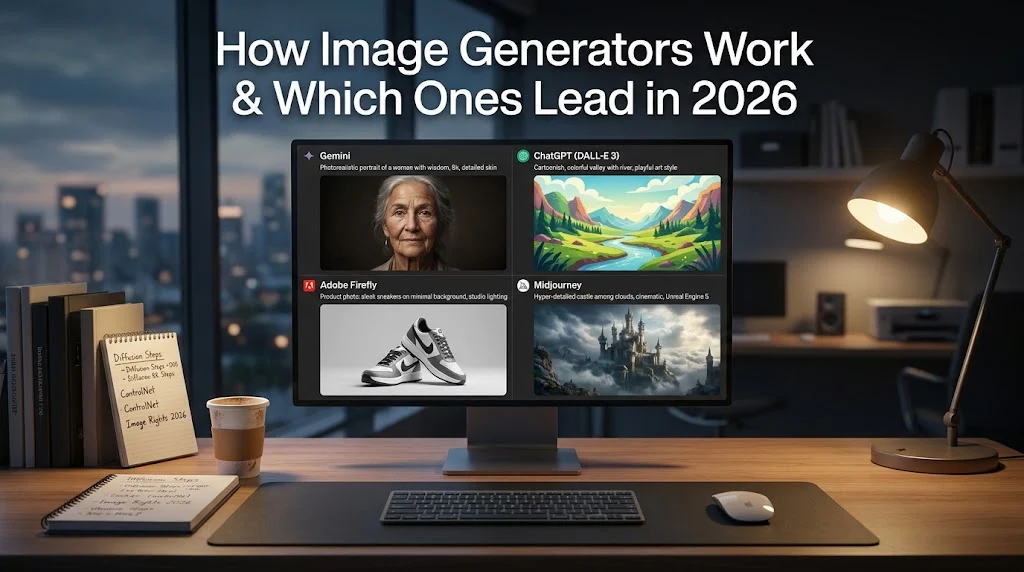
An image generator AI is a tool that creates pictures from text descriptions using diffusion or flow models. These models learn to reverse a process of adding noise to images, gradually reconstructing a coherent picture from random noise conditioned on your prompt. Google’s Gemini Nano Banana Pro and OpenAI’s ChatGPT Images lead current quality benchmarks, while Adobe Firefly leads on commercial safety and Midjourney on artistic style.
At-a-Glance: Key Takeaways
- Diffusion models generate all pixels jointly, unlike LLMs that produce words sequentially. They learn by reversing a noise-adding process, step by step, until an image emerges .
- Gemini Nano Banana Pro leads overall quality, earning an 8.5/10 from CNET and PCMag’s top pick for accuracy and detail .
- Adobe Firefly is the safest for commercial work, training only on licensed content and offering IP indemnification, but requires a subscription to remove watermarks .
- Midjourney excels at artistic style, not photorealism, and is paid-only starting at $10/month. All images are public unless you pay for stealth mode .
- Cost per image varies 55-fold, from $0.0027 for FLUX.1 Schnell to $0.15 for Gemini 3 Pro Image, depending on provider and model .
- Copyright for AI-generated images is unresolved. Pure AI output has no human author and may not be protectable. Meaningful human editing is required for any claim .
What Is Image Generator AI?
An image generator AI is a system that produces pictures from text descriptions. The underlying technology is fundamentally different from large language models. LLMs generate discrete tokens sequentially, predicting one word at a time. Image generators produce continuous-valued pixels jointly, assigning a color to every pixel simultaneously so they form a coherent picture .
This distinction matters for understanding both capability and limitation. Because pixels are generated together, image models can produce spatially consistent scenes. But they also lack the explicit reasoning that token-by-token generation sometimes affords. A model that can render a photorealistic face may still fail at counting objects or following complex spatial instructions .
How Image Generator AI Works
The Diffusion Process
Diffusion models learn by reversing a process of progressive noise corruption. During training, the model sees images gradually destroyed by added noise. It learns to predict and remove that noise at each step. At generation time, the model starts with pure noise and applies this denoising process repeatedly, guided by the text prompt, until a coherent image emerges .
The prompt conditions the denoising at every step. Text is converted into a feature representation, and that representation is injected into the model’s internal layers. This is how “a cat on the moon” steers the random noise toward a specific visual outcome .
The Latent Space Shortcut
Applying diffusion directly to high-resolution pixels is computationally prohibitive. The breakthrough that made modern image generators practical was latent diffusion, developed by researchers at LMU Munich in 2022. Instead of denoising full-resolution images, the model operates in a compressed latent space, then reconstructs the final image from the generated features. This enables 512×512 and higher resolution outputs without impossible compute costs .
The Prompt Is Not Magic
A common misconception is that a good prompt guarantees a good image. Research on user experience consistently finds that prompt execution is inconsistent across platforms. A 2025 ACM study found common challenges included “inconsistent prompt execution, difficulties in describing ideas effectively, and AI artifacts” . The prompt is a steering mechanism, not a precise control interface.
The Major Image Generator AI Tools Compared
Gemini Nano Banana Pro: Best Overall Quality
CNET scores Gemini’s Nano Banana Pro 8.5/10, calling it the “best choice overall for any AI image generation.” PCMag names it a top pick for accuracy and detail . The model excels at character consistency, realism, and prompt adherence.
What Free Includes
Free users can generate images until hitting a cap, after which Google downgrades them to the original Nano Banana model. PCMag notes that even the downgraded model is “still good enough to earn our Technical Excellence Award” .
Where the Limits Hit
The free tier is metered by compute, not a simple credit count. Heavy users will hit caps unpredictably. Higher resolution and advanced editing require a Google AI subscription.
Who it suits: Most users who want the best free quality for social media, presentations, and concept work.
ChatGPT Images: Convenience Within the Assistant
ChatGPT’s image generation is built directly into the chat interface. CNET scores it 7/10, noting creative and engaging images that can mimic various artistic styles .
What It Does Well
The integration is the advantage. You can iterate conversationally, asking for changes in plain language without switching tools. The free tier is accessible to anyone with a ChatGPT account.
Where It Falls Short
CNET’s testing found text rendering “hit-or-miss” despite OpenAI’s claims. The lack of post-generation editing tools makes it hard to fix mistakes. The paid tier is $20/month .
Who it suits: Existing ChatGPT users who want image generation without another subscription.
Adobe Firefly: Commercial Safety First
Firefly is the choice for professional work where legal exposure matters. It trains only on licensed content and offers IP indemnification, meaning Adobe will defend you if an output is challenged .
What It Does Well
PCMag names it “Best for Customization,” citing good preset styles, the ability to match uploaded image styles, and choice of aspect ratios. Your content does not train Adobe’s AI .
Where It Falls Short
Free users get 25 credits monthly, a demo allowance. Images can look distorted or fail to match requests. There is no negative prompt option, and watermark removal requires a subscription .
Who it suits: Designers and agencies doing client work where commercial safety is non-negotiable.
Midjourney: Artistic Style, Not Realism
CNET names Midjourney the “Best creative AI image generator,” praising extremely creative, versatile stylistically results. But it explicitly warns: “if you’re looking for ultrarealistic or stock photography-like imagery, you won’t get what you want” .
What It Does Well
Midjourney excels at stylized, artistic interpretations. It has a strong community and active Discord server. Improvements have helped prompt adherence, and it offers upscaling and editing tools .
Where It Falls Short
It is paid-only, starting at $10/month. All images are public in an online gallery unless you pay for stealth mode. Disney, Universal, and Warner Bros. are suing the company over its ability to generate protected characters .
Who it suits: Artists, illustrators, and creatives seeking distinctive style over photorealism.
The Cost Reality
Per-image costs vary dramatically depending on model and provider. A GitHub analysis of provider list prices found a 55-fold spread, from $0.0027 for FLUX.1 Schnell on Together AI to $0.15 for Gemini 3 Pro Image on fal .
Provider matters as much as model. Ideogram v3 costs $0.03 on fal and $0.09 on Replicate, three times the price for the same model .
For free-tier users, the practical cost is zero. The trade-off is caps, watermarks, and restricted commercial rights. For developers building applications, the per-image rate is the relevant metric.
Copyright and Ownership: The Unsettled Question
The legal status of AI-generated images remains unresolved. The foundational principle in US law is that copyright requires a human author. In March 2026, the Supreme Court declined to hear a case seeking copyright for an AI-generated image, leaving lower court rulings in place: works without a human creator are ineligible for protection .
What this means practically: A work produced purely by prompting has no copyright owner. Competitors may be free to copy it. Protection extends only as far as the human contribution reaches: selecting among outputs, editing, combining elements, or adding substantial original material .
The EU takes a different approach through the AI Act, requiring disclosure of training data and respecting rightsholder opt-outs. As of August 2026, the EU AI Office can verify compliance and impose corrective measures .
Who should care: Anyone building a brand or product catalogue on AI-generated assets. The lack of copyright protection may not matter for internal use, but it matters for competitive differentiation.
Who Should Use Which Image Generator AI
Casual users should start with Gemini’s free tier for the best quality without payment. The Nano Banana Pro model handles most social media, presentation, and concept work.
ChatGPT users can use the built-in image generation for convenience. The quality is adequate, and the conversational iteration is useful.
Professional designers and agencies should use Adobe Firefly for commercial safety. The IP indemnification and licensed training data justify the subscription for client work.
Artists and illustrators should use Midjourney for distinctive style. The artistic output is stronger than its photorealism.
Developers building applications should evaluate open-weight models like FLUX.2 klein-4B (Apache 2.0) for self-hosting, or API providers based on per-image cost and text rendering quality .
Common Mistakes and Cautions
Assuming the prompt guarantees the output. Research consistently finds inconsistent prompt execution across platforms. The prompt is a steering mechanism, not a control interface .
Ignoring copyright limits. Pure AI output may have no copyright owner. Meaningful human editing is required for any protection claim .
Overlooking training data disputes. Disney, Universal, and Warner Bros. are suing Midjourney. Publishers are suing OpenAI. The legal exposure extends to businesses using these tools at scale .
Expecting free tiers to be unlimited. Gemini caps and downgrades. Firefly’s 25 credits are a demo. ChatGPT’s daily limits are restrictive for production.
Trusting text rendering claims. CNET found ChatGPT’s text rendering hit-or-miss despite OpenAI’s claims. Ideogram and FLUX.2 Flex are stronger for typography .
Frequently Asked Questions
What is an image generator AI?
An image generator AI is a tool that creates pictures from text descriptions using diffusion or flow models. These models learn to reverse a noise-adding process, reconstructing coherent images from random noise conditioned on your prompt .
What is the best free image generator AI?
Gemini’s Nano Banana Pro offers the best free quality, earning top marks from CNET and PCMag. Free users can generate until hitting a cap, after which Google downgrades to the original Nano Banana model, which PCMag still considers award-worthy .
Can I use AI-generated images commercially?
It depends on the tool. Adobe Firefly explicitly permits commercial use with IP indemnification. Gemini and ChatGPT permit it within their terms. Midjourney has no free tier. However, copyright protection for pure AI output is unresolved, and meaningful human editing is required for any claim .
Who owns the copyright of AI-generated images?
In the US, works without a human author are ineligible for copyright. A pure prompt-generated image may have no owner, meaning competitors can copy it. Protection extends only as far as human editing and selection . The EU AI Act adds disclosure requirements but does not resolve ownership.
How much does image generator AI cost?
Per-image costs range from $0.0027 (FLUX.1 Schnell) to $0.15 (Gemini 3 Pro Image) depending on model and provider. Free tiers offer capped access. Paid subscriptions start at $10/month for Midjourney and Firefly, $20/month for ChatGPT and Gemini upgrades .
Conclusion
Image generator AI has moved from novelty to infrastructure. Diffusion models produce photorealistic, stylized, and conceptual images on demand. Gemini leads on quality. Firefly leads on commercial safety. Midjourney leads on artistic style.