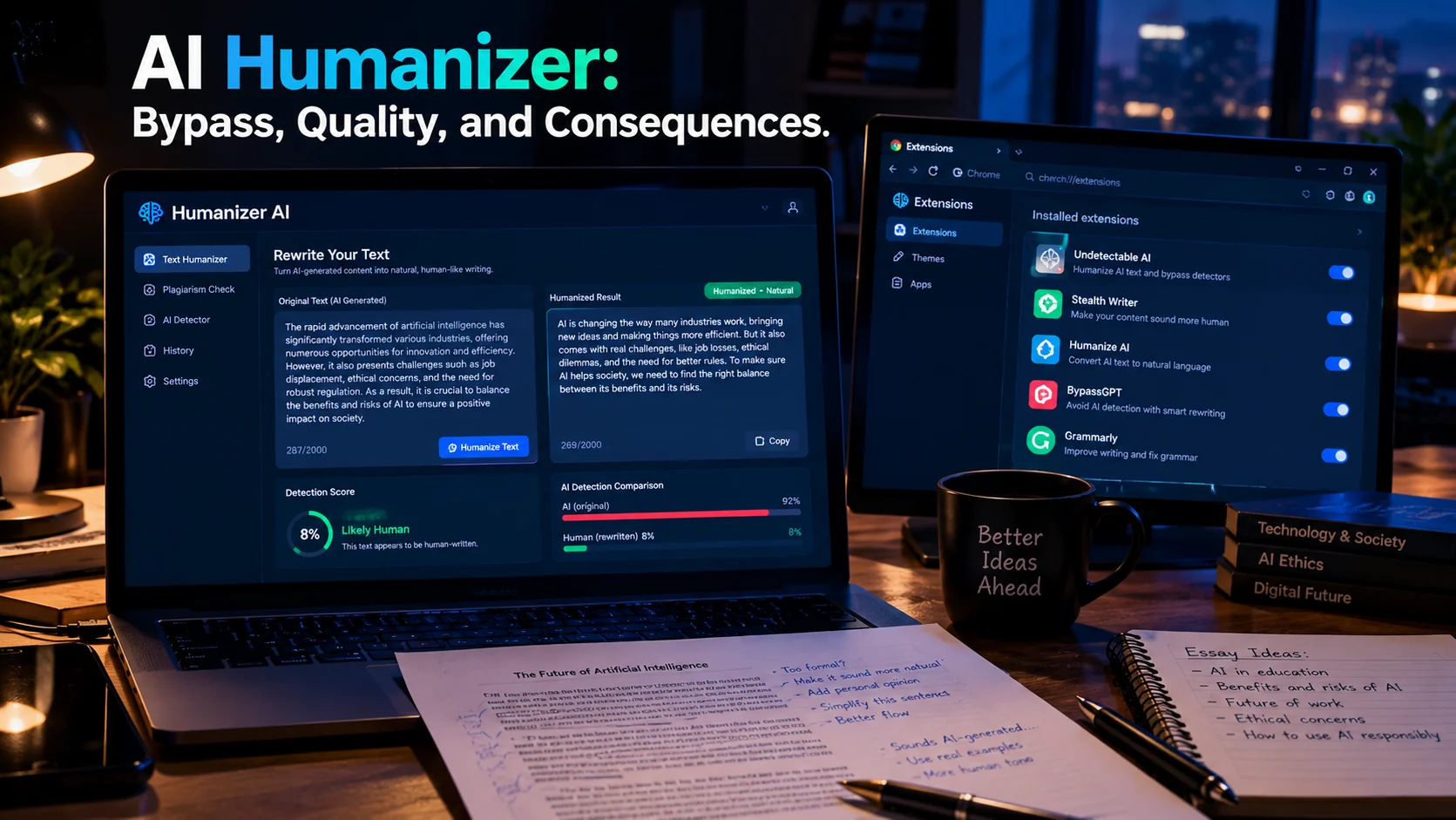
An AI humanizer is a tool that rewrites AI-generated text to reduce its detectability by AI detection systems. The category includes Chrome extensions, web apps, and Python libraries, with tools claiming to bypass Turnitin, GPTZero, and Originality.ai, though independent research shows detection accuracy is already unreliable and these claims are difficult to verify.
At-a-Glance: Key Takeaways
- The category is fragmented and unverified. Most AI humanizers are small Chrome extensions or web apps with fewer than 200 users and minimal independent testing .
- Claims center on bypassing detectors, not improving writing. Tools explicitly advertise success against Turnitin, GPTZero, Copilot, and other detection systems .
- Pricing ranges from free to roughly $20-$130 annually. Most tools use subscription models with limited free tiers .
- Academic research confirms AI detectors are unreliable. A study found up to 8% of pre-LLM scientific abstracts were falsely classified as AI-generated .
- Double humanization risks distorting meaning. Users report that running text through multiple tools can corrupt technical terms and require full manual review .
- Privacy policies vary but often claim no data retention. Most tools state user text is not stored, though verification is limited .
What Is an AI Humanizer?
An AI humanizer is a software tool that rewrites AI-generated text to make it appear human-written. The primary purpose is evasion: reducing the likelihood that AI detection systems will flag the content as machine-generated .
The category emerged in response to the proliferation of AI detectors in academic and professional settings. As AI writing tools like ChatGPT, Claude, and Gemini became ubiquitous, institutions adopted detection software to identify AI-generated submissions. Humanizers position themselves as the countermeasure .
Unlike paraphrasing tools that aim to improve clarity or change tone, humanizers are specifically engineered to defeat detection algorithms. They manipulate text at the statistical level, altering sentence structure, rhythm, and word choice to create patterns that mimic human writing .
How AI Humanizers Work
The Technical Approach
AI detectors look for patterns characteristic of language models: predictable sentence structures, low variance in sentence length, and specific vocabulary distributions. Humanizers attempt to disrupt these patterns .
The tools typically perform several transformations. They vary sentence length and rhythm, a property called “burstiness” that detectors use as a human signal. They restructure clauses and adjust information density. And they replace common AI phrasing with alternatives that are less statistically predictable .
Some tools combine these transformations with synonym substitution, though the more sophisticated humanizers claim to work at the “pattern level” rather than simple word swaps .
The Workflow
Most humanizers follow a simple three-step process. Users paste AI-generated text into the tool, select a mode (standard, academic, conversational, etc.), and receive rewritten output. Chrome extensions integrate this workflow directly into the browser, allowing users to select text on any webpage and humanize it with a right-click .
Some tools include built-in detectors, allowing users to check their humanized text before submission. Hastewire, for example, provides sentence-level scoring that highlights which parts still flag as AI-generated .
Major AI Humanizer Tools
Note on pricing: Prices vary by source and billing cycle. Annual plans offer significant discounts over monthly. Most free tiers are too limited for meaningful evaluation .
The Detection Arms Race
Detectors Are Unreliable
The premise of humanizers—that they help text “pass” detection—assumes detectors work reliably. Research suggests otherwise.
A study found that up to 8% of abstracts from respected scientific journals published before LLMs existed were falsely classified as AI-generated by detection tools . This false positive rate undermines the credibility of detection as a gatekeeping mechanism.
A 2026 GitHub analysis noted that Turnitin’s real-world detection rates have declined as models like GPT-5 and Claude Sonnet 4.5 produce more diverse language patterns. The analysis reports Turnitin detecting roughly 68% of raw GPT-5 output in German and 82% in English, dropping to under 10% after humanization .
The Bypass Claims
Humanizers advertise specific bypass rates. One GitHub comparison tested multiple tools against detectors including Turnitin, PlagScan, and Docoloc, reporting that Phrasly achieved a 6.1% score on Copyleaks and 4.3% on Docoloc, while other tools exceeded 9% .
These claims are difficult to verify independently. Detectors are updated frequently, typically every 4-8 weeks, meaning a tool’s bypass rate today may not hold tomorrow .
The Quality Trade-off
Jotform’s testing of GPTHuman revealed a critical problem. The tool achieved a 0% AI detection score on Copyleaks, but the humanized text was “poorly written,” with “extremely deficient sentence structure” and “distracting word choices” that required “a complete rewrite” to be usable .
This illustrates the core tension: a tool can defeat detection while producing text that fails basic quality standards. Passing a detector is not the same as producing good writing.
Who Uses AI Humanizers
Students are the primary market. Phrasly and similar tools explicitly target students concerned about AI detection in academic submissions . The ethical implications are significant: using a humanizer to disguise AI-generated work is a form of academic dishonesty.
Content agencies and freelancers use humanizers to process AI-assisted drafts for clients. The GitHub discussion describes freelancers using tools like Phrasly to bypass Copyleaks for agency work .
Professionals may use humanizers for emails, reports, or documents where AI assistance was used but detection would be undesirable.
Researchers studying AI detection and evasion use these tools to understand the limits of current detection systems .
Privacy and Security Considerations
Privacy practices vary across tools. Most claim not to store user text , but verification is limited.
Chrome extensions collect authentication information, and some process data through external APIs . The Humanize AI extension states data is “processed securely and never stored longer than necessary” .
Jade’s AI Humanizer can run locally with an offline mock engine, eliminating data transmission entirely. The PyPI package supports local REST API deployment .
Web-based tools process text on remote servers. Users should assume their text passes through third-party infrastructure and should not submit sensitive or confidential material.
Important distinction: No SOC 2 certification or similar compliance frameworks are referenced for these tools. They are consumer-grade products, not enterprise software.
Ethical and Academic Integrity Concerns
The AI humanizer category exists primarily to circumvent detection systems. This raises straightforward ethical questions.
In academic settings, submitting AI-generated work as one’s own is plagiarism. Using a humanizer to disguise that work does not change its nature; it adds a layer of deception .
Beyond academia, the tools contribute to a broader erosion of trust in written communication. If any text could be AI-generated and disguised, the value of written work as a signal of effort and understanding diminishes.
The research community has begun documenting these concerns. A study on AI text humanizing tools notes the “increased utilisation of these instruments prompts grave worries regarding the efficacy of existing standards pertaining to academic integrity” .
Common Mistakes and Cautions
Assuming detection bypass equals quality. GPTHuman’s 0% detection score came with text that required complete rewriting .
Overlooking detector updates. Detectors are updated every 4-8 weeks. A bypass that works today may fail next month .
Trusting marketing claims without verification. Most humanizers are small tools with unverified claims and minimal user bases .
Double humanizing without review. Running text through multiple tools can corrupt technical terms and meaning. Always manually review the output .
Using humanizers for sensitive content. Web-based tools process text remotely. Do not submit confidential or personal information.
Frequently Asked Questions
What is an AI humanizer?
An AI humanizer is a tool that rewrites AI-generated text to reduce its detectability by AI detection systems. It manipulates sentence structure, rhythm, and word choice to mimic patterns characteristic of human writing .
Do AI humanizers actually work?
They can reduce detection scores in some cases, but results are inconsistent and detectors are updated frequently. Independent testing shows wide variation in effectiveness, and some tools produce low-quality output even when they achieve low detection scores .
Are AI humanizers ethical?
Using them to disguise AI-generated work in academic or professional settings is a form of deception. The category exists primarily to evade detection, which raises significant integrity concerns .
How much do AI humanizers cost?
Pricing ranges from free tiers with severe limitations to roughly $20/month or $130/year for unlimited use. QuillBot Premium is around €8.33/month annually, Phrasly around $10.99/month, and Humbot around $7.99-$9.99/month .
What are the best AI humanizer alternatives?
Alternatives depend on the goal. For improving writing quality, use a paraphraser or editor. For genuine human writing, write it yourself. For understanding detection limits, tools like GPTHuman or Phrasly can be tested, but results should be verified independently .
Conclusion
The AI humanizer category is a response to unreliable AI detection. Detectors produce false positives, struggle with modern models, and are updated frequently. Humanizers exploit these weaknesses, offering to rewrite AI text so it passes detection.
What matters most is recognizing what these tools are and are not. They are detection evasion tools, not writing improvement tools. Their success is measured by bypass rates, not output quality. Some achieve low detection scores while producing text that requires complete rewriting. The category is fragmented, unverified, and ethically fraught.
AI humanizers may suit researchers studying detection systems or users seeking to understand the limits of current technology. They may not suit anyone concerned with academic integrity, writing quality, or the ethical implications of disguising AI-generated work.
Before using any humanizer, consider whether the goal is legitimate. If you need to improve AI-assisted writing, use an editor. If you need to produce original work, write it yourself. If you need to bypass detection, understand that you are participating in an arms race with tools that are already unreliable and that your success may be temporary.