“Humanizar AI” is the Spanish and Portuguese term for “humanize AI,” referring to tools and techniques that rewrite AI-generated text to sound more natural and evade AI detectors. Research from the University of Notre Dame found that 96% of AI-generated texts passed through humanizing software slipped past detection, while the same study found human-written text edited by AI was frequently flagged as artificial .
At-a-Glance: Key Takeaways
- The term is multilingual. “Humanizar AI” is the Spanish/Portuguese equivalent of “humanize AI,” reflecting strong interest in Spanish-speaking markets .
- Detection bypass works surprisingly well. A Notre Dame study found 96% of humanized AI texts evaded detection, while AI-assisted human writing was often falsely flagged .
- **Prices range from free to $50/month.** Free tiers exist, but premium plans typically run $10 to $50 monthly depending on features and word limits .
- Evernote offers a humanizer with a 10,000-word limit. It processes 50+ languages, deletes data within 30 days, and is positioned for academic and professional writing .
- App Store reviews reveal reliability issues. Common complaints include errors, inconsistent detection scores, and subscription billing confusion .
- Open-source alternatives exist. Projects like Humanizer X and StealthHumanizer offer free options but require technical setup .
What Does “Humanizar AI” Mean?
“Humanizar AI” is the Spanish and Portuguese phrase for “humanize AI.” It describes the process of transforming text generated by artificial intelligence into content that reads as if a person wrote it. The term has become a category name for a growing class of software tools called AI humanizers.
These tools target the statistical fingerprints that AI models leave behind. Large language models tend to produce text with predictable sentence structures, repetitive phrasing patterns, and a distinctive rhythm that AI detectors can identify. Humanizers rewrite that text, varying sentence length, injecting colloquialisms, and breaking up the regular patterns that detectors flag .
The demand for these tools comes from several directions. Students worry that AI-assisted essays will be flagged. Content marketers want AI-generated copy to pass as human-authored. Professionals using AI to draft emails and reports want the output to feel less robotic .
How AI Humanizers Work
The Statistical Fingerprint Problem
AI detectors do not look for specific words. They analyze statistical properties of text: perplexity, which measures how predictable word choices are, and burstiness, which measures variation in sentence structure and length .
Human writing has high burstiness. A person might write a short, punchy sentence followed by a longer, more complex one. AI writing tends toward uniformity. Humanizers manipulate these statistical properties to make AI text look more like human writing .
Rewriting Strategies
Different tools use different approaches. Simple humanizers perform word-level substitutions, swapping formal vocabulary for casual alternatives. More sophisticated tools restructure entire sentences, break long constructions into shorter ones, and remove the “triple rhythm” pattern that ChatGPT and similar models favor .
Humanizer X, an open-source project, describes a four-pass architecture: pattern detection, statistical fingerprint manipulation, voice integration, and verification. The claim is that this approach beats detectors by operating at the same statistical level detectors use, rather than just swapping words .
Detection Verification
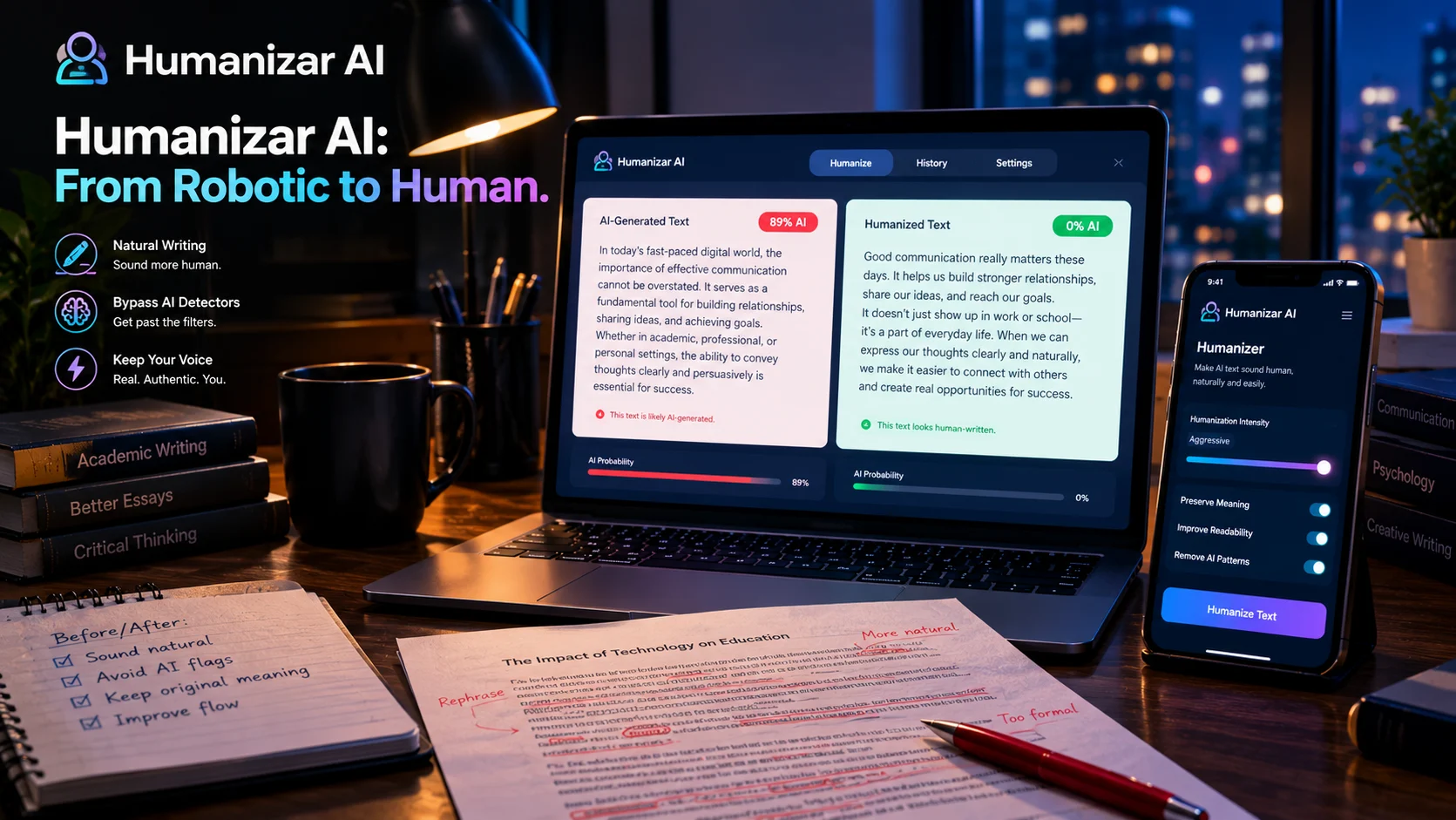
Most humanizer tools include a detection feature. Users paste their text, humanize it, then check whether the output passes AI detection. This creates a feedback loop that helps users adjust intensity levels. HumanizerAI’s API documentation describes three intensity settings: light for subtle changes, medium for balanced rewriting, and aggressive for maximum bypass .
Major Humanizer Tools Compared
Research: Does Humanizing Actually Work?
A study presented at an AI summit in Atlanta and reported by Franceinfo provides the most direct evidence available .
The Findings
Researchers from the University of Notre Dame tested two AI detectors against a set of texts. The results were stark:
- Detectors performed well on raw AI text. They correctly identified text written entirely by AI.
- Humanized AI text evaded detection 96% of the time. Once passed through humanizing software, the vast majority of AI-generated texts slipped past the detectors.
- AI-assisted human writing was frequently flagged. When human authors used AI to polish their own text, detectors flagged it as artificial in the majority of cases.
What This Means
The study reveals a perverse outcome. The “candide” who uses AI as a writing assistant gets caught. The person deliberately using AI and then humanizing the output evades detection. As the reporter noted, this is “not a very moral conclusion” .
This finding challenges the reliability of AI detection as a gatekeeping mechanism. If humanizers work as effectively as the research suggests, detection-based enforcement becomes difficult to sustain.
User Reviews: What Real People Report
App Store reviews for humanizer apps reveal a gap between marketing claims and user experience.
Positive Feedback
Some users report dramatic detection score improvements. One reviewer claimed their essay went “from 89% AI to 0% AI” . Another praised the interface and voice input features .
Common Complaints
Negative reviews cluster around several issues:
- Reliability errors. “This is a phenomenal app when it works. Unfortunately, I get ‘error’ messages far too often for it to be a reliable tool” .
- Inconsistent detection. “First it said it was AI and then I redid it again and then it said it wasn’t” .
- Billing confusion. “I was gonna cancel the subscription and it still took the money” .
- Quality problems. “It put random numbers and made up words into my essay along with random fully capitalized words” .
The Reliability Pattern
The pattern suggests that humanizer apps can work well under ideal conditions but struggle with consistency, edge cases, and billing transparency. For users who need dependable output, this inconsistency is a significant risk.
Privacy and Data Handling
Privacy practices vary across humanizer tools, and this matters when processing sensitive academic or professional content.
Evernote AI Humanize states that content is processed only to complete the humanization request, is not used for AI training, and is deleted from servers within 30 days. The tool supports 10,000-word documents and 50+ languages .
Humanize AI Chrome extension claims data “is processed securely and never stored longer than necessary,” but does not specify retention periods or security certifications .
HumanizerAI provides API documentation and agent skills, but available public materials do not detail data retention policies or compliance frameworks like SOC 2 .
Important distinction: SOC 2 certification does not automatically mean zero data retention. None of the tools reviewed here make explicit ZDR claims. Users with strict privacy requirements should review each tool’s full policy before processing confidential content.
Who Should Consider AI Humanizers
Content marketers and bloggers producing high volumes of AI-assisted copy may use humanizers to make drafts feel less formulaic. The statistical-level rewriting can improve readability.
Non-native English speakers using AI to draft professional communication may find humanizers help the text sound more natural .
Students face a more complex situation. The Notre Dame research suggests humanizers work, but the ethical and academic integrity questions remain unresolved. Institutions vary in their policies on AI assistance.
Developers and technical teams may prefer open-source options like Humanizer X, which offers free access without subscription constraints .
Anyone processing sensitive content should weigh the privacy trade-offs. Cloud-based humanizers require uploading text to third-party servers.
Common Mistakes and Cautions
Assuming all humanizers work equally. The research shows humanizers beat detectors at high rates, but app reviews reveal significant reliability variance. A tool that works on one text may fail on another.
Ignoring the ethical dimension. Using humanizers to deceive detectors on academic work or professional submissions raises integrity questions. The Notre Dame study’s finding that humanized AI text evades detection does not make the practice appropriate in all contexts.
Underestimating subscription risks. App Store reviews describe billing confusion, difficulty canceling, and charges after cancellation . Verify cancellation terms before subscribing.
Expecting perfect detection bypass. The 96% evasion rate means 4% of humanized texts still get caught. For high-stakes submissions, even a small failure rate is a risk.
Overlooking free alternatives. Humanizer X and StealthHumanizer offer free, open-source options. Paid tools are not the only path .
Frequently Asked Questions
What does “humanizar AI” mean?
“Humanizar AI” is Spanish and Portuguese for “humanize AI.” It refers to tools and techniques that rewrite AI-generated text to sound more natural and evade AI detectors. The term is widely used in Spanish-speaking markets .
Do AI humanizers actually work?
Research from the University of Notre Dame found that 96% of AI-generated texts passed through humanizing software evaded detection. However, the same study found human-written text edited by AI was frequently flagged as artificial. App reviews also reveal reliability issues with commercial humanizers .
How much do AI humanizers cost?
Most tools offer free tiers with word limits. Premium plans typically range from $10 to $50 per month, depending on features and usage limits. HumanizerAI charges $19.99/month for 50,000 words, while some iOS apps charge $7.99 monthly .
Are AI humanizers safe to use?
Privacy practices vary. Evernote deletes data within 30 days and does not use content for training. Other tools provide less clear disclosures. Users processing sensitive content should review each tool’s privacy policy before uploading text .
What are the best free AI humanizer tools?
Open-source options include Humanizer X (4-pass architecture) and StealthHumanizer (35+ providers, 16+ languages). Both are free but require technical setup. HumanizerAI offers free AI detection, though humanization consumes credits .
Conclusion
“Humanizar AI” describes a category of tools that rewrite AI-generated text to sound human and evade detection. The research suggests they work remarkably well at the evasion task: 96% of humanized AI texts slipped past detectors in the Notre Dame study .
What matters most is understanding the trade-offs. Detection bypass creates an ethical gray area, particularly in academic contexts. Commercial tools vary widely in reliability, with app reviews revealing errors, inconsistent scores, and billing confusion. Privacy practices are often unclear, and no reviewed tool claims zero data retention.
AI humanizers may suit content professionals who want AI-assisted drafts to sound more natural, non-native speakers polishing professional communication, and developers willing to use open-source options. They may not suit anyone processing sensitive content without reviewing privacy policies, users who need guaranteed reliability, or those uncomfortable with the ethical implications of detection evasion.
Before using any humanizer, test it on a sample text and verify the output quality yourself. Review the privacy policy. Understand the subscription terms. And consider whether the goal is improving readability or deceiving detection. Those are different objectives with different ethical weights.