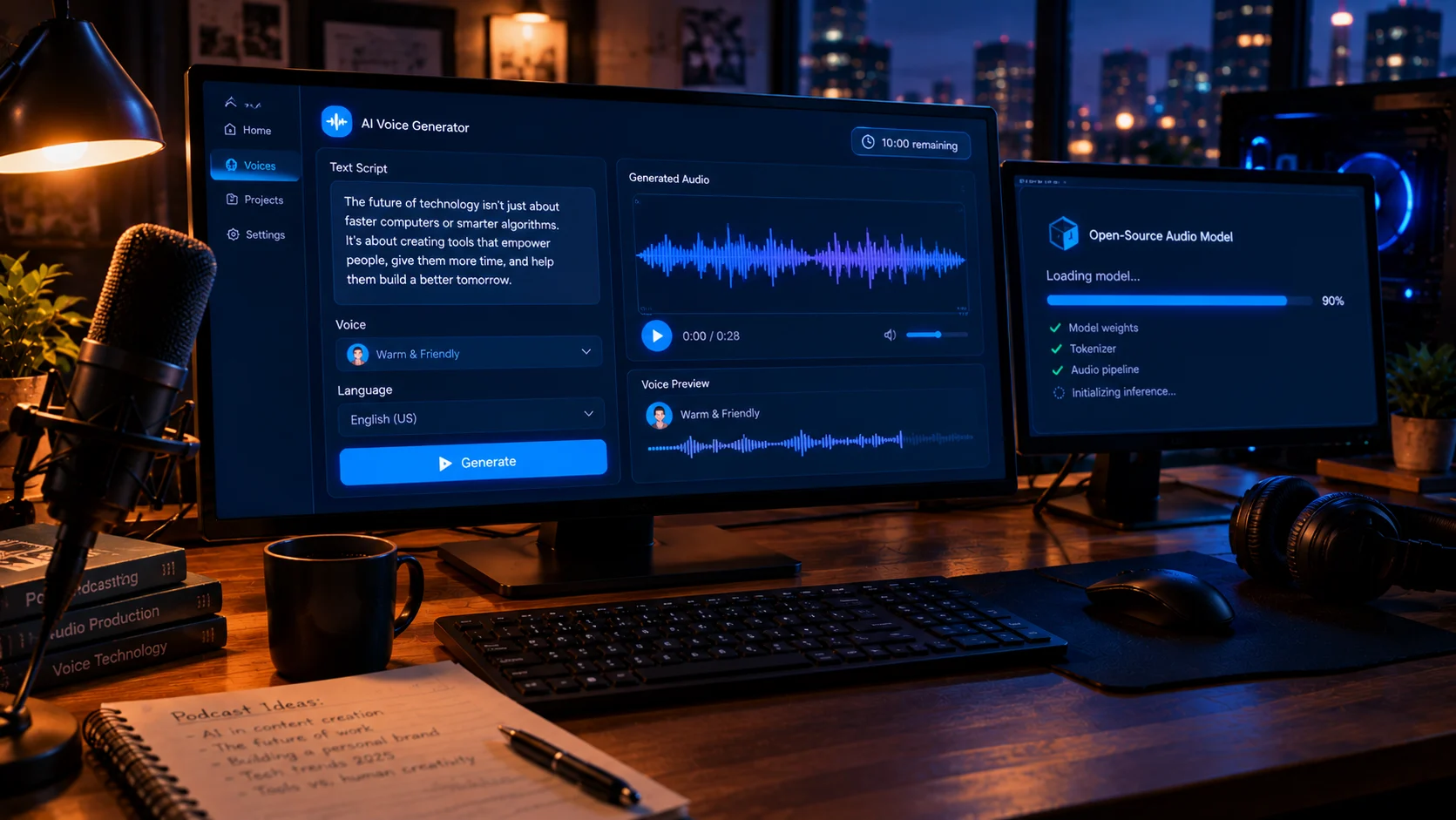
A free AI voice generator converts text into spoken audio without upfront payment, but free tiers in 2026 impose strict limits on minutes, commercial rights, and voice selection. ElevenLabs offers roughly 10 minutes monthly with no commercial use, Murf provides 10 total minutes with no download, and TTSMaker stands out by permitting commercial use without attribution .
At-a-Glance Box
- Free minutes are scarce. ElevenLabs allows about 10 minutes monthly. Murf gives 10 minutes total, not monthly. PlayHT offers 10,000 monthly credits, roughly 12.5 minutes .
- Commercial rights are the hidden divide. ElevenLabs, Murf, Fish Audio, and WellSaid prohibit commercial use on free plans. TTSMaker and Chatterbox permit it .
- Murf’s free tier cannot export. You can hear your voiceover but not download it, making the free plan useless for any published work .
- ElevenLabs trains on free-tier data by default. Opting out requires a manual toggle, and Zero Retention Mode is Enterprise-only .
- Open-source models eliminate every restriction. Kokoro and Chatterbox run locally with no caps, no watermarks, and no data leaving your machine.
- TTSMaker is the most practical free hosted option for commercial work. Unlimited downloads, no attribution, no credit card, subject to character-per-generation limits .
What “Free” Actually Means for AI Voice Generators
The search for a free AI voice generator usually starts with a specific need. You want to narrate a short video, test a voice for a project, or create an audio version of a blog post without committing to a subscription. The results page promises “free AI voices” dozens of times without explaining what that phrase includes.
The reality is more constrained. Every free tier imposes three limits: a generation cap, a rights restriction, and often a voice-quality penalty. Some platforms watermark output. Others prohibit commercial use entirely. A few let you hear the result but not download it. Understanding these boundaries before investing time is the difference between a useful test and a wasted afternoon.
This guide maps the current free tier landscape as of late 2026. It covers what each major platform delivers, what it quietly withholds, and which tools match which use cases.
How Free Tiers Actually Work
The Minute and Credit Landscape
Free allowances follow three models. Monthly refills reset each cycle and never accumulate. One-time grants appear at signup and vanish after use. Character-based caps limit how much text you can convert per generation, regardless of total minutes.
ElevenLabs provides about 10 minutes of audio per month on its free tier, tracked through a 10,000-credit allowance where standard text-to-speech consumes roughly one credit per character . Murf offers 10 minutes of voice generation total, not monthly, meaning the allowance never replenishes . PlayHT grants 10,000 credits monthly, roughly 12.5 minutes of audio, with a single voice-clone slot .
TTSMaker takes a different approach. Rather than limiting total minutes, it caps each generation at 1,000 characters with the default voice while allowing unlimited downloads and commercial use . Narakeet permits 20 free audio files without registration, limited to 1 KB scripts and explicitly noncommercial .
The practical math matters more than the headline number. Murf’s 10 total minutes disappear after a single podcast intro. ElevenLabs’ monthly 10 minutes support one or two short narrations before the reset.
Commercial Rights and Ownership
This is where free tiers diverge most sharply, and where reading the terms of service becomes essential.
ElevenLabs, Murf, Fish Audio, and WellSaid all prohibit commercial use on their free plans. ElevenLabs additionally requires attribution even for noncommercial sharing . TTSMaker stands apart by permitting commercial use with no attribution required . PlayHT’s pricing page does not clearly grant commercial rights for its free Starter plan, so free output should be treated as evaluation material unless the account terms explicitly authorize publication .
Chatterbox, an open-source model from Resemble AI, permits commercial use under an MIT license, though output carries a built-in audio watermark .
The distinction between “free to generate” and “free to publish” determines whether a tool is a sandbox or a workspace.
Voice Quality and Model Access
Free tiers often restrict access to premium voices. ElevenLabs provides its best voice models to free users, but the monthly cap makes sustained use impractical . Speechify’s free plan includes only 10 robotic voices, reserving its natural-sounding and celebrity voices for paying customers . Murf offers access to its voice library for preview, but since free users cannot download, the quality is academic.
Google Cloud Text-to-Speech offers a substantial monthly free usage limit, including up to one million characters for several advanced voice classes, but requires billing to be enabled and charges automatically for overages . This suits developers testing integrations, not casual users.
Platform-by-Platform Breakdown
| ElevenLabs | ~10 min/month | Prohibited | Yes, with attribution | Tiny quota, training on by default |
| Murf | 10 min total | Prohibited | No | Cannot export free audio |
| PlayHT | ~12.5 min/month | Unclear | MP3 | Commercial rights ambiguous |
| TTSMaker | Unlimited downloads | Permitted | Yes | 1,000 characters per generation |
| Narakeet | 20 files, no account | Prohibited | Yes | 1 KB script limit, noncommercial |
| Speechify | 10 basic voices | Restricted | Limited | Robotic voices only |
ElevenLabs: Best Voices, Worst Free Terms
ElevenLabs produces the most natural-sounding voices in the market. Independent testing consistently places its models at or near the top of quality benchmarks . The free tier provides access to these voices, which makes the platform useful for evaluating whether the quality justifies a subscription.
The restrictions are severe. Ten minutes per month supports one or two short narrations. Commercial use is prohibited. Attribution is required even for personal sharing . More concerning, ElevenLabs uses free-tier data for model training by default. Opting out requires a manual toggle that only applies prospectively, and Zero Retention Mode is reserved for Enterprise customers .
For users who need to hear what premium AI voices sound like before paying, ElevenLabs delivers. For anyone needing usable output, the free tier does not.
Murf: Preview Without Export
Murf’s free tier is the most restrictive in the hosted market. The 10-minute allowance is a one-time total, not monthly. More critically, free users cannot download any generated audio . You can hear the voiceover in the browser, adjust pitch and emphasis, and evaluate whether the editor suits your workflow. You cannot use the result.
Murf’s strength is its full voiceover editor with pronunciation libraries and integrations with Canva, Google Slides, and Adobe Audition . Those features are available to free users for evaluation. They become useful only after upgrading to the Creator plan at $29 monthly .
For anyone who needs actual audio files, Murf’s free tier is a demo, not a tool.
TTSMaker: The Commercial Exception
TTSMaker offers what no other hosted platform does: unlimited downloads, commercial rights, no attribution requirement, and no credit card . The tradeoff is granularity. Each generation is capped at 1,000 characters with the default voice, so longer scripts must be split into sections and assembled afterward .
For short narration, social media clips, and any project where the character limit fits the script, TTSMaker delivers usable output at zero cost. The voice quality does not match ElevenLabs or Murf, but the licensing terms are unambiguous and the downloads are unrestricted.
If commercial use matters and the budget is zero, TTSMaker is the most practical hosted option.
PlayHT: Recurring Credits, Ambiguous Rights
PlayHT’s Starter plan provides 10,000 credits monthly, roughly 12.5 minutes of audio, with MP3 output and a single voice-clone slot . The monthly reset makes it more sustainable than Murf’s one-time allowance.
The problem is licensing clarity. PlayHT’s public pricing page does not explicitly grant commercial rights for Starter plan output. The terms suggest free output should be treated as evaluation or personal-use material unless the account terms authorize publication . For anyone planning to monetize the audio, this ambiguity is a risk.
PlayHT suits users who need recurring free credits for personal projects and can accept the licensing uncertainty. For commercial work, the lack of clarity is disqualifying.
The Open-Source Alternative: Genuinely Free, Genuinely Unrestricted
The only structurally free AI voice generation comes from open-source models running on your own hardware. No platform policy governs output, no watermark applies, and no credit system limits iteration.
Kokoro is an 82-million-parameter model under Apache 2.0 that generates studio-quality speech nearly 100 times faster than real-time on a GPU. It supports multiple languages and produces natural, expressive voices . Chatterbox from Resemble AI excels at voice cloning from short reference audio, includes a built-in watermark for responsible use, and is MIT licensed with no commercial restrictions .
Mistral’s Voxtral TTS, released in March 2026, is an open-weight model supporting nine languages with zero-shot voice cloning from samples under five seconds. It is available on Hugging Face and can run locally, eliminating privacy concerns about sending voice samples to external services .
The tradeoff is hardware and setup. A capable GPU, Python environment, and comfort with command-line tools are prerequisites. Cloud GPU rentals offer a middle path, but that is not free either. For users with the technical comfort, local generation eliminates every restriction described above.
Privacy and Data Considerations
Free AI voice generators process everything you send them: the text you paste, the voice samples you upload, and the audio you generate. What happens to that data varies by provider.
ElevenLabs uses free-tier audio and text for model training by default. Opting out requires a manual toggle, and the opt-out applies only prospectively, meaning data already submitted may have been used. Zero Retention Mode is Enterprise-only. Data is stored in the U.S. by default .
TTSMaker’s privacy policy is not clearly documented in available sources, but its commercial-use allowance suggests a different business model than training on user data. PlayHT and Murf operate as commercial platforms with enterprise clients, implying formal data handling, but free-tier specifics remain vague.
No major free AI voice generator publicly commits to Zero Data Retention on free accounts. SOC 2 certification, where present, addresses organizational controls rather than whether individual inputs are retained. Assume free-tier text and audio are stored for some period unless the provider explicitly states otherwise.
Common Mistakes With Free AI Voice Generators
Burning the monthly quota on test generations. ElevenLabs’ 10 minutes disappear quickly if you iterate on pronunciation and pacing. Draft your script first, then generate once with the final text.
Assuming “free” means “commercial.” ElevenLabs, Murf, Fish Audio, and WellSaid prohibit commercial use on free plans. Murf cannot even export. The absence of a watermark does not imply permission to publish.
Overlooking the character limit. TTSMaker’s unlimited downloads come with a 1,000-character cap per generation. A 2,000-word blog post requires splitting and reassembly. Plan for the workflow.
Ignoring training defaults. ElevenLabs trains on free-tier data unless you toggle the opt-out. If your text contains sensitive information, the free tier is the wrong environment.
Expecting consistent quality across voices. Speechify’s free plan includes only robotic voices. ElevenLabs provides premium voices but limits volume. Quality and quantity rarely coexist on free tiers.
Who Should Use a Free AI Voice Generator
Creators testing voice quality should use ElevenLabs’ monthly allowance to hear premium voices before subscribing. Ten minutes is enough to evaluate whether the quality justifies the cost.
Anyone needing commercial output on a zero budget should use TTSMaker. The unlimited downloads and commercial rights make it the only hosted option that permits published work without payment.
Developers prototyping integrations can use Google Cloud Text-to-Speech’s free tier for its large character allowance, accepting the billing requirement and overage risk.
Users with technical skills and privacy concerns should explore Kokoro, Chatterbox, or Voxtral TTS locally. The setup cost pays for itself in unrestricted generation and zero data exposure.
Anyone needing volume should recognize that no hosted free tier provides it. Rotating free tiers across platforms yields perhaps 30 to 40 minutes monthly, enough for one video, not a production workflow .
Latest Developments Worth Watching
The free tier landscape shifted in 2026. Mistral released Voxtral TTS as an open-weight model in March, offering voice cloning and nine-language support without cloud dependency . ElevenLabs launched v4 and v4 Turbo in late 2026, making the new models available to free accounts, but the monthly credit cap remained unchanged .
The broader trend is toward tighter free allowances. As inference costs remain significant and voice cloning raises regulatory questions, providers face pressure to convert free users into paying customers. The 10-minute monthly cap may not persist indefinitely.
Regulatory pressure is also mounting. Voiceprints are treated as biometric data under GDPR and similar regimes, imposing consent and retention obligations that free tiers are poorly positioned to satisfy . Platforms may tighten free-tier data handling in response, limiting what free users can do with cloned voices.
Conclusion
A free AI voice generator is a constrained tool, not a hidden bargain. The free tiers from ElevenLabs, Murf, PlayHT, and TTSMaker provide genuine access to capable models, but each imposes limits on minutes, rights, or export that determine what you can actually do with the output.
What matters most is matching the free tier to your intent. If you need to evaluate premium voice quality before subscribing, ElevenLabs delivers. If you need commercial output without payment, TTSMaker is the only hosted option that permits it. If you need recurring credits for personal projects, PlayHT’s monthly allowance works, provided you accept the licensing ambiguity. And if you need unrestricted generation without platform oversight, local open-source models are the only honest answer.
Before committing to any free tier, verify three things directly on the platform: the current monthly or total allowance, the commercial-use policy for free accounts, and whether your text or voice samples are used for training. These details change frequently, and the free tier described in any review may not match the one you encounter at signup.