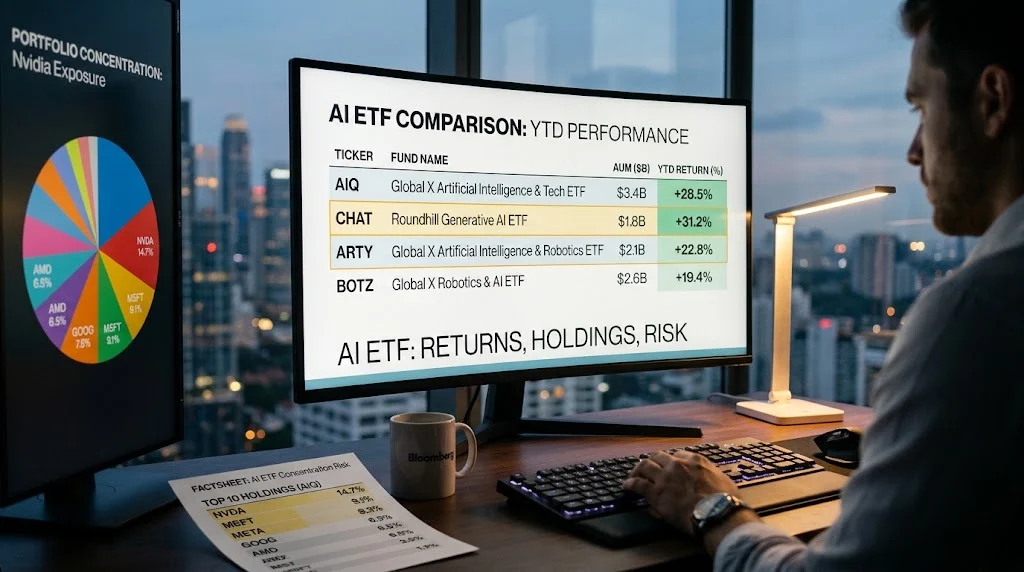
The best AI ETF depends on your definition of “AI.” The Global X Artificial Intelligence & Technology ETF (AIQ) is the largest dedicated AI fund with roughly $10 billion in assets, the Roundhill Generative AI & Technology ETF (CHAT) targets generative AI applications, and the iShares Future AI & Tech ETF (ARTY) offers diversified exposure with a lower expense ratio. Returns vary dramatically, from CHAT’s 57% year-to-date gain to BOTZ’s modest 4.4% return.
At-a-Glance: Key Takeaways
- AIQ is the largest dedicated AI ETF with approximately $10.16 billion in AUM and a 0.68% expense ratio, holding about 90 stocks with Nvidia representing less than 3% of the portfolio .
- CHAT focuses on generative AI with 49 holdings, top five positions at 26.7% of the portfolio, and a 0.75% expense ratio. It returned 57.2% year-to-date in 2026 .
- ARTY offers diversified AI exposure with 52 holdings, a 0.47% expense ratio, and a 63.4% year-to-date return. Its top 10 holdings account for 40.7% of assets .
- BOTZ is a robotics fund, not a pure AI fund, with 9.81% in ABB and 9.57% in Keyence. It returned just 4.4% year-to-date in 2026 .
- Concentration risk varies wildly. SMH has 21% in Nvidia and 69% in its top 10. AIQ has less than 3% in Nvidia and 33% in its top 10 .
- Expense ratios range from 0.35% to 1.00%, with European UCITS options often cheaper than US-listed equivalents .
What Is an AI ETF?
An AI ETF is an exchange-traded fund that holds a basket of companies tied to artificial intelligence. But “tied to AI” is a broad label. Some funds own the chipmakers building AI infrastructure. Some own the software companies deploying generative AI. Some own robotics firms that use AI as one tool among many.
The result is a category where funds sharing the same label have produced wildly different returns. The ETF.com comparison of CHAT, BOTZ, and AIS found returns ranging from +122% to +1% in the first half of 2026, with almost entirely different holdings beneath the shared branding .
The search intent is commercial investigation. Investors want to know which AI ETF is worth buying, what the risks are, and how the funds actually differ.
The Major AI ETFs Compared
AIQ: The Largest Dedicated AI ETF
AIQ is the default choice for investors seeking broad AI exposure with lower concentration risk. It holds approximately 90 stocks, with its top 10 accounting for around 33% of assets. Nvidia represents less than 3% of the portfolio .
The fund tracks the Indxx Artificial Intelligence & Big Data Index. Its largest holding is Palantir at 3.82% weightage, followed by other AI and data-focused companies .
The trade-off: AIQ’s diversification means it will not capture the full upside of a concentrated bet on a single AI winner. The ETF’s 25.3% year-to-date return in 2026 trails CHAT and ARTY, both of which returned over 55% . But its lower concentration also means less downside if a single company disappoints.
Who it suits: Investors who want AI exposure without making a concentrated bet on Nvidia, Microsoft, or any single company.
CHAT: The Generative AI Play
CHAT is an actively managed fund focused on companies building, running, and commercializing generative AI. It holds 49 stocks, with its top five positions accounting for 26.7% of the portfolio .
The top holdings tell the story: Alphabet (7.53%), Nvidia (6.11%), Microsoft (5.13%), Meta Platforms (4.28%), and Palantir (3.67%) . These are the companies most directly associated with the ChatGPT era: hyperscalers, chip designers, and AI application developers.
The trade-off: CHAT’s concentration in mega-cap tech means it is as much a bet on continued Big Tech dominance as it is on AI specifically. The 0.75% expense ratio is higher than AIQ’s 0.68% and ARTY’s 0.47% . The fund’s 57.2% year-to-date return in 2026 rewarded that concentration .
Who it suits: Investors who believe the largest tech companies will capture most of the generative AI value and are comfortable with concentrated exposure.
ARTY: Diversified AI with Lower Fees
ARTY targets companies involved in AI and related technologies across developed and emerging markets. It holds 52 stocks, with its top 10 accounting for 40.7% of assets .
The top holdings differ from CHAT’s: Advanced Micro Devices (5.48%), Vertiv Holdings (5.25%), Advantest Corp (4.06%), and Broadcom (3.96%) . The fund places heavier emphasis on data center infrastructure and chip suppliers than on the hyperscalers themselves.
The trade-off: ARTY’s 0.47% expense ratio is the lowest among the major US-listed AI ETFs . Its 63.4% year-to-date return in 2026 was among the strongest . But the fund’s Hold consensus from analysts suggests the market sees limited upside from current levels .
Who it suits: Investors who want AI exposure with a lower fee and less concentration in the mega-cap tech names that dominate CHAT.
BOTZ: The Robotics Fund Masquerading as AI
BOTZ is the oldest fund on this list, launched in 2016 when “AI” meant something different. Its top holdings are ABB (9.81%), Keyence (9.57%), Fanuc (9.00%), Nvidia (8.51%), and Intuitive Surgical (6.35%) .
This is not a software AI portfolio. It is a factory-floor automation portfolio. The fund returned just 4.4% year-to-date in 2026, compared to CHAT’s 57.2% and ARTY’s 63.4% .
The trade-off: BOTZ offers exposure to industrial automation and robotics, which are AI-adjacent but not pure AI plays. The fund’s 0.68% expense ratio is reasonable, but its 4.4% return in a year when other AI funds doubled suggests the market is not rewarding this exposure .
Who it suits: Investors who want robotics and industrial automation exposure, not pure AI.
The Concentration Risk Nobody Mentions
The most important question for any AI ETF is not its return. It is what it owns.
The Benzinga analysis of AI ETF concentration found stark differences. The VanEck Semiconductor ETF (SMH) has 21% in Nvidia and 69% in its top 10 holdings. If hyperscaler AI spending slows by 20%, SMH is the most vulnerable fund in the category .
By contrast, AIQ holds approximately 90 stocks, with its top 10 at around 33% and Nvidia at less than 3% . A spending slowdown would hit AIQ far less severely.
This matters because the AI buildout is driven by a small group of hyperscalers: Microsoft, Amazon, Alphabet, and Meta. Goldman Sachs estimates AI infrastructure spending will reach $527 billion in 2026 . If those companies reduce spending, the suppliers whose revenue depends on that spending will feel it first.
The concentration risk is not just about individual stocks. It is about the underlying customer base. A fund heavily weighted toward Nvidia is a fund heavily weighted toward the spending decisions of four companies.
Who Should Use Which AI ETF
Investors seeking broad AI exposure with lower concentration risk should consider AIQ. Its 90 holdings and less than 3% Nvidia weighting make it the most diversified option among the major AI ETFs .
Investors who believe generative AI will be dominated by Big Tech should consider CHAT. Its top holdings are the companies most directly building and monetizing large language models .
Investors seeking AI exposure with a lower fee should consider ARTY. Its 0.47% expense ratio and diversified holdings offer a middle ground between AIQ and CHAT .
Investors interested in robotics and industrial automation should consider BOTZ or ROBO, understanding that these are not pure AI plays and have underperformed pure AI funds in 2026 .
European investors have UCITS options including Xtrackers AI & Big Data (0.35% OCF, largest European AI ETF by AUM) and L&G Artificial Intelligence (0.49% OCF, best 12-month performance in the UCITS panel at 50.93%) .
Common Mistakes and Cautions
Assuming all AI ETFs are the same. CHAT, BOTZ, and AIS share the AI label but returned +57%, +4%, and +122% respectively in 2026. The holdings are almost entirely different .
Ignoring concentration risk. SMH has 21% in Nvidia. AIQ has less than 3%. A 20% slowdown in hyperscaler spending would affect them very differently .
Confusing robotics with AI. BOTZ is a robotics fund. Its top holdings are industrial automation companies. If you want generative AI exposure, BOTZ is not the right fund .
Overlooking expense ratios. They range from 0.35% (Xtrackers UCITS) to 1.00% (KraneShares). Over a decade, the difference compounds significantly .
Chasing past returns. The VistaShares AI Supercycle ETF (AIS) returned 122% in H1 2026, but it is concentrated in semiconductors and power infrastructure. High returns in one period do not guarantee future performance .
Frequently Asked Questions
What is the best AI ETF overall?
There is no single best. AIQ is the largest and most diversified with less than 3% Nvidia exposure. CHAT offers concentrated generative AI exposure. ARTY provides diversified AI at a lower 0.47% fee. The best depends on whether you prioritize diversification, concentration, or cost .
Which AI ETF has the highest return?
The VistaShares AI Supercycle ETF (AIS) returned 122% in H1 2026, and ARTY returned 63.4% year-to-date. CHAT returned 57.2%. Returns vary dramatically based on what part of the AI economy the fund targets .
What is the difference between AIQ and CHAT?
AIQ holds approximately 90 stocks with Nvidia at less than 3%, making it broadly diversified. CHAT holds 49 stocks with top holdings including Alphabet, Nvidia, Microsoft, and Meta, making it more concentrated in the companies directly building generative AI .
Is BOTZ a good AI ETF?
BOTZ is a robotics and industrial automation fund, not a pure AI fund. Its top holdings are ABB, Keyence, and Fanuc. It returned just 4.4% year-to-date in 2026 while pure AI funds returned over 50% .
What are the best AI ETFs for European investors?
UCITS options include Xtrackers AI & Big Data (0.35% OCF, largest European AI ETF by AUM) and L&G Artificial Intelligence (0.49% OCF, best 12-month return at 50.93%). These are not available to US investors .
Conclusion
The best AI ETF depends on what you think “AI” means and how much concentration you can tolerate. AIQ offers broad exposure with less than 3% in Nvidia. CHAT bets on the mega-cap companies building generative AI. ARTY balances diversification with a lower fee. BOTZ is a robotics fund that happens to use AI.