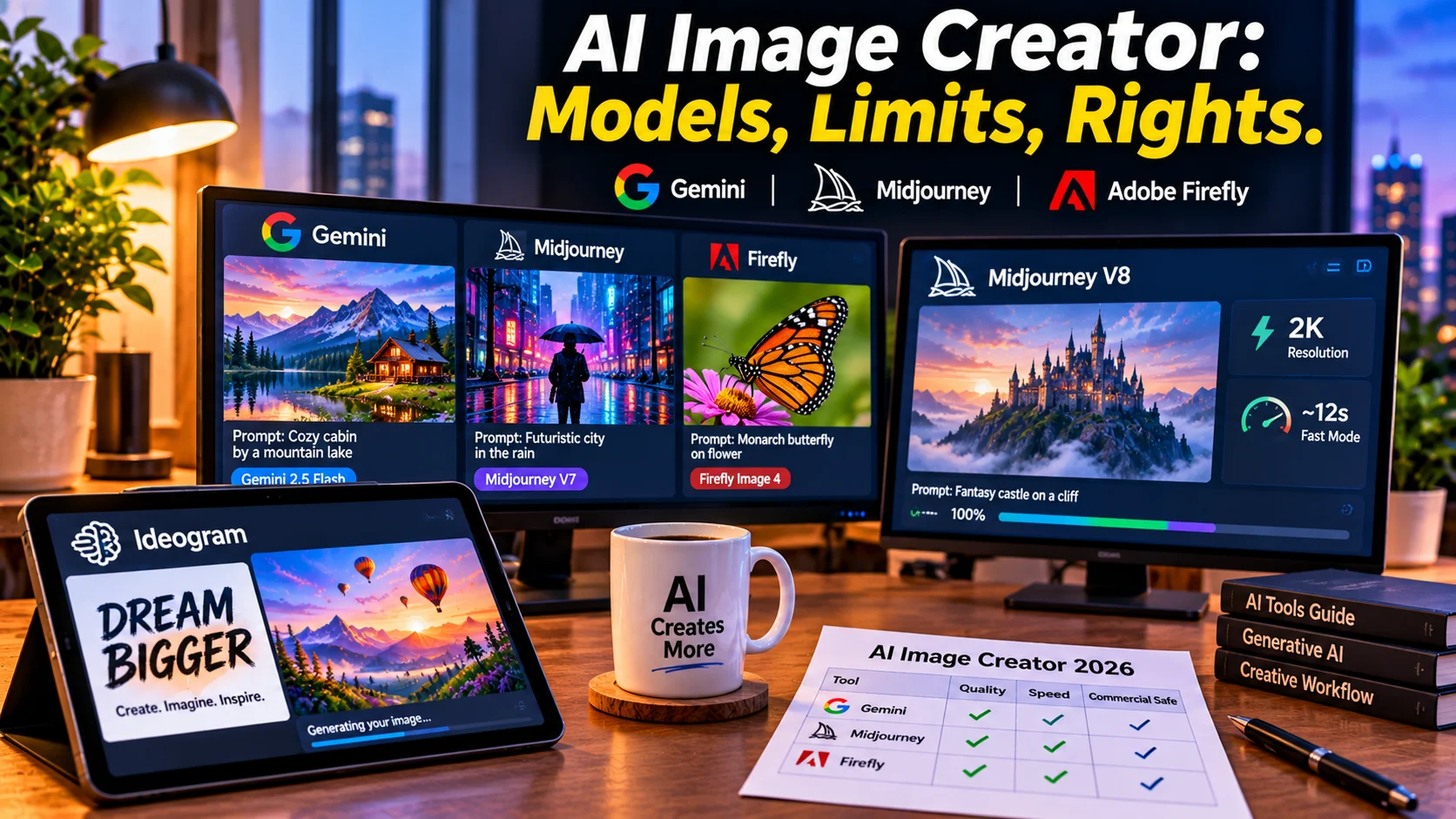
An AI image creator is a tool that generates or edits visuals from text prompts. The landscape in 2026 is led by Google’s Gemini (Nano Banana) for overall quality and character consistency, Midjourney V8 for artistic generation and speed, Adobe Firefly for commercially safe output, and Ideogram for text rendering, with Leonardo offering a broad multi-model platform for iOS users.
At-a-Glance: Key Takeaways
- Gemini’s Nano Banana model leads overall quality, earning PCMag’s top pick and CNET’s highest score (8.5) for realism and character consistency .
- Midjourney V8 is the fastest creative tool, generating images roughly 5x faster than V7 with native 2K resolution, but it requires a paid subscription starting at $10/month .
- Adobe Firefly is the safest commercial choice, trained only on licensed content with IP indemnification, though its free tier is limited to 25 monthly credits .
- Ideogram leads on text rendering, with free accounts receiving 30 weekly credits and paid plans from $20/month .
- Leonardo.Ai offers access to multiple models, including Nano Banana, Seedream, and FLUX, through a single iOS platform with 60 million users .
- Sora is gone. OpenAI discontinued the Sora web and mobile apps in April 2026 and shut down the API in September 2026, so any “Sora image generator” claims are misleading .
What Is an AI Image Creator?
An AI image creator is a software tool that uses artificial intelligence to generate new visuals from text descriptions or edit existing images. The category spans dedicated platforms built around proprietary models (Midjourney), general-purpose assistants with image capabilities (Gemini, ChatGPT), design suites with integrated AI (Adobe Firefly), and multi-model aggregators that provide access to several engines at once (Leonardo).
The search intent is primarily commercial investigation. Users want to know which tool produces the best results for their specific needs, what the limitations are, and whether the output can be used commercially.
The honest answer is that “best” depends entirely on the task. A tool that excels at artistic concept art may fail at rendering legible text. A tool that is commercially safe may lack creative range. The market has matured enough that no single tool dominates every category.
The Major AI Image Creators Compared
Gemini (Nano Banana): Best Overall Quality
Google’s Gemini, powered by the Nano Banana model, is the strongest general-purpose AI image creator available. PCMag names it a top pick for accuracy and detail, and CNET gives it the highest score (8.5) for character consistency and realism .
What It Does Well
Nano Banana excels at rendering realistic images with consistent characters across generations. This matters for storytelling, branding, and any workflow where a character or product must remain recognizable. The model handles complex scenes with multiple objects and maintains coherence that earlier models struggled with.
Gemini’s free tier provides access to Nano Banana Pro until you hit a cap, after which Google downgrades you to the original Nano Banana model—which PCMag still considers excellent . Paid plans start at $20/month.
Where It Falls Short
Privacy is a consideration. Gemini trains on user data by default unless you disable history in settings. The free tier is metered by compute, which is harder to predict than a simple credit count.
Who it suits: Anyone who wants the best overall quality and character consistency, particularly for storytelling, marketing visuals, and realistic imagery.
Midjourney V8: Speed and Artistic Range
Midjourney V8, launched in March 2026, is the biggest upgrade the platform has seen. It generates images roughly 5x faster than V7, supports native 2K resolution with the --hd parameter, and significantly improves text rendering .
What It Does Well
Midjourney remains the choice for artistic, stylized, and creative imagery. CNET notes it is “extremely creative” with “versatile stylistic” range . V8 improves prompt adherence, so complex descriptions are followed more accurately.
The speed improvement is dramatic. What used to take 30-60 seconds now completes in under 10 seconds for standard generations .
Where It Falls Short
Midjourney has no free tier. Plans start at $10/month for Basic, with GPU hours that can run out quickly when using premium features. The --hd, --q 4, style references, and moodboard references all cost 4x the standard GPU time .
All images are public by default unless you pay for stealth mode. CNET notes that Disney, Universal, and Warner Bros. are suing Midjourney over its ability to generate recognizable copyrighted characters .
Who it suits: Artists, designers, and creatives who value artistic range and speed and are willing to pay for it.
Adobe Firefly: Commercial Safety
Adobe Firefly is the choice for professionals who need legally safe output. It is trained only on licensed content, and Adobe provides IP indemnification for commercial use .
What It Does Well
Firefly integrates directly into Adobe’s ecosystem, including Photoshop, Express, and Creative Cloud. You can generate an image, then edit it with Adobe’s professional tools without leaving the workflow. PCMag names it “Best for Customization” .
The commercial safety is the differentiator. If you are creating content for a client, Firefly’s indemnification means Adobe will defend you if the output is challenged.
Where It Falls Short
The free tier provides only 25 monthly generative credits, which is a demo allowance, not a workflow. Paid plans start at $10/month. PCMag notes images can look distorted or fail to match the request, and there is no negative prompt option to exclude objects .
Who it suits: Commercial designers, agencies, and anyone creating client work where legal safety is paramount.
Ideogram: Text Rendering Leader
Ideogram has carved a niche by solving one of the hardest problems in AI image generation: rendering legible text. Most models produce garbled letterforms. Ideogram consistently delivers clean typography.
What It Does Well
Ideogram is particularly strong for posters, logos, social graphics, and any image where text needs to be readable. The platform also offers AI image editing, generative fill, and background removal .
Free accounts receive 30 credits weekly. Paid plans start at $20/month for Plus (2,400 credits) .
Where It Falls Short
On the free plan, generated images are public and cannot be deleted . Private generation requires a paid plan. Credits reset monthly and do not roll over .
Who it suits: Designers, marketers, and anyone who needs text in their images—posters, social graphics, mockups, and branding materials.
Leonardo.Ai: Multi-Model Access on iOS
Leonardo.Ai is a full creative platform that provides access to multiple models, including Google’s Nano Banana, Seedream, FLUX, and Leonardo’s own models, all from an iOS app .
What It Does Well
Leonardo’s strength is breadth. You can switch between models depending on the task, use pre-designed templates, edit images with AI, and upscale results—all in one app. The platform has 60 million users and 2 billion generations, suggesting a mature ecosystem .
Where It Falls Short
The free tier is token-based, and commercial use requires a paid plan. Paid tiers start at $15.99/month for Essential, scaling to $79.99/month for Ultimate . Token consumption varies by model and resolution.
Who it suits: iOS users who want access to multiple models and editing tools in a single app, without committing to a single provider’s ecosystem.
What Happened to Sora?
OpenAI discontinued the Sora web and mobile apps in April 2026 and shut down the Sora API in September 2026 . Any website claiming to offer a “Sora image generator” is misleading. Sora was primarily a video tool, and its image capabilities were a side feature that no longer exists.
If you still have videos in an old Sora account, export them before the data is permanently deleted. For new image generation, use Gemini, Midjourney, Firefly, Ideogram, or Leonardo instead .
Where the Paywall Actually Lands
Across AI image creators, the pattern is consistent.
Free tiers have caps. Gemini downgrades after a compute cap. Firefly provides 25 monthly credits. Ideogram gives 30 weekly credits. Leonardo uses tokens.
Commercial rights are often gated. Firefly offers indemnification on paid plans. Ideogram and Gemini permit commercial use within terms, but private generation requires payment. Midjourney is paid-only.
Privacy is a trade-off. Gemini trains on user data by default. Midjourney images are public unless you pay for stealth mode. Firefly trains only on licensed content.
Advanced features cost more. Midjourney’s HD and quality modes cost 4x GPU time. Ideogram’s private generation requires a paid plan. Leonardo’s commercial use requires a subscription.
Who Should Use Which AI Image Creator
Social media creators and general users should start with Gemini for overall quality and a generous free tier .
Artists and designers should use Midjourney V8 for artistic range and speed, accepting the paid subscription .
Commercial designers and agencies should use Adobe Firefly for IP indemnification and commercial safety .
Anyone needing text in images should use Ideogram for its superior typography rendering .
iOS users wanting multi-model access should use Leonardo.Ai for its breadth of models and editing tools .
Common Mistakes and Cautions
Assuming “Sora” still exists. OpenAI shut down Sora in 2026. Any site claiming to generate images with Sora is using a different model under the Sora name .
Ignoring commercial restrictions. Midjourney is paid-only. Ideogram’s free images are public. Firefly offers indemnification, but its free tier is limited. Verify terms before using output for client work.
Overlooking privacy defaults. Gemini and ChatGPT train on user data by default. Midjourney images are public unless you pay for stealth mode. Disable training or use Firefly if privacy matters.
Expecting text rendering from every model. Most models produce garbled text. Ideogram and Midjourney V8 are the exceptions, not the rule .
Underestimating GPU costs. Midjourney’s premium features cost 4x GPU time. A Basic plan with 3.3 hours can be exhausted quickly with HD and quality modes .
Frequently Asked Questions
What is the best AI image creator overall?
Gemini’s Nano Banana model leads on overall quality and character consistency, earning PCMag’s top pick and CNET’s highest score. Midjourney V8 is best for artistic range and speed. Adobe Firefly is best for commercial safety. Ideogram is best for text rendering .
Is Midjourney free?
No. Midjourney has no free tier. Plans start at $10/month for Basic, with GPU hours that can run out quickly when using premium features like HD and quality modes .
What happened to OpenAI’s Sora?
OpenAI discontinued the Sora web and mobile apps in April 2026 and shut down the API in September 2026. Sora was primarily a video tool. Any website claiming to offer Sora image generation is misleading .
Can I use AI image creators commercially?
It depends on the tool. Adobe Firefly offers IP indemnification for commercial use. Gemini, Ideogram, and Leonardo permit commercial use within their terms, but may require paid plans for private generation. Midjourney is paid-only. Always verify current terms.
Which AI image creator is best for text in images?
Ideogram is the leader for text rendering, with Midjourney V8 making significant improvements. Most other models produce garbled letterforms when asked to include words .
Conclusion
The AI image creator landscape in 2026 is defined by specialization, not a single winner. Gemini leads on overall quality and character consistency. Midjourney V8 offers the fastest artistic generation. Adobe Firefly provides the safest commercial output. Ideogram solves text rendering. Leonardo aggregates multiple models on iOS.