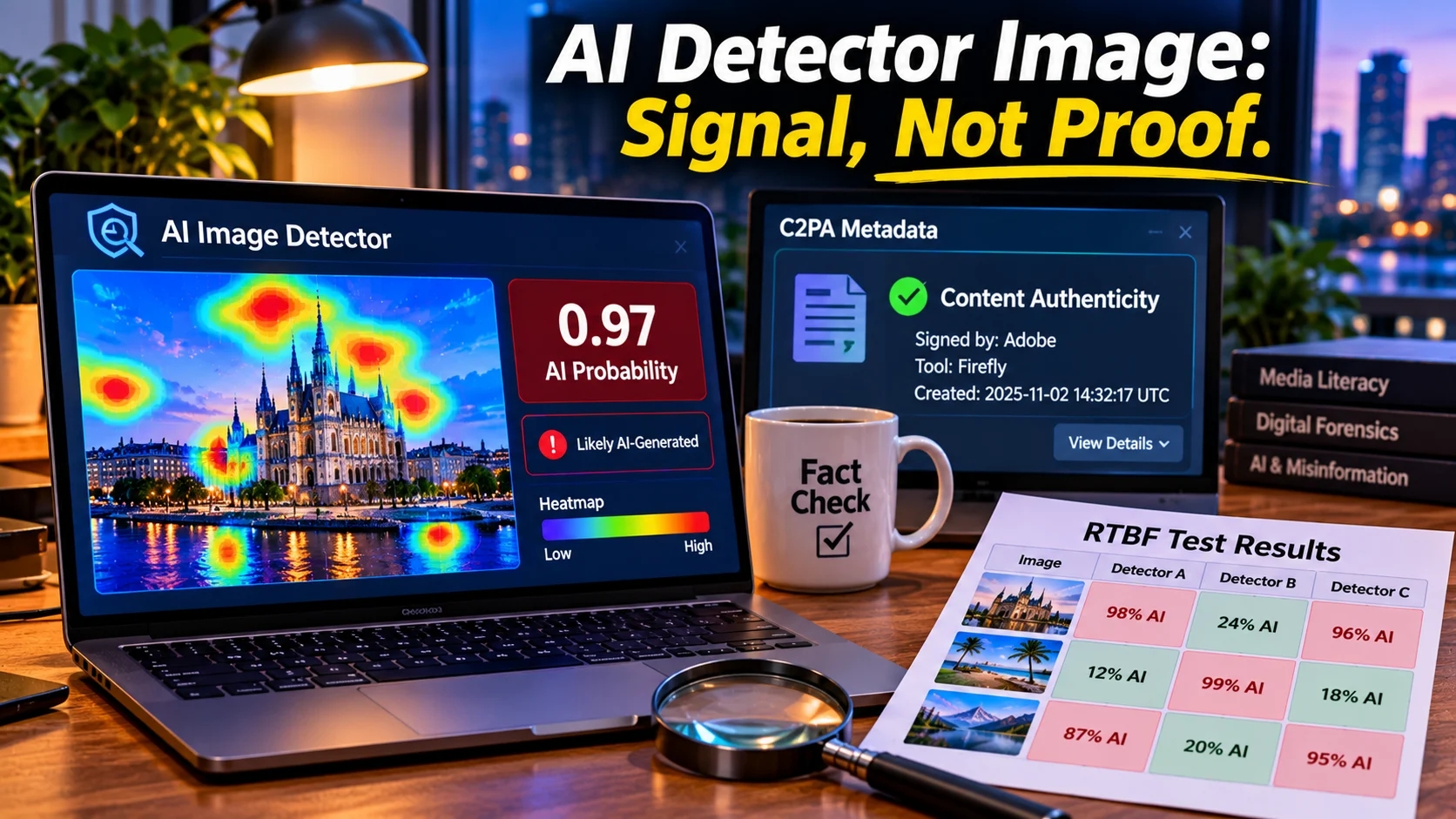
An AI detector image tool estimates whether a picture was generated by artificial intelligence, but independent testing shows accuracy collapses on unseen generators and post-processed images. Pangram claims 99.2% detection with 0.27% false positives, while a Zenodo cross-generator study found detectors dropping to chance (0.523) on generators they were not trained on . No detector is reliable enough for high-stakes decisions without human verification.
At-a-Glance: Key Takeaways
- Vendor claims diverge wildly from independent results. Pangram reports 99.2% detection and 0.27% false positives on its own tests, but the Zenodo cross-generator study found in-distribution accuracy does not predict performance on unseen generators .
- Post-processing breaks detection. Compression, cropping, and social media re-upload can reduce accuracy to near-zero, according to Imagera AI’s 2026 comparison .
- Turnitin does not detect AI images. Its AI detector analyzes text only. Images in submissions are outside its analysis entirely .
- Open-source options exist. Smaug AI Image Detector runs on a laptop, achieves 0.973 AUC on real-world Reddit images, and is Apache 2.0 licensed .
- Provenance is more reliable than detection. C2PA metadata and SynthID watermarks verify origin at creation time, but are easy to strip or edit .
- False positives remain a serious problem. A ScienceDirect study found human investigators disagreed with classifier tools in 23%–36% of cases, and the human was correct in 83%–89% of disagreements .
What Is an AI Detector Image Tool?
An AI detector image tool is software that analyzes a picture and estimates whether it was generated by artificial intelligence. It is not a watermark checker or a metadata reader. It is a forensic classifier that looks for statistical traces left by generative models.
The field splits into two families. Passive detectors act like forensic classifiers, looking for artifacts in frequency domains, noise patterns, or compression behavior. Provenance-based systems verify evidence embedded at creation time, like C2PA manifests or SynthID watermarks .
The search intent is commercial investigation. Users want to know which tools work, what their limitations are, and whether a score can be trusted for moderation, journalism, education, or legal purposes.
The honest answer is that passive detection is unreliable in adversarial conditions, and provenance is only as good as the generator’s cooperation. Neither is sufficient alone.
How AI Image Detectors Work
The Forensic Approach
Passive detectors analyze images for traces of synthesis. The Zenodo cross-generator study describes several approaches: spectral detectors examining frequency-domain artifacts, CNN-based classifiers trained on generated versus real images, and physics-based detectors looking for camera fingerprints .
The problem is that these detectors learn shortcuts. A detector trained on PNG-versus-JPEG differences will fail when the deployment images use different compression. A detector trained on one generator’s artifacts will fail on a new model with different synthesis patterns .
The Zenodo study found that a fine-tuned CNN dropped to chance (0.523) on its worst unseen generator, and a hand-crafted physics detector went confidently below chance (0.258), meaning it systematically inverted its predictions . Only frozen foundation features from models like CLIP generalized, achieving 0.917 accuracy on unseen generators.
The Provenance Approach
Provenance-based systems ask a different question: not “does this look synthetic” but “is there trustworthy evidence about where this came from?”
C2PA (Coalition for Content Provenance and Authenticity) embeds cryptographically signed manifests in image metadata, recording which tool created the image and when. Google’s SynthID adds an invisible watermark designed to survive common edits .
The advantage is reliability when the signal survives. The disadvantage is that metadata is easy to strip, and watermarks can be removed with adversarial tools. A Reuters test found Meta’s own detector failed on 55% of cropped fakes from its generator, despite a watermarking system designed to survive edits .
The Major AI Detector Image Tools Compared
The Accuracy Problem in Numbers
The Cross-Generator Collapse
The Zenodo study’s most important finding is that in-distribution accuracy does not predict real-world performance. A detector that scores 0.795 on its training distribution can drop to 0.523 (chance) on unseen generators .
The collapse is governed by training diversity. Leave-one-out training recovered the CNN to 0.876 and the CLIP probe to 0.960, meaning the detector needs exposure to many generators to generalize. But even then, performance varies.
Post-Processing Kills Detection
Imagera AI’s 2026 comparison found that accuracy drops dramatically after compression, cropping, filtering, or social media re-upload, reducing detection to near-zero in adversarial conditions . The ICML 2025 DEAR paper confirmed this: existing detectors report high performance, but it is largely driven by bias toward the real class, and sensitivity to generated content collapses under standard post-processing like compression and resizing .
The Human-Machine Disagreement
A ScienceDirect study tested public forensic tools against a single investigator. The tools and the investigator agreed 64%–77% of the time, and when they agreed, they were correct 97% of the time. But on disagreements, the human was correct 83%–89% of the time. The main error was classifiers missing deepfakes, not falsely flagging real images .
The study concluded that classifier outputs should provide additional information during triage rather than replace the investigator’s assessment .
The RTBF Test
Belgian public broadcaster RTBF tested seven free detectors against three images: an AI cat, a fake Ukrainian soldier photo, and a fake Maduro arrest image. No tool was consistent. Tools that correctly identified the cat failed on the soldier. Tools that caught the soldier missed Maduro. Grok failed the cat but caught the other two .
The cat image was generated with Nano Banana, which embeds SynthID. The tools likely detected the watermark, not the synthesis. When the watermark was absent or stripped, performance collapsed .
What Turnitin Actually Detects
A common misconception is that Turnitin detects AI-generated images. It does not.
Turnitin’s AI detector analyzes text patterns only. Images, charts, and graphics embedded in submissions are outside its analysis. If an image contains text, that text might be analyzed, but the image itself is not checked .
This creates a meaningful gap. A student could submit a lab report with AI-generated charts and human-written prose, and Turnitin would only flag the prose if it appeared AI-generated. The images would pass without scrutiny.
For research manuscripts, Turnitin offers PubShield in partnership with Proofig AI. This tool detects image duplication, manipulation, and AI-generated visuals in scientific manuscripts, but it is aimed at journal publishers and institutional research workflows, not undergraduate coursework .
The Open-Source Alternative
For users who want local processing and reproducible results, Smaug AI Image Detector is a strong option.
Released by Abacus.AI in October 2026, Smaug is a fine-tune of Google’s EmbeddingGemma-2, streamlined to 439M parameters by removing the audio tower. It runs on a single consumer GPU with about 1 GB of memory, on Apple Silicon, or on a plain CPU .
The model achieves 0.973 AUC on OpenFake Reddit, a real-world benchmark of images as they are posted online. At a 5% false-alarm rate, it catches 86.7% of AI-generated images, against 77.4% for the next best open-source detector. At its default threshold, it flags only 0.4%–3.0% of real photographs as AI .
Smaug is available on Hugging Face under Apache 2.0, with quantized GGUF weights for llama.cpp. Images can be checked locally without sending them to a third-party service .
Privacy and Security Considerations
AI image detectors process your uploads on remote servers unless you use local tools.
What to check before uploading:
- Whether images are retained after analysis
- Whether images are used for model training
- Whether you can delete your data
- The tool’s terms for handling sensitive content
Some vendors address this directly. AI or Not states that checked content is deleted immediately. Adobe states that files uploaded to its Inspect tool are not stored . Smaug runs locally, eliminating transmission entirely .
Important distinction: No SOC 2 certification or similar compliance framework is typically referenced for consumer AI image detectors. They are not enterprise-grade by default.
Who Should Use AI Detector Image Tools
Journalists and fact-checkers should use provenance signals first (C2PA, SynthID) and passive detection second. The RTBF test showed that no single tool is consistent across image types .
Educators should understand that Turnitin does not detect AI images. If visual integrity matters, they need separate processes, not detector scores .
Researchers should use PubShield for manuscript review, not consumer tools. It is purpose-built for scientific image integrity .
Developers should explore Smaug for local, reproducible detection. The open-source model runs on modest hardware and provides AUC scores rather than binary verdicts .
Anyone making high-stakes decisions should not rely on any detector alone. The cross-generator collapse and post-processing failures mean a score is a signal, not a verdict .
Common Mistakes and Cautions
Assuming vendor accuracy claims apply universally. Pangram’s 99.2% is on its own test set. The Zenodo study found detectors drop to chance on unseen generators .
Ignoring post-processing. Compression, cropping, and re-upload reduce accuracy to near-zero. A screenshot of an AI image may not be detectable .
Expecting Turnitin to detect AI images. It does not. Its AI detector is text-only. Images pass without scrutiny .
Trusting a single tool. The RTBF test found no consistent performer across three images. Detection requires multiple signals, including provenance .
Overlooking the human-in-the-loop. The ScienceDirect study found humans correct 83%–89% of the time when they disagreed with a classifier. Tools should triage, not decide .
Frequently Asked Questions
What is the best AI detector image tool?
There is no universal best. Pangram claims the highest accuracy (99.2%) on its own tests, but independent cross-generator studies show detectors collapse on unseen models. Smaug offers the strongest open-source option with 0.973 AUC on real-world Reddit images and local processing .
Can Turnitin detect AI-generated images?
No. Turnitin’s AI detector analyzes text patterns only. Images, charts, and graphics embedded in submissions are outside its analysis. Text within images might be analyzed, but the image itself is not checked .
How accurate are AI image detectors?
Accuracy varies dramatically by generator and post-processing. The Zenodo study found a CNN dropping to chance (0.523) on its worst unseen generator. Post-processing can reduce accuracy to near-zero. Vendor claims of 99%+ are on curated test sets, not real-world conditions .
Are there free AI image detectors?
Yes. Illuminarty offers 5 free scans daily. AI or Not has a consumer free tier. Smaug is open-source and free to run locally. Most free tiers have usage limits or reduced accuracy compared to paid APIs .
What is C2PA and why does it matter?
C2PA (Coalition for Content Provenance and Authenticity) embeds cryptographically signed metadata in images, recording which tool created them and when. It is more reliable than passive detection when the signal survives, but metadata is easy to strip and watermarks can be removed .
Conclusion
AI detector image tools offer a signal, not a verdict. The technology works best on raw, unprocessed images from generators it was trained on. It fails on unseen models, compressed images, and adversarial conditions.