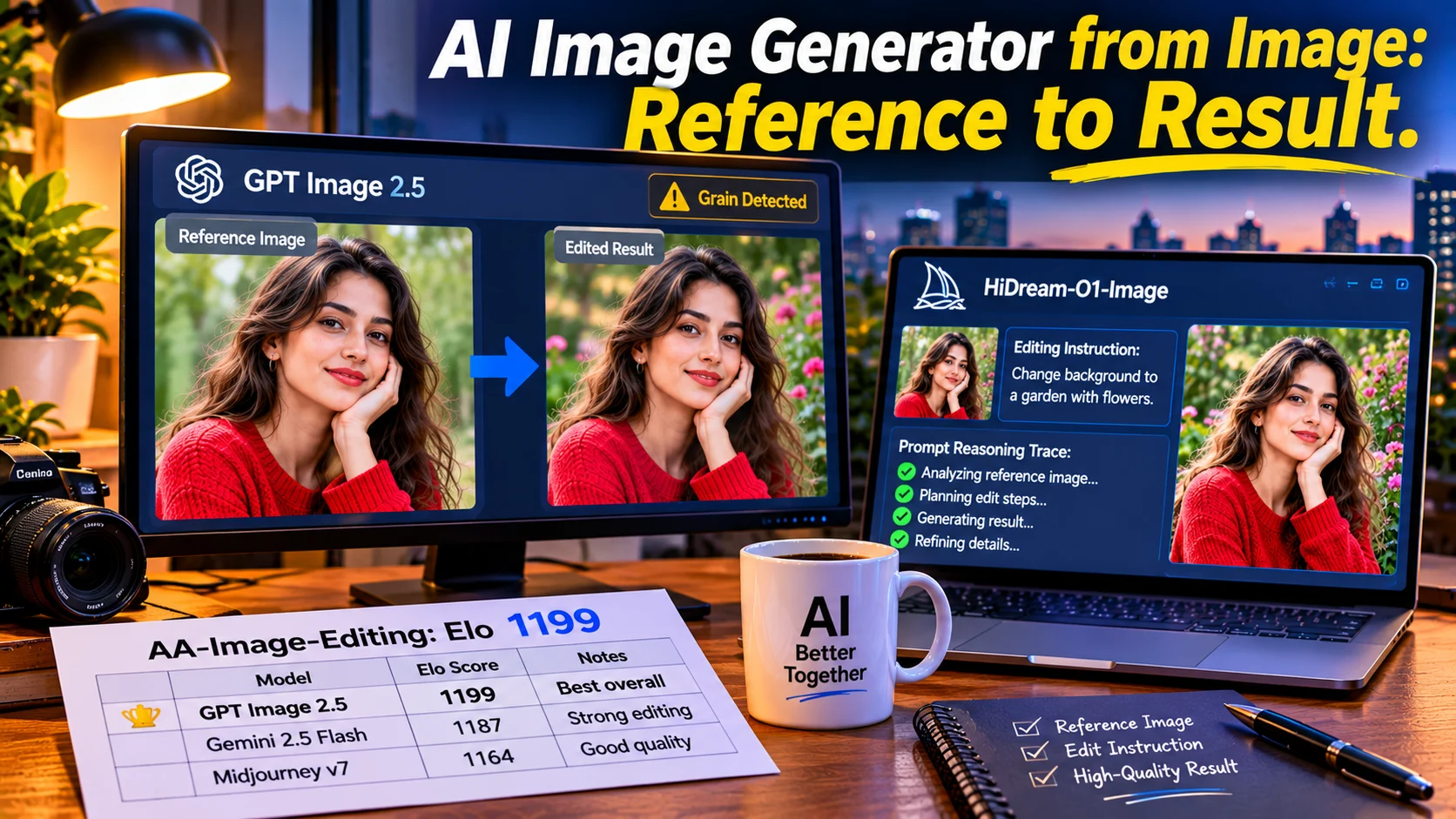
An AI image generator from image uses a reference photo to guide generation, either by editing the existing image or creating variations that preserve its subject. GPT Image 2.5 leads editing quality on Artificial Analysis, HiDream-O1-Image offers open-source subject-driven personalization, and Amazon Titan supports subject consistency for commercial use. The best choice depends on whether you need precise edits, subject preservation, or local processing.
At-a-Glance: Key Takeaways
- GPT Image 2.5 leads the Artificial Analysis editing leaderboard with an Elo of 1199, though API pricing is steep at $210 per 1,000 images .
- HiDream-O1-Image is the strongest open-source option, scoring 0.979 on LongText-Bench for English text rendering and supporting instruction-based editing with a single reference image .
- Amazon Titan Image Generator supports subject consistency, fine-tuning with reference images to preserve a pet, shoe, or handbag across generations .
- FLUX 3 accepts up to 10 reference images for editing or composition, with grounding enabled by default for web-researched context .
- Noise artifacts plague GPT Image 2.5, with users reporting grainy skies and skin despite promises of sharper detail .
- Commercial rights vary significantly. Open-source models like HiDream-O1-Image permit commercial use under MIT; cloud tools require term verification .
What Is an AI Image Generator from Image?
An AI image generator from image takes a reference photo as input and produces a new image guided by that reference. This differs from text-to-image generation, which creates from scratch. The reference image can serve three purposes: it can be edited directly (change the background, swap clothing), it can define a subject to preserve across new scenes (put this person in a different setting), or it can guide composition and style for a new generation.
The search intent is commercial investigation. Users want to know which tools handle reference images well, what the limitations are, and whether the output meets their quality bar.
The honest answer is that quality varies dramatically by task. Editing an existing image is a different problem than maintaining subject consistency across new scenes. A tool that excels at one may fail at the other.
How Image-Guided Generation Works
The technical approach depends on the task. For editing, the model receives the reference image and a text instruction, then generates a modified version that preserves the original composition while applying the requested change. HiDream-O1-Image handles this with a single reference image and an instruction, using a flow_match scheduler for editing tasks .
For subject-driven personalization, the model learns a subject’s appearance from one or more reference images, then places that subject in new contexts. HiDream-O1-Image supports multi-reference personalization with skeleton and layout control, allowing precise positioning of the subject in new scenes . Amazon Titan’s subject consistency feature fine-tunes the model on reference images to preserve a chosen subject across generations .
For composition guidance, the reference image defines layout and structure while the prompt describes content. Amazon Titan’s image conditioning feature uses a reference image to guide generation, aligning the output with the reference’s layout and composition while following the text prompt .
The Major Image-Guided Generators Compared
GPT Image 2.5: Best Editing Quality
GPT Image 2.5 leads the Artificial Analysis editing leaderboard with an Elo of 1199, well ahead of Nano Banana 2.1 (1152) and MAI-Image-2.6 (1151) . In practical testing, it preserved identity better than competitors across multiple editing rounds, maintaining facial features and composition while applying requested changes .
Where the Limits Hit
The noise problem is real. Users report grainy skies, textured skin, and “awful noise patterns” despite OpenAI’s claims of sharper detail. A Yahoo test found that even with prompts requesting smooth gradients, the model produced persistent grain across studio backgrounds and twilight scenes . For production work, this requires post-processing.
API pricing is steep at $210 per 1,000 images, making it expensive for high-volume workflows . The model also tends to “over-edit,” changing elements beyond what was requested. In one test, asking to change a drink flavor resulted in the entire bottle changing color .
HiDream-O1-Image: Open-Source Control
HiDream-O1-Image is the leading open-weight model for image-guided generation. It supports instruction-based editing with a single reference image, multi-reference subject personalization, and native 2,048 × 2,048 resolution .
What Makes It Different
The Reasoning-Driven Prompt Agent explicitly reasons through layout, subject attributes, physical logic, and text-rendering details before generating. It rewrites user instructions into self-contained English prompts, improving output on complex requests .
Text rendering is a strength. The model scores 0.979 on LongText-Bench for English, far above most open-source alternatives . For applications requiring legible text within edited images, this matters.
Where the Limits Hit
Running the model requires a CUDA-capable GPU. The 8B parameter version is manageable on consumer hardware; larger variants require more. Setup involves cloning the repository, installing dependencies, and configuring the scheduler . This is not a browser-based tool.
Amazon Titan Image Generator: Subject Consistency for Commercial Use
Amazon Titan Image Generator G1 v2 offers subject consistency, allowing users to fine-tune the model with reference images to preserve a chosen subject (pet, shoe, handbag) in generated images .
What It Does Well
The feature set is comprehensive: inpainting, outpainting, image variation, image conditioning, background removal, and color-guided content. Images carry an invisible watermark and C2PA metadata for provenance verification . This matters for commercial applications where authenticity tracking is required.
Where the Limits Hit
Maximum image size is 1,408 × 1,408 pixels for editing tasks. Input prompts are limited to 512 characters. English only. These are meaningful constraints for professional workflows .
FLUX 3: Multi-Reference Editing
FLUX 3 accepts up to 10 reference images for editing or composition. When reference images are supplied, the first one sets the aspect ratio if left on auto. Grounding is enabled by default, researching the prompt with web and image search before generating .
Where the Limits Hit
The model is available through API only (Replicate, Black Forest Labs). No local weights. Pricing is $48 per 1,000 images, placing it between cheaper options and GPT Image 2.5 .
Common Mistakes and Cautions
Assuming all editing tools preserve identity. GPT Image 2.5 preserves better than most, but identity drift occurs after multiple edits. Test with your actual subject before committing .
Ignoring noise artifacts. GPT Image 2.5 produces grainy output that requires post-processing. For print or high-resolution work, budget time for cleanup .
Overlooking resolution limits. Amazon Titan caps at 1,408px. Free cloud tiers often cap lower. Check before relying on output for print.
Forgetting commercial terms. Open-source models like HiDream-O1-Image permit commercial use under MIT. Cloud tools require term verification. Amazon Titan includes provenance metadata .
Expecting one tool to do everything. Editing, subject personalization, and composition guidance are different tasks. Match the tool to the task.
Frequently Asked Questions
What is an AI image generator from image?
It is a tool that uses a reference photo to guide generation, either by editing the existing image or creating variations that preserve its subject. Tools range from GPT Image 2.5 for editing quality to HiDream-O1-Image for open-source control .
Which tool preserves identity best when editing?
GPT Image 2.5 leads the Artificial Analysis editing leaderboard and performed best in practical identity-preservation tests, though identity drift occurs after many edits. For open-source, HiDream-O1-Image supports subject-driven personalization .
Can I use these tools for commercial work?
It depends. HiDream-O1-Image is MIT licensed, permitting commercial use. Amazon Titan includes provenance metadata for commercial applications. Cloud tools like GPT Image 2.5 require term verification .
What is subject consistency?
Subject consistency means preserving a chosen subject (a pet, product, or person) across new generations. Amazon Titan fine-tunes on reference images to achieve this. HiDream-O1-Image uses multi-reference personalization .
Why does GPT Image 2.5 produce grainy images?
The noise is a model artifact. OpenAI’s model generates grain that mimics photographic texture but appears in areas that should be smooth, like skies and studio backgrounds. Post-processing may be required for production use .
Conclusion
AI image generators that work from reference images serve different needs. GPT Image 2.5 leads on editing quality but produces noise artifacts and costs $210 per 1,000 images. HiDream-O1-Image offers open-source control with strong text rendering and subject personalization, at the cost of GPU hardware.