Anijam AI is a Multi-Agent video creation platform developed by Seekoo Technology that automates animation production from a single natural language prompt. It generates story outlines, concept art, storyboards, and video clips on a canvas workspace, with pricing from $16/month and over 1,000 paying users within two weeks of launch.
At-a-Glance: Key Takeaways
- Anijam uses a Multi-Agent architecture with a Manager Agent coordinating specialized sub-agents for story planning, visual design, and video generation .
- The platform raised over $10 million from investors including MiraclePlus, Atypical Ventures, and Vision Plus Capital .
- Founders bring credentials from Adobe, Tencent, and Megvii, with CTO Wang Jue being an IEEE Fellow and former Adobe Principal Scientist .
- **Pricing ranges from Free to $166 month**, with the Creator plan at $26/month being the recommended tier for serialized content .
- Over 1,000 paying users within two weeks of launch, with more than half of creations completed on mobile devices .
- The platform emphasizes “controllable editing” rather than “lottery-style” generation, allowing local modifications without regenerating entire scenes .
What Is Anijam AI?
Anijam AI is a Multi-Agent video creation platform developed by Seekoo Technology, a Hangzhou-based startup founded by former Adobe, Tencent, and Megvii executives. The platform positions itself as the “Cursor for video creation,” drawing a parallel to how AI coding tools transformed software development .
The core premise is that video creation remains high-barrier and long-process, even with generative AI. A complete video requires script ideation, character design, storyboard breakdown, shot composition, action coordination, visual consistency, editing, voiceover, and rhythm adjustment. Most users struggle not with generation itself, but with building narrative structure and designing shot language .
Anijam addresses this by re-architecting the creation process. Users input a single natural language sentence, such as “Create a video about Monkey King fighting the White Bone Demon three times,” and the system automatically completes the entire pipeline: story outline generation, visual concept design, storyboard breakdown, keyframe generation, video clip production, and final synthesis .
How Anijam AI Works
The Multi-Agent Architecture
Anijam’s core innovation is its three-layer Multi-Agent system. A Manager Agent coordinates multiple execution agents, each with specialized skills. This architecture allows the system to handle the complexity of long-form video creation without losing narrative coherence .
The Manager Agent oversees the entire production pipeline. Sub-agents handle specific tasks: story planning, character design, scene generation, and shot composition. Each agent can be called independently or as part of a coordinated workflow .
The Canvas Workspace
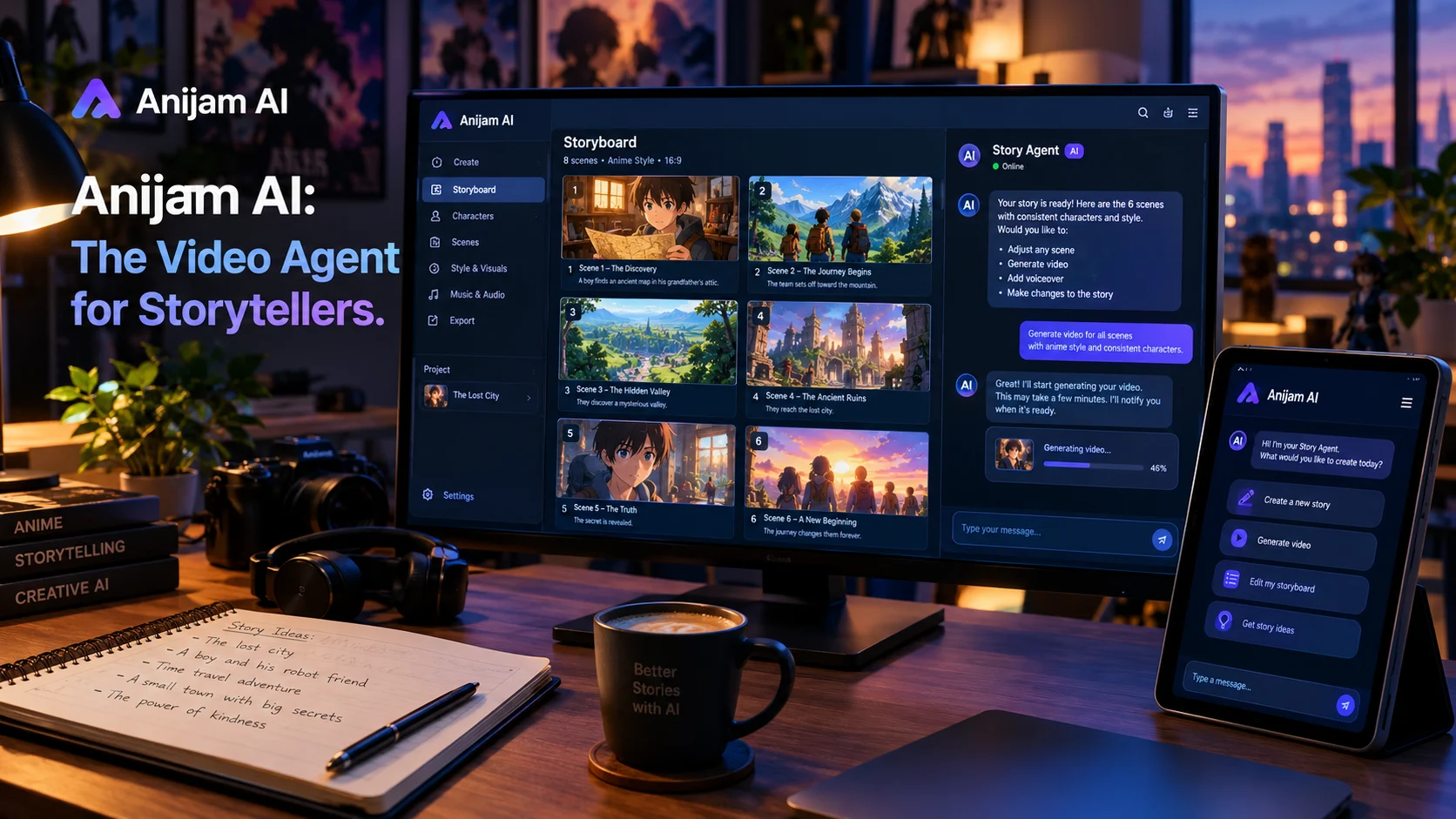
The production interface is built around a canvas split into three panels :
Left Panel (Tools): Manual generation tools including AI Image, AI Video, Lip Sync, Character, Voice, and Style. Content generated here lands directly on the canvas.
Center (Canvas + Story Blocks): An infinite workspace where Story Blocks (Story Outline, Concept Art, Storyboard) organize content by production stage. Blocks are containers that both the user and the Agent read from and write to.
Right Panel (Story Agent): A chat interface where users direct the AI. Users describe their story, ask for the next shot, or request style changes.
The Creation Workflow
When a user inputs a prompt, the Story Agent generates a Story Outline covering audience, duration, platform, aspect ratio, characters, and style notes. It then produces Concept Art for each character and key object for approval before animation begins. Finally, it builds a Storyboard with individual shots, each with a description and generated preview .
Everything the Agent creates is written into the matching Story Block automatically, keeping outline, concept art, and storyboard synchronized as the conversation continues .
Controllable Editing
Unlike traditional AI video generation that relies on regenerating entire scenes, Anijam emphasizes local editability. Users can modify a character’s expression without affecting the action or background. The system supports natural language modifications: adjusting shot perspective, changing composition, or replacing local elements .
The team is also developing an AI self-feedback mechanism. The vision includes a “third-party AI director” that scores generated shots and optimizes the generation process through “AI guiding AI,” reducing manual adjustment cycles .
Key Features and Capabilities
Long-Form Video Generation
Anijam supports video generation of up to 5-10 minutes. A roughly 2-minute video may take tens of minutes to an hour depending on content complexity . This distinguishes it from most AI video tools limited to short clips.
Consistent Character System
The platform locks character appearance, outfit, and proportions across scenes. The Creator plan supports up to 10 consistent characters, while Master and Master Pro tiers support 60 and 120 respectively .
AI Music Video Generator
Anijam’s music video tools support uploading MP3 or WAV files, with AI analyzing the vocal track to generate lip-synced singing characters. The system supports up to 4 independently animated characters in the same scene, each with their own voice track and lip sync .
For dance content, the AI dance engine reads song structure (verse, chorus, drop) to generate motion matching the music. Over 100 dance templates are available, plus motion transfer from reference videos .
Virtual Try-On for Fashion
The virtual try-on tool maps outfits onto AI models with matching fit, drape, and lighting. Users can describe motion in plain language or upload reference videos for natural fabric movement. The system generates AI models from text or uploaded photos, maintaining consistent faces across outfits .
Platform Sync
Projects sync across Web and the Anijam mobile app, allowing users to start on desktop and finish on phone. More than half of creations were completed on mobile devices within two weeks of launch .
Pricing and Plans
Anijam uses a credit-based tiered subscription model.
| Free | $0 | — | Limited | 720p (watermarked) | — |
| Beginner | $16 | $192/yr | 3,000 | 720p | — |
| Creator | $26 | $312/yr | 6,000 | 1080p + upscale | 10 |
| Master | $58 | $696/yr | 16,000 | 1080p (8K upscale) | 60 |
| Master Pro | $166 | $1,992/yr | 50,000 | 1080p (8K upscale) | 120 |
- Image generation: Nano Banana Pro 2K (25 credits), Seedream 4.5 2K (10 credits), GPT Image 2 1K (3-67 credits)
- Video generation: Wan 2.7 720P (32 credits/second), Seedance 2.0 720P (55 credits/second)
Top-up credits: $10 for 1,500 extra credits, subscribers only, valid for one year .
- Free tier is for evaluation only (watermarked, non-commercial)
- Beginner lacks Motion Control, Oscar Mode, and consistent-character slots
- Creator is the practical tier for serialized content creators
- Master and Master Pro target studios and multi-IP operations
Real-World Results
Launch Metrics
Anijam launched in mid-April 2026. Within two weeks :
- Over 1,000 paying users
- More than half of creations completed on mobile devices
- A YouTube account built entirely with Anijam grew from zero to approximately 2,000 followers in one week by producing over a dozen videos
User Behavior Insights
The team was surprised by mobile usage patterns. One user created a 10-minute-plus video entirely on their phone, telling a complete story from start to finish. This contradicted the assumption that long-form creation would be PC-dominant .
Credit consumption was notably fast. Users with many ideas generated multiple variants and long videos, indicating strong creative demand and willingness to pay .
Who Should Use Anijam AI
Serialized content creators building recurring characters across episodes. The consistent character system and Creator plan’s 10 character slots suit YouTube Shorts and TikTok production schedules .
Animation and story creators who need narrative structure, not just clip generation. The Multi-Agent system handles story outline, concept art, and storyboard generation automatically .
Music video producers creating lip-synced performances or beat-synced dance videos. The music video tools support up to 4 characters and 100+ dance templates .
Fashion and UGC creators producing virtual try-on content for TikTok and Instagram. The virtual try-on tool generates try-on videos from a single outfit photo .
Creators on a budget may find the credit-based pricing expensive for heavy use. The Beginner tier lacks key features, pushing serious users to Creator at $26/month .
Common Mistakes and Cautions
Underestimating credit consumption. Video generation costs 32-55 credits per second for premium models. A 2-minute video could consume 3,840-6,600 credits, exceeding the Creator plan’s monthly allocation .
Assuming the Free tier is production-ready. Free exports are watermarked and non-commercial. The $16/month Beginner plan removes the watermark but lacks Motion Control and consistent characters .
Expecting instant generation. A 2-minute video may take tens of minutes to an hour depending on complexity. This is not real-time generation .
Confusing Anijam with simpler template apps. The mobile app offers templates, but the Web platform is a full canvas workspace with Multi-Agent orchestration. The tools serve different workflows .
Overlooking the credit abstraction. The conversion from credits to actual video seconds is not published cleanly. Expect a ramp-up period to understand your real burn rate .
Frequently Asked Questions
What is Anijam AI?
Anijam AI is a Multi-Agent video creation platform for animation. It automates the entire production pipeline from a single prompt: story outline, concept art, storyboard, keyframes, video clips, and final synthesis. It is developed by Seekoo Technology and positions itself as the “Cursor for video creation” .
How much does Anijam AI cost?
Pricing ranges from Free (watermarked, non-commercial) to $166/month for Master Pro. The Creator plan at $26/month (annual) is the practical tier for serialized content, offering 6,000 credits, 1080p export, and 10 consistent characters .
Is Anijam AI free to use?
There is a free tier, but exports are watermarked and limited to 720p with non-commercial licensing. For production use, the Beginner plan at $16/month removes the watermark but lacks Motion Control and consistent character slots .
What makes Anijam different from other AI video tools?
Anijam’s differentiation is its Multi-Agent architecture and controllable editing. Rather than generating entire scenes repeatedly, users can modify local elements without affecting the rest. The system handles long-form video (5-10 minutes) and narrative structure, not just short clips .
Who is Anijam AI for?
It suits serialized content creators, animation storytellers, music video producers, and fashion UGC creators. The platform supports recurring characters, beat-synced dance videos, and virtual try-on content. It may not suit users seeking instant, single-clip generation without narrative structure .
Conclusion
Anijam AI represents a significant architectural bet in the AI video space. Rather than building another single-model generation tool, Seekoo Technology built a Multi-Agent system that decomposes video creation into specialized tasks coordinated by a Manager Agent. The result is a platform that handles narrative structure, not just clip generation.
What matters most is understanding the trade-offs. Anijam’s strength is controllability: local editing, consistent characters, and story-driven workflows. Its limitations are credit consumption, generation time, and the complexity of learning a canvas-based system. The free tier is evaluation-only, and the Beginner plan is a soft trial that serious creators will outgrow quickly.
Anijam AI may suit creators building serialized content, animation storytellers, and producers who need recurring characters across episodes. It may not suit users seeking instant single-clip generation, those on tight budgets, or creators who prefer template-based simplicity over canvas-based control.
Before committing, use the free tier to test the workflow on your actual content. Model your credit consumption against the video lengths you produce. And consider whether the Multi-Agent approach delivers enough value over simpler alternatives to justify the learning curve and subscription cost.