AI image generation uses diffusion models to transform text prompts into original visuals by progressively removing noise from a random starting point. Google’s Gemini and Imagen models lead on quality and flexibility, Adobe Firefly offers commercial safety with IP indemnification, and open models like FLUX provide cost-effective alternatives for developers.
At-a-Glance: Key Takeaways
- Diffusion models generate images by reversing noise, not by stitching together existing pictures. The model learns to denoise random static into coherent visuals guided by your prompt .
- Gemini and Imagen are Google’s top-tier models, with Gemini offering conversational editing and Imagen optimized for photorealism and typography .
- Adobe Firefly prioritizes commercial safety, training only on licensed content and offering IP indemnification, though free credits are limited .
- Pricing varies dramatically by model: OpenAI’s GPT Image 2 costs about $0.013 per image, while Gemini 3 Pro Image runs $0.13, roughly ten times more .
- Copyright remains unresolved. Most jurisdictions require human authorship for protection, but terms of service often grant users ownership of their outputs .
- Prompt quality determines output quality. Specific descriptions of style, lighting, composition, and subject produce dramatically better results than vague requests .
What Is AI Image Generation?
AI image generation is the process of creating original visuals from text descriptions using machine learning models. It is not a search engine that retrieves existing photos, and it is not a collage tool that assembles fragments of human-made art. It is a generative system that synthesizes new pixels based on patterns learned from training data.
The technology has moved from research novelty to mainstream utility in under three years. Designers use it for concept exploration, marketers use it for social graphics, and developers integrate it into applications through APIs. The quality gap between leading models has narrowed, but the differences in pricing, editing capabilities, and commercial terms remain significant.
How AI Image Generators Work
The Diffusion Process
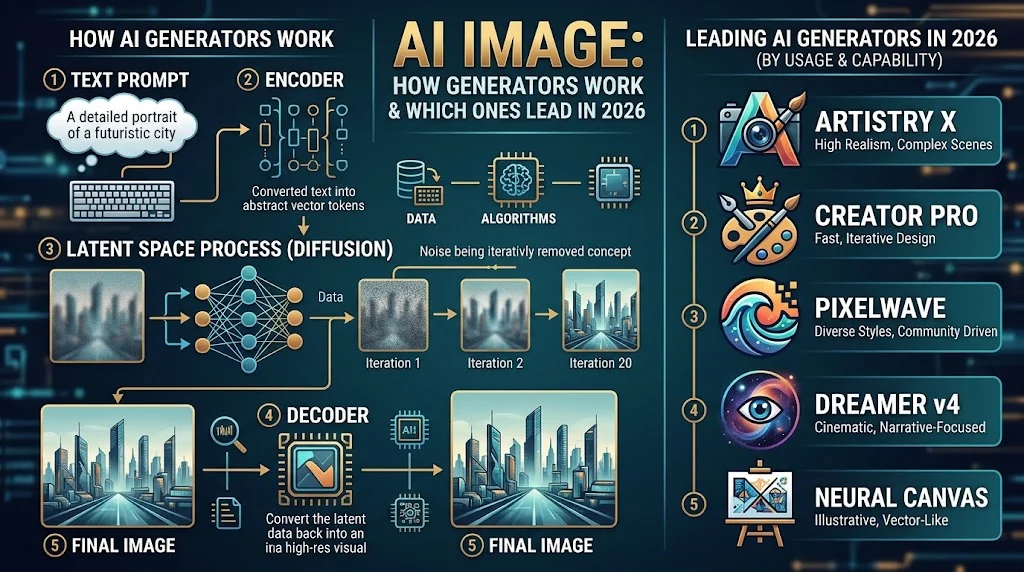
The dominant architecture for AI image generation is the diffusion model. The concept is counterintuitive but elegant: instead of learning to draw an image from scratch, the model learns to remove noise from a noisy image .
Training involves taking clear images and progressively adding random noise until they become unrecognizable static. The model observes this process millions of times, learning the statistical patterns of how noise obscures structure. At inference time, the process reverses. The model starts with random noise and iteratively removes it, guided by the text prompt, until a coherent image emerges .
This is why generation takes multiple steps. Each step refines the image slightly, moving it closer to the prompt’s description. The model is not retrieving a stored image. It is sculpting pixels from noise.
Text Encoding and Prompt Understanding
Before generation begins, the text prompt must be converted into something the model can use. This is handled by a text encoder, often a model like CLIP that has learned to associate words with visual concepts. The encoder maps your description into a vector representation that captures semantic meaning .
When you write “a cat on the moon,” the encoder understands not just the individual words but the relationship between them. The model then uses this representation to guide the denoising process, pulling the emerging image toward feline shapes and lunar landscapes.
The Role of the Prompt
Prompt quality is the single biggest lever users control. A vague prompt like “a cat” forces the model to invent every detail: style, lighting, background, pose. A specific prompt like “a tabby cat sitting on a crescent moon, digital illustration, soft blue lighting, stars in background, whimsical style” gives the model clear constraints .
Different models respond differently to prompts. Some handle long, detailed descriptions well. Others perform better with shorter, punchier phrasing. Learning a model’s preferences is part of the skill.
The Major AI Image Platforms Compared
Google’s Gemini and Imagen: The Quality Leaders
Google offers two distinct image generation paths through Vertex AI, and understanding the difference matters for anyone building applications.
Gemini is the recommended starting point. It excels at conversational editing, multi-turn refinement, and combining creative elements from multiple images. It can modify individual elements with language commands and iteratively work on an image without masks. The trade-off is higher latency and token-based pricing .
Imagen 4 is optimized for near-real-time performance and excels at photorealism, artistic detail, and typography. It is the better choice when image quality is the top priority and editing flexibility is secondary .
PCMag’s testing named Gemini one of its top picks for 2026, praising the accuracy and detail of its images. The free tier provides access to the Nano Banana Pro model until a cap is hit, after which users are downgraded to the original Nano Banana model, which PCMag still considers strong enough for its Technical Excellence Award .
Adobe Firefly: Built for Commercial Use
Adobe Firefly takes a different approach. Every image is trained on licensed content, and Adobe offers IP indemnification for commercial use. For businesses concerned about copyright exposure, this is the safest option available .
The trade-offs are real. PCMag’s testing found Firefly images “can look distorted or not match the request,” and the free tier is limited. Removing watermarks requires a subscription. Video generation tops out at five seconds. There is no negative prompt option to exclude objects .
But for agencies and brands that need legal certainty, Firefly’s indemnification may justify the limitations. The platform integrates directly into Adobe Express and Creative Cloud, making it convenient for existing Adobe users.
Pricing: A Tenfold Spread
The cost of AI image generation varies dramatically by model, and the cheapest option is not always the right one. OpenRouter’s comparison of image generation APIs found a tenfold spread between models .
| OpenAI GPT Image 2 | ~$0.013 | Cheapest, good for simple tasks |
| FLUX.2 Pro | ~$0.03 | Balanced quality and cost |
| Sourceful Riverflow | ~$0.065 | Mid-range option |
| Gemini 3 Pro Image | ~$0.13 | Highest quality, highest cost |
The Gemini model also accepts up to 14 reference images, while FLUX caps at eight and OpenAI handles sixteen. For workflows that require maintaining brand consistency across many reference images, this matters .
Copyright and Ownership: An Unresolved Landscape
The legal status of AI-generated images remains unsettled, and anyone using them commercially should understand the risks.
Human authorship is required for copyright protection in most jurisdictions. The U.S. Copyright Office has consistently held that AI cannot be an author. In the 2022 Thaler case, the office denied registration for an image created by an AI system, stating that copyright protection is predicated on human authorship .
Terms of service often grant users ownership. Midjourney, for example, grants users ownership of their generated outputs while reserving a non-exclusive license for the company to use those works for training and promotion . This means you may own the image, but the platform also has rights to it.
Style is not protected. An image generated in the style of Studio Ghibli is not automatically a copyright violation, because artistic style itself is not copyrightable. The Ghibli boom of 2025 generated millions of images without legal action, though the ethical debate continues .
The practical advice: For commercial work, use platforms that offer indemnification like Adobe Firefly, review the terms of service for the specific platform, and do not assume that generating an image grants you exclusive rights to it.
Who Should Use AI Image Generation
Designers and marketers should use Gemini for high-quality concept exploration and social graphics. The free tier is generous, and the conversational editing makes iteration fast.
Businesses with legal exposure should use Adobe Firefly. The IP indemnification is worth the quality trade-offs and limited free credits.
Developers building applications should evaluate OpenAI’s GPT Image 2 for cost efficiency or Gemini 3 Pro Image for quality. The API pricing is transparent and scales with usage.
Content creators needing text in images should use Ideogram, which leads on typography rendering.
Anyone needing print-quality or high-volume output should budget for paid tiers. Free allowances are for testing, not production.
Common Mistakes and Cautions
Assuming free means unlimited. Every free tier has caps. Gemini downgrades models after a threshold. Firefly limits credits. Free is for testing, not for sustained work .
Ignoring the copyright question. Most platforms grant users ownership through terms of service, but the underlying copyright status of AI-generated images remains legally unsettled. For high-stakes commercial work, indemnification matters .
Writing vague prompts. A prompt like “a landscape” forces the model to invent everything. Specific descriptions of style, lighting, composition, and subject produce dramatically better results .
Confusing models with services. Midjourney and Stable Diffusion are models, not standalone services in the same way Gemini and Firefly are. They require different access paths and have different strengths .
Expecting perfection on the first try. Even the best services occasionally produce errors and distortion. Multiple generations and prompt tweaks are normal. The process is iterative .
Frequently Asked Questions
What is the best AI image generator?
Gemini and ChatGPT are PCMag’s top picks for 2026, praised for accuracy and detail. Adobe Firefly is best for commercial safety with IP indemnification. The “best” depends on whether you prioritize quality, legal safety, or cost .
Is AI image generation free?
You can generate images for free, but with restrictions. Gemini offers free access to its Nano Banana Pro model until a cap, then downgrades to a lesser model. Firefly has a limited free tier. Free is for testing, not for high-volume production .
How do AI image generators work?
They use diffusion models. The model learns to reverse the process of adding noise to images. At generation time, it starts with random noise and iteratively denoises it, guided by your text prompt, until a coherent image emerges .
Who owns the copyright to AI-generated images?
The legal status is unresolved. Most jurisdictions require human authorship for copyright protection. Platform terms of service often grant users ownership of their outputs, but the underlying copyright status remains uncertain. For commercial work, use platforms with indemnification .
What is the difference between Gemini and Imagen?
Gemini is Google’s recommended starting point, offering conversational editing and flexibility. Imagen is optimized for photorealism and near-real-time performance. Gemini is better for iterative editing; Imagen is better for pure image quality .
Conclusion
AI image generation has matured into a practical tool with distinct platforms for different needs. Google’s Gemini and Imagen lead on quality and flexibility. Adobe Firefly offers commercial safety with indemnification. Open models like FLUX provide cost-effective alternatives for developers. Ideogram handles text better than most.