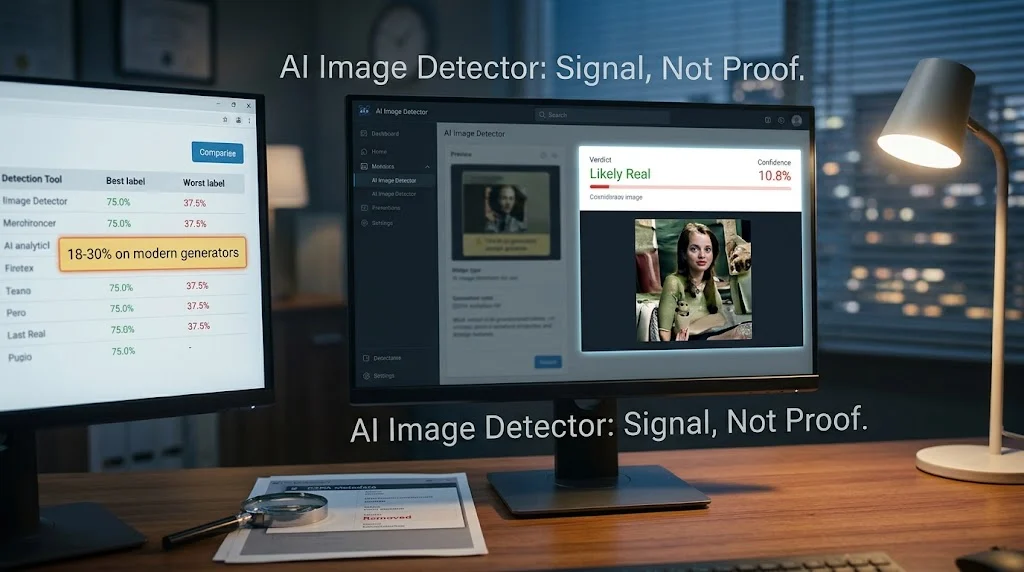
An AI image detector is a tool that estimates whether an image was generated by artificial intelligence, but independent benchmarks show its accuracy is unreliable outside controlled tests. A 2026 zero-shot study of 16 detectors found the best achieved 75% mean accuracy while the worst sat at 37.5%, and modern commercial generators like Flux Dev and Midjourney v7 defeated most detectors with just 18-30% detection rates .
At-a-Glance: Key Takeaways
- No universal winner exists. Detector rankings swing wildly across datasets, with Spearman correlations ranging from 0.01 to 0.87, meaning performance on one benchmark tells you almost nothing about another .
- Modern generators defeat most detectors. Flux Dev, Firefly v4, and Midjourney v7 achieved only 18-30% average detection accuracy across the benchmark’s 16 detectors .
- In-distribution accuracy is misleading. A detector scoring 79.5% on its training data dropped to 52.3% (chance) on unseen generators in a cross-generator study .
- Only frozen foundation features generalize. A frozen CLIP probe achieved 91.7% cross-generator accuracy, while fine-tuned CNNs collapsed to chance .
- Metadata provenance fails in real use. C2PA Content Credentials were removed by the first editing action in every test, with zero survival across 50 post-processing checks .
- Watermarks survive editing but are vendor-locked. SynthID survived every action for both Google and OpenAI, but each company’s detector reads only its own watermark .
What Is an AI Image Detector?
An AI image detector is a software tool that analyzes an image and assigns a probability score indicating how likely it was generated by artificial intelligence. The category spans developer APIs (Hive Moderation, Sightengine), consumer web tools (Illuminarty, AI or Not), and research benchmarks .
The search intent is commercial investigation. Users want to know which detectors actually work, what their limitations are, and whether they can be trusted for verification, moderation, or forensic purposes.
The honest answer is that AI image detection is an unsolved problem. The tools are useful as signals in a larger verification system. They are not reliable as standalone authenticators.
How AI Image Detectors Work
Detectors rely on statistical patterns learned from training data. Early approaches used hand-crafted features like spectral analysis or physics-based fingerprints. Modern systems use deep learning, particularly convolutional neural networks (CNNs) fine-tuned on labeled datasets of real and AI-generated images.
The fundamental problem is generalization. A detector trained on Stable Diffusion images may fail completely on Flux or Midjourney outputs. The patterns it learned do not transfer to generators it has never seen .
A 2026 cross-generator study quantified this collapse. A 2-D spectral detector scored 0.795 in-distribution but dropped to 0.523 (chance) on unseen generators. A fine-tuned CNN dropped to chance on its worst unseen generator. A hand-crafted physics detector went confidently below chance at 0.258, a phenomenon the authors called “fingerprint inversion” .
Only frozen foundation features generalized. A frozen CLIP probe achieved 0.917 cross-generator accuracy. When the training set included diverse generators (leave-one-out), the CNN recovered to 0.876 and the CLIP probe to 0.960 .
Editorial interpretation: The evidence suggests that detectors relying on specific generator fingerprints are fragile. Detectors that leverage broad visual understanding (like CLIP features) generalize better, but even they are not reliable enough for high-stakes decisions.
The Accuracy Problem in Numbers
The Zero-Shot Benchmark
The most comprehensive recent evaluation, published on arXiv in February 2026, tested 16 state-of-the-art detectors across 12 datasets comprising 2.6 million images from 291 unique generators .
| Best detector | 75.0% mean accuracy |
| Worst detector | 37.5% mean accuracy |
| Performance gap | 37 percentage points |
| Modern commercial generators | 18-30% average detection accuracy |
| Ranking instability | Spearman ρ of 0.01 to 0.87 across dataset pairs |
The study concluded that “no universal winner exists” and that practitioners “must carefully select detectors based on their specific threat landscape rather than relying on published benchmark performance” .
The Real-World Robustness Gap
A NeurIPS 2025 benchmark (AIGIBench) tested 11 detectors on real-world data including social media and AI art platform samples. Despite high reported accuracy in controlled settings, “these detectors suffer significant performance drops on real-world data, limited benefits from common augmentations, and nuanced effects of pre-processing” .
AIMultiple’s practical test of four consumer tools found a consistent pattern: all tested tools “tended to misclassify AI-generated images as real,” with the most common error being false negatives. The tools performed slightly better at recognizing real images, but “overall consistency remains uncertain” .
The Confidence Score Problem
Most detectors provide confidence scores. None explain their reasoning. AIMultiple noted that “users may interpret low or medium scores as inconclusive, making it hard to make informed decisions without additional human reviewers or context” .
A false negative from their test: an AI-generated image of an older woman was classified as “likely real” with an AI probability score of 10.8% .
Provenance and Watermarks: What Survives
Two approaches attempt to solve detection at the source: metadata (C2PA Content Credentials) and invisible watermarks (SynthID).
C2PA Metadata Fails Immediately
A September 2026 study tested ten AI images through four everyday actions: Canva export, screenshot, WhatsApp transfer, and Instagram post. The C2PA metadata was removed by the first action every time, with a survival rate of zero across fifty post-processing checks .
The authors concluded that “metadata-based provenance does not work in real use” .
SynthID Survives but Is Vendor-Locked
The SynthID watermark survived every action and every chain for both Google and OpenAI images, when read by that company’s own detector. OpenAI added SynthID to its images in May 2026 .
The critical limitation: each detector reads only its own company’s watermark. No single public tool reads both. A “not detected” result from Google’s detector says nothing about an OpenAI image, and vice versa. The authors concluded that “a ‘not detected’ answer cannot be trusted to mean ‘not AI'” .
Editorial interpretation: Provenance is the most promising path, but it currently fails as a usable system because detection is split across companies with no shared infrastructure. Metadata is too fragile for real-world use.
Major AI Image Detectors Compared
The Apidog comparison concluded that for developers, “Sightengine or Hive Moderation” are the best starting points for general API access with generator attribution .
Who Should Use AI Image Detectors
Content moderation teams can use detectors as one signal among many. The tools can flag suspicious images for human review, but should not trigger automatic bans.
Journalists and fact-checkers should treat detector scores as a starting point for investigation, not a conclusion. The failure rate on modern generators means a “likely real” result provides little assurance.
Platforms building provenance systems should prioritize C2PA signing and SynthID watermarking at generation time, understanding that detection remains fragmented across vendors.
Researchers should use the UniAIDet and AIGIBench benchmarks for evaluation, noting that in-distribution accuracy does not predict real-world performance .
Anyone needing definitive verification should not rely on AI image detectors alone. The evidence is clear: no tool is reliable enough for high-stakes decisions without human review.
Common Mistakes and Cautions
Trusting published accuracy claims. Vendor benchmarks use curated datasets. The zero-shot study found modern generators defeat most detectors with 18-30% accuracy .
Assuming a “real” verdict means human-made. False negatives are the most common error. AIMultiple found tools “tended to misclassify AI-generated images as real” .
Ignoring the generator attribution problem. A detector trained on Stable Diffusion may not recognize Flux or Midjourney outputs. Only frozen foundation features generalize .
Relying on C2PA metadata. The metadata is stripped by the first editing action. It provides no forensic value after an image has been processed .
Treating a watermark check as definitive. SynthID survives editing, but each company’s detector reads only its own watermark. A “not detected” result is not evidence of human authorship .
Frequently Asked Questions
How accurate are AI image detectors?
Accuracy varies widely and is generally poor on modern generators. The 2026 zero-shot benchmark found the best detector at 75% mean accuracy and the worst at 37.5%. Modern commercial generators like Flux Dev and Midjourney v7 achieved only 18-30% detection accuracy across 16 detectors .
Can AI image detectors detect all AI images?
No. Generalization is the core failure mode. A detector trained on one generator often fails on unseen generators. A cross-generator study found a fine-tuned CNN dropped to chance accuracy on its worst unseen generator .
What is C2PA Content Credentials?
C2PA is a metadata standard for proving an image’s origin. It is signed and embedded in the file. However, a 2026 study found the metadata was removed by the first editing action in every test, with zero survival across 50 post-processing checks .
What is SynthID?
SynthID is an invisible watermark embedded in image pixels by Google and OpenAI. It survives editing and social media processing, but each company’s detector reads only its own watermark. No public tool reads both .
Should I trust an AI image detector’s verdict?
No. Detectors are useful as signals in a larger verification system. They are not reliable as standalone authenticators. False negatives are common, confidence scores lack explanation, and performance collapses on modern generators .
Conclusion
AI image detectors are not solved technology. The evidence is unambiguous: accuracy collapses on unseen generators, modern models defeat most tools, metadata provenance fails immediately, and watermarks are vendor-locked.