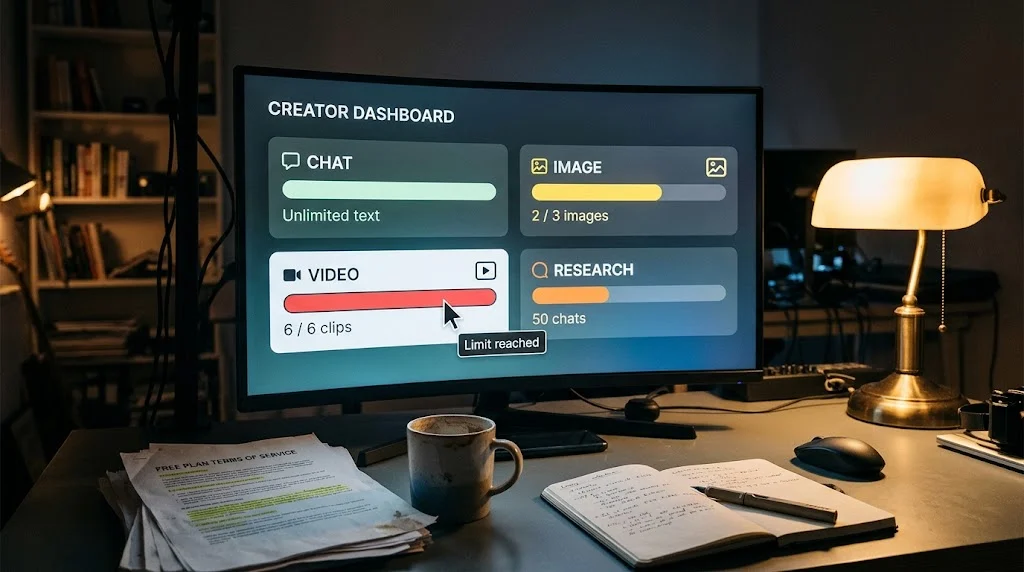
A free AI generator lets you create text, images, video, or audio without paying upfront, but free tiers in 2026 impose real boundaries on model access, output volume, and commercial rights. Google Vids now offers six free AI video generations monthly, ChatGPT provides limited daily image creation, and NotebookLM allows 50 source uploads per notebook at no cost .
At-a-Glance Box
- “AI generator” is not one tool. The keyword covers chat, images, video, audio, and writing. Free tiers differ wildly across categories.
- Google Vids is the newest free video option. Six monthly AI clip generations at 1080p with SynthID watermarking, desktop only .
- NotebookLM leads free research synthesis. 100 notebooks, 50 sources each, 50 daily chats, and 3 Audio Overviews per day at zero cost .
- Image generation splits on commercial rights. Some free tiers permit it; others prohibit it or retain ownership of your output.
- Free chat is generous on text, tight on frontier models. Unlimited conversations exist, but the best models sit behind paywalls.
- Open-source remains the only unrestricted path. Self-hosted models eliminate quotas and watermarks, but require hardware and setup.
What “AI Generator Free” Actually Means
The phrase ai generator free covers an enormous range of tools. Someone searching it might want a chatbot, an image creator, a video maker, a writing assistant, or a music generator. The free tiers for each category operate under different rules.
This guide maps the current landscape by category. It focuses on what each major free tier actually delivers, what it quietly withholds, and which tools match which use cases. The goal is not to list every free AI tool. It is to explain what “free” means for each type of generator, so you can choose with clear expectations.
How Free Tiers Differ by Category
Chat and Text Generators
Free AI chat is the most mature category. ChatGPT offers unlimited text conversations on GPT-5.6 Luna, though access to newer models like GPT-6 Astra requires payment. Claude provides Sonnet 4.6 on its free tier with a 200K context window, but limits usage to roughly 15 to 40 messages per rolling five-hour window. DeepSeek stands apart with no paid consumer plan at all, offering its full model for free subject to server congestion.
The pattern across chat tools is consistent: free users get capable models, not frontier models. The gap between free and paid capability is real and widening as providers reserve their best systems for subscribers.
Image Generators
Free image generation is more fragmented. Some tools permit commercial use on free tiers; others prohibit it outright. Some watermark output; others do not.
Google Gemini generates roughly 20 images daily on its free tier, but applies a visible Gemini logo. Google ImageFX, built on Imagen 4, produces higher-quality output with no visible watermark, though daily limits hover around 10 to 15 images and Google does not publish an official cap. ChatGPT offers only 2 to 3 daily images but grants commercial rights and applies no visible watermark.
Leonardo.AI provides 150 daily tokens, the most usable recurring allowance among hosted tools, but free-tier generations are public and the free plan does not own its outputs. Microsoft Designer prohibits commercial use entirely on its free tier.
Video Generators
Free AI video generation expanded significantly in 2026. Google Vids now lets personal Google account holders generate AI video clips at no cost using Gemini Omni 1.1 Flash . The allowance is six AI video clip or avatar generations per month combined, with 1080p output and SynthID watermarking embedded in every frame . Generation and editing workflows are restricted to desktop browsers.
The monthly allowance is small. Six clips per month supports occasional experimentation, not regular content production. The rollout signals a broader trend: video generation is becoming accessible, but free volume remains constrained by inference costs.
Writing and Research Generators
NotebookLM is the strongest free tool for source-grounded research synthesis. It allows 100 notebooks, each supporting up to 50 sources, 50 daily chats, and 3 Audio Overviews per day . The tool grounds its answers in your uploaded documents, citing sources rather than generating unsupported claims.
For general writing, Grammarly Free offers unlimited corrections and 100 AI prompts per month . QuillBot’s free paraphraser caps queries at 125 words, with tone modes gated behind a subscription . The pattern across writing tools is that free tiers provide useful daily assistance but restrict volume and advanced features.
Platform-by-Platform Breakdown
| ChatGPT | Chat / Images | Unlimited text, 2–3 images/day | Permitted | Tiny image quota |
| Claude | Chat | ~15–40 messages / 5 hrs | Permitted | No frontier models |
| DeepSeek | Chat | No published cap | Check terms | Server congestion |
| Google Vids | Video | 6 clips/month | Restricted | Desktop only, SynthID |
| NotebookLM | Research | 100 notebooks, 50 sources each | Personal use | Source-grounded only |
| Google Gemini | Images | ~20 images/day | Permitted | Visible logo |
| Google ImageFX | Images | ~10–15 images/day | Restricted terms | Unpublished caps |
| Leonardo.AI | Images | 150 tokens/day | Free plan does not own output | Public generations |
Google Vids: The New Free Video Option
Google Vids opened free AI video generation to personal Google accounts in September 2026 . The tool uses Gemini Omni 1.1 Flash to generate 1080p clips from text prompts, with controls for scene extension, clip duration, and upscaling .
The limitations are structural. Six monthly generations is enough to test the tool’s capabilities, not enough to build a workflow. Every frame carries an imperceptible SynthID watermark, which matters for provenance compliance but not for visual quality . Mobile users can view finished output but cannot generate or edit.
For small teams and independent creators who need occasional short clips, the free tier provides a legitimate entry point. For anyone producing video regularly, the allowance runs out quickly.
NotebookLM: Free Research Synthesis
NotebookLM’s free tier is unusually generous for a tool tied to a major AI provider. The 100-notebook allowance, 50 sources per notebook, and 3 daily Audio Overviews support sustained research workflows without payment .
The constraint is scope. NotebookLM works only with sources you upload. It does not crawl the web or generate answers from its training data. That makes it reliable for document analysis and less useful for open-ended questions.
For students, researchers, and analysts who need to synthesize their own materials, NotebookLM’s free tier is the strongest option available. For anyone seeking a general-purpose AI assistant, it is not a substitute.
The Commercial Rights Divide
Free AI generators diverge most sharply on commercial use. The distinction matters for freelancers, small businesses, and anyone monetizing output.
Permitted on free tiers: ChatGPT images, Google Gemini images, Claude text, DeepSeek text (subject to terms). Prohibited or restricted: Microsoft Designer images, Leonardo.AI free outputs, Google Vids clips (personal use emphasis). Unclear or changing: Google ImageFX terms, NotebookLM outputs.
The absence of a watermark does not imply commercial permission. Always verify the current terms before using free-tier output for client work or monetized content.
Privacy and Data Considerations
Free AI generators process everything you send them. What happens to that data varies by provider and category.
Google’s Gemini API free tier explicitly states that content is used to improve its products. The paid tier carries the opposite policy . ChatGPT and Claude publish privacy policies that may allow free-tier conversations to be used for training unless users opt out. NotebookLM’s source-grounded design limits its data collection to uploaded documents, but those documents are still processed on Google’s servers.
No major free AI generator publicly commits to Zero Data Retention. SOC 2 certification, where present, addresses organizational controls rather than whether individual prompts or files are stored. Assume free-tier inputs are retained unless the provider states otherwise.
Common Mistakes With Free AI Generators
Treating “free” as a category. A free video generator and a free chat tool operate under completely different constraints. Read the specific terms for the tool you are using.
Ignoring commercial rights. Microsoft Designer prohibits commercial use. Leonardo’s free plan does not own its outputs. A watermark-free image is not automatically yours to sell.
Planning volume around unpublished limits. Google ImageFX does not publish its daily cap. Copilot does not disclose daily question limits. Building a workflow around an opaque quota invites disruption.
Assuming free models match paid ones. ChatGPT’s free tier runs older models. Gemini’s free tier lost Flash and Pro access in October 2026. The capability gap is real.
Overlooking public visibility. Leonardo and Recraft publish free-tier images by default. Confidential or client work should not go through these tools without a paid plan.
Who Should Use a Free AI Generator
Casual users testing a concept can use ChatGPT for text and images, or Google Vids for a short video experiment. The free allowances cover occasional needs without commitment.
Students and researchers should use NotebookLM for source synthesis and Claude for long-document analysis. Both free tiers provide genuine utility for document-heavy work.
Small teams producing occasional content can use Google Vids for short promotional clips, accepting the six-clip monthly limit and desktop requirement.
Anyone needing commercial output should verify commercial rights before using any free tier. ChatGPT images and Google Gemini images permit commercial use; many other free tools do not.
Developers and technical users with GPU access should explore open-source models for unrestricted generation. The setup cost pays for itself in eliminated quotas.
Latest Developments
Google’s September 2026 expansion of Vids to personal accounts was the most significant free AI generator announcement of the year . Six free monthly video generations at 1080p, with SynthID watermarking, brings generative video into the same accessibility tier as image and text generation, albeit with tight volume limits.
The broader trend is toward category-specific free tiers. Chat remains generous on text volume but restrictive on model access. Image generation is fragmented on rights and watermarks. Video generation is newly accessible but volume-constrained. Research tools like NotebookLM offer the most usable free allowances because their scope is narrower.
The next shift will likely come from regulatory pressure. Provenance requirements like the EU AI Act’s Article 50, taking effect in August 2026, are pushing platforms toward embedded watermarking. Free tiers that currently offer unwatermarked output may face legal constraints in some markets.
Conclusion
Free AI generators vary in usage limits, model access, and commercial rights. The best choice depends on your needs, whether it’s chatting, image creation, video generation, or research.
Before choosing a tool, check its current free limits, commercial-use policy, and data privacy terms. The best free AI generator is the one that fits your needs without unexpected restrictions.