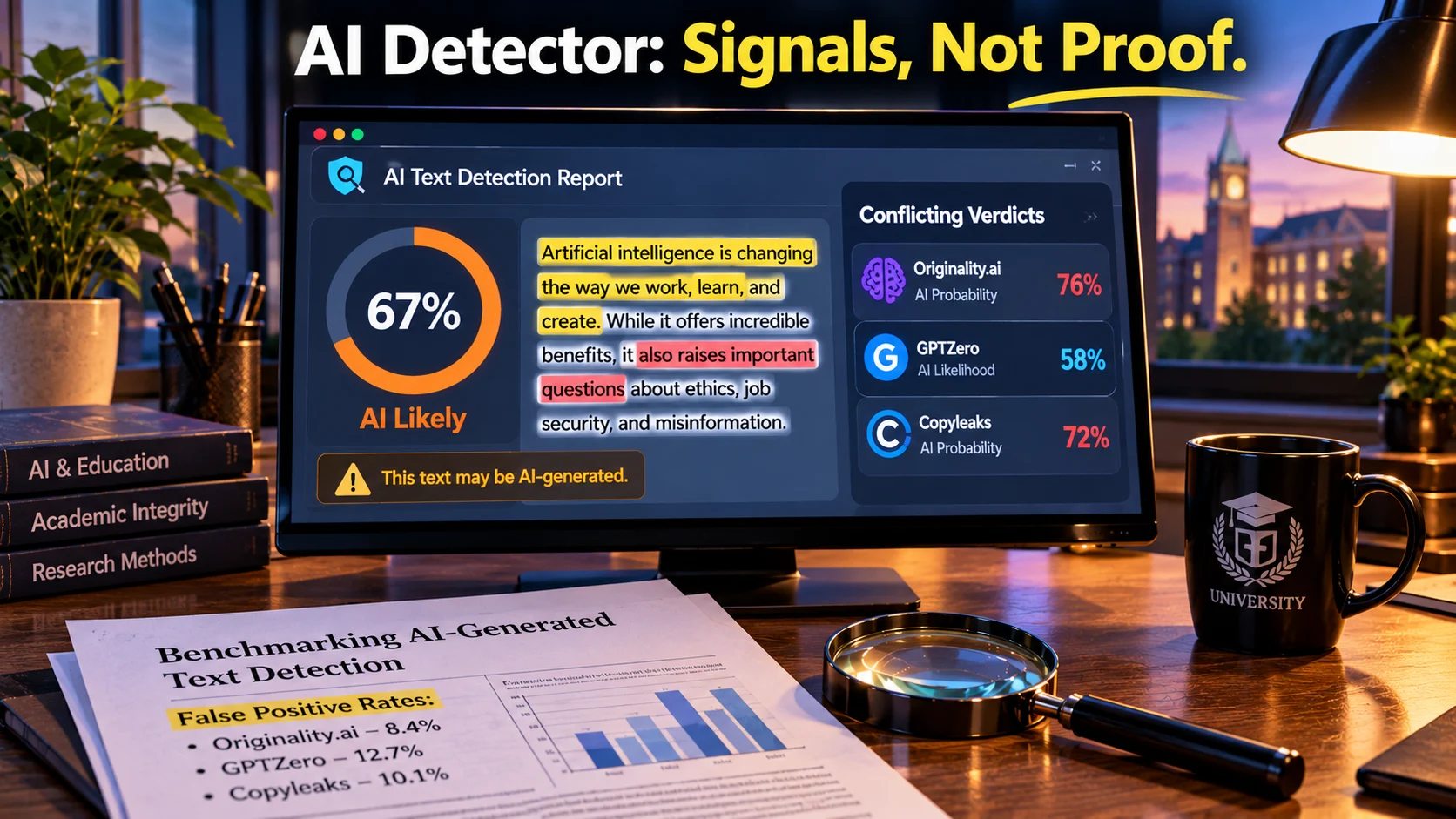
An AI detector is a tool that estimates whether text was generated by artificial intelligence, typically by analyzing statistical patterns like perplexity and burstiness. Independent research shows accuracy varies widely, with false positive rates between 15.6% and 30.6% and significantly reduced performance on hybrid human-AI texts, raising serious questions about using these tools for high-stakes decisions .
At-a-Glance: Key Takeaways
- Accuracy varies dramatically by tool and text type. A 2026 IEEE benchmark found Originality.ai achieved 84.4% accuracy, while ZeroGPT scored 69.4% .
- False positive rates are concerning. The same study found false positives ranging from 15.6% to 30.6%, meaning human-written text is regularly misclassified as AI .
- Hybrid texts break detectors. Accuracy dropped to 54.2%-70.8% on human-AI collaborative writing, with tools often disagreeing completely on the same text .
- Detectors disagree with each other. On hybrid texts, inter-rater agreement fell to chance level (kappa 0.02), with 28 of 30 texts receiving both a human and AI verdict from different tools .
- Pricing ranges from free tiers like GPTZero’s 10,000 words monthly to Copyleaks at $13.99/month and Originality.ai at $12.95/month annually .
- No detector is suitable as sole evidence for academic misconduct or employment decisions without human review.
What Is an AI Detector?
An AI detector is a software tool that analyzes text and estimates the probability that it was generated by a large language model rather than written by a human. The technology is used in academic integrity enforcement, content publishing, hiring, and SEO quality control.
Detectors typically analyze statistical properties of text. Language models produce text with predictable patterns: lower perplexity (more “expected” word choices) and lower burstiness (more uniform sentence structure). Human writing tends to be more varied and less predictable. Detectors learn these patterns from training data and classify new text accordingly.
The fundamental limitation is that detectors do not detect AI. They detect patterns that correlate with AI generation. A human writing in a formal, predictable style may trigger the same signals as a language model. An AI model prompted to write variedly may evade detection. This distinction matters for every high-stakes application.
How Accurate Are AI Detectors?
The research landscape is consistent on one point: no detector is reliable enough for autonomous decision-making.
The IEEE Benchmark (2026)
A peer-reviewed study evaluated five widely-used detectors against 180 academic writing samples: human-written, AI-generated, and hybrid texts .
| Originality.ai | 84.4% | 15.6% |
| Turnitin AI | Moderate | Lower FPR but high false negatives |
| Copyleaks | Moderate | 30.6% |
| GPTZero | Moderate | Moderate |
| ZeroGPT | 69.4% (lowest) | 30.6% |
The study confirmed statistically significant performance differences across tools. More importantly, all detectors performed substantially worse on hybrid texts, with accuracy dropping to 54.2%-70.8% .
The Inter-Rater Reliability Problem
A separate 2026 study treated nine commercial detectors as independent raters of 90 academic texts . The findings were stark:
- Overall agreement was substantial (Krippendorff’s alpha 0.71).
- On hybrid human-AI texts, agreement fell to chance level (mean pairwise kappa 0.02).
- 28 of 30 hybrid texts received both a human verdict and an AI verdict from different tools.
- The median per-text score range was 100 points.
The authors concluded: “On mixed human-AI writing, the classification a text receives relies more on the choice of detector than on the text itself” .
Turnitin’s False Negative Problem
A 2026 study in De Gruyter Brill replicated Turnitin’s low false positive rate but found a substantially higher false negative rate, even more so for the latest ChatGPT model (GPT-5). The authors emphasized “the need for cautious interpretation of AI-detection scores, particularly as generative models continue to evolve” .
Editorial interpretation: The research consensus is that AI detectors are probabilistic screening tools, not forensic instruments. Using them as the sole basis for misconduct findings or content rejection creates unacceptable error rates.
The Major AI Detectors Compared
Pricing and Access
Free Tiers
GPTZero offers 10,000 words per month free . Copyleaks provides limited free credits. Most tools offer trials rather than permanent free tiers.
Paid Plans
Originality.ai costs $12.95/month billed annually or $14.95 monthly, operating on credits . Copyleaks charges $13.99/month for 1,200 credits (up to 300,000 words or 1,200 images) . **Winston AI** starts at $14/month . Grammarly Premium is $12/month billed annually .
Important pricing context: Credit systems create unpredictable costs. A 5,000-word document consumes multiple credits, and heavy users may exceed plan allowances quickly. The IEEE study’s finding that accuracy varies by tool means paying more does not guarantee proportionally better results.
Privacy and Security Considerations
AI detectors process submitted text on remote servers. Most are consumer or institutional tools without published enterprise security certifications.
What to check before uploading:
- Whether submitted text is used for model training
- How long text is retained
- Whether the tool complies with GDPR or FERPA
- The vendor’s data processing agreement
Important distinction: No SOC 2 certification or similar compliance framework is uniformly referenced for AI detectors. Educational institutions processing student work should review vendor agreements carefully, especially given the false positive rates documented in research.
Who Should Use an AI Detector
Educators and administrators should use detectors as screening signals only, never as sole evidence for misconduct. The 15.6%-30.6% false positive rates mean human review is mandatory before any adverse action .
Publishers and editors can use detectors to flag content for manual review, but should not reject submissions based on detector scores alone. The inter-rater disagreement on hybrid texts makes single-tool verdicts unreliable .
Researchers studying AI detection can use the published benchmarks and corpora to evaluate new tools. The IEEE and Zenodo studies provide replicable methodologies .
Anyone seeking definitive answers about whether a specific text was AI-generated will not find them. Detectors provide probabilities, not certainties. The technology is not forensic.
Common Mistakes and Cautions
Treating detector scores as proof. Research shows 28 of 30 hybrid texts received contradictory verdicts from different tools . A single score is not evidence.
Ignoring false positive rates. 15.6%-30.6% of human-written text is misclassified as AI in benchmark testing . Penalizing someone based on a detector score risks punishing authentic work.
Assuming hybrid text is detectable. Accuracy drops to 54.2%-70.8% on collaborative writing . Detectors cannot reliably distinguish human editing from AI generation.
Overlooking model evolution. Turnitin’s false negative rate increased for GPT-5 compared to earlier models . As models improve, detectors fall further behind.
Using free tiers for high-stakes decisions. Free allowances are for testing, not for misconduct investigations or content rejection at scale.
Frequently Asked Questions
What is the most accurate AI detector?
In the 2026 IEEE benchmark, Originality.ai achieved the highest overall accuracy at 84.4%, followed by other tools in the 69.4%-84.4% range. However, even the best tool had a 15.6% false positive rate, making no detector suitable as sole evidence .
Can AI detectors be wrong?
Yes, frequently. False positive rates range from 15.6% to 30.6%, meaning human-written text is regularly flagged as AI. Detectors also disagree with each other at chance level on hybrid texts .
Do AI detectors work on ChatGPT text?
Performance varies by model and tool. Turnitin’s false negative rate was higher for GPT-5 than earlier models, meaning newer AI text is harder to detect. Originality.ai claims detection of GPT-5, Claude, and Gemini, but independent accuracy varies .
Is there a free AI detector?
GPTZero offers 10,000 words monthly free. Copyleaks and others provide limited trials. Most professional-grade detectors require paid subscriptions .
Can I use AI detector results for academic misconduct?
Research strongly cautions against it. The 15.6%-30.6% false positive rate and inter-rater disagreement on hybrid texts mean detector scores should be used only as screening signals, with human review and contextual evidence before any adverse action .
Conclusion
AI detectors occupy an uncomfortable position in the technology landscape. They are widely deployed in academic and professional settings, yet independent research consistently shows they are unreliable for the decisions they are asked to support.