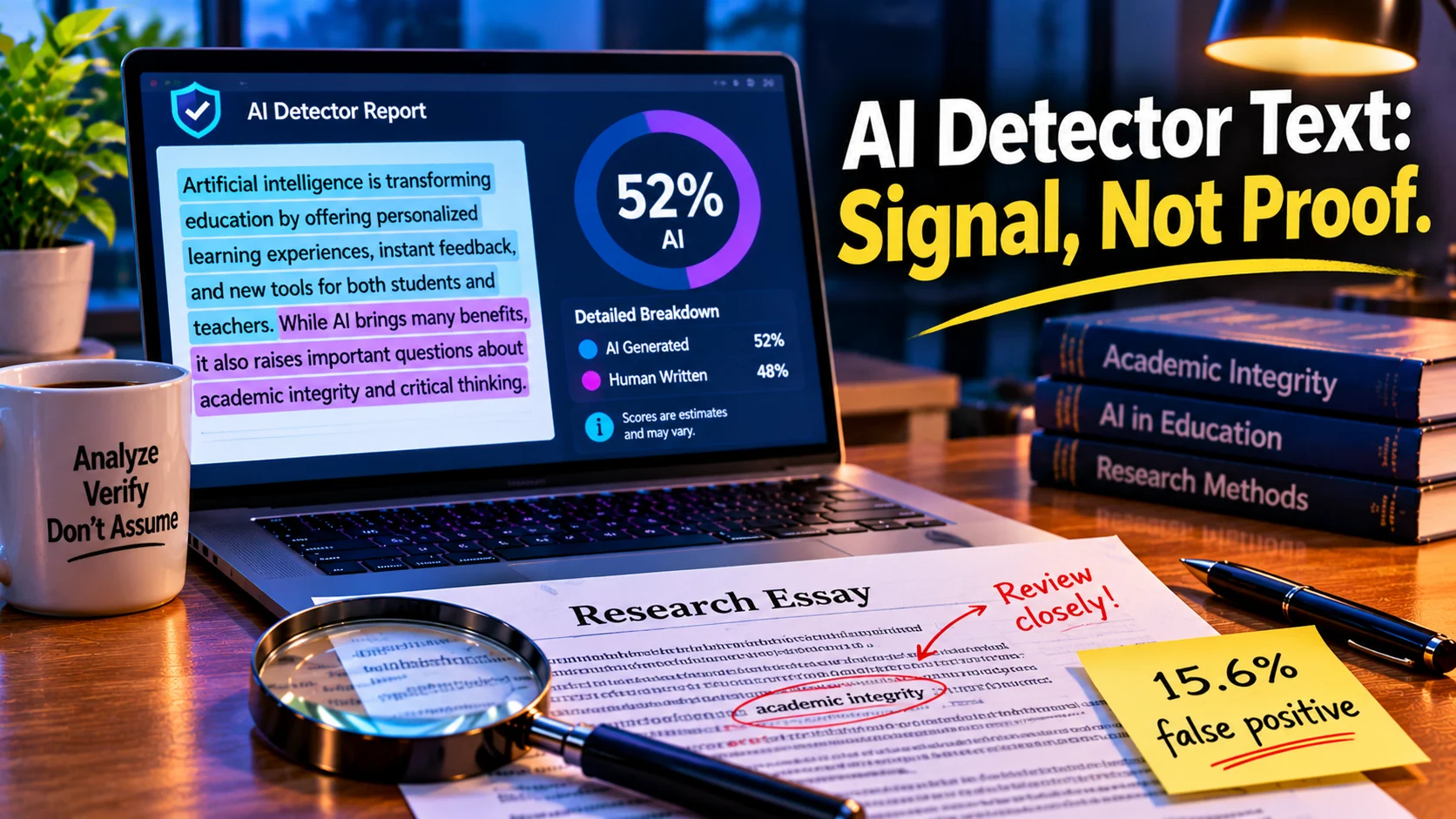
An AI detector text score estimates the likelihood that a passage was machine-generated, but it does not prove authorship. Independent research shows false-positive rates of 15.6% to 30.6% across major tools, with accuracy dropping to 54.2%–70.8% on hybrid texts that mix human and AI writing .
At-a-Glance: Key Takeaways
- False positives are a documented problem. A 2026 IEEE study found rates of 15.6% to 30.6% across five major detectors, raising “substantial concerns for equitable academic integrity enforcement” .
- Hybrid texts defeat detection. When human and AI writing mix, accuracy collapses to 54.2%–70.8%, meaning the tools struggle with the most common real-world scenario .
- No single tool dominates. Originality.ai led the IEEE study at 84.4% accuracy, while ZeroGPT scored lowest at 69.4%. Performance varies wildly by dataset and text type .
- Non-native and formulaic writers are disproportionately flagged. Structured, formal writing patterns trigger false positives at higher rates .
- The score is a probability, not a verdict. Detectors analyze patterns like perplexity and burstiness, not copied content. They cannot know intent or authorship .
- Vendors themselves caution against sole reliance. Turnitin states its model “may not always be accurate” and should not be the sole basis for adverse action.
What Is an AI Detector Text Score?
An AI detector text score is a numerical estimate of how likely a piece of writing was generated by a large language model. It is not a plagiarism check. Plagiarism tools compare your text against existing sources. AI detectors analyze internal writing patterns and assign a probability based on how closely the text matches AI-like behavior .
The score typically appears as a percentage. A 50% score means the model identified roughly half of the analyzed text as likely AI-generated. It does not mean there is a 50% chance the student cheated.
The distinction matters because the consequences of a high score can be severe: academic misconduct investigations, delayed graduation, and reputational harm. The tools are making probabilistic judgments about style, not factual determinations about authorship.
How AI Detectors Analyze Text
Detectors rely on statistical signals learned from training data. Two commonly cited features are perplexity and burstiness .
Perplexity measures predictability. AI models tend to choose the most statistically likely next word, producing text that feels even and predictable. Human writing includes more variation in word choice.
Burstiness measures variation across sentences. Human writing mixes short and long sentences, creating rhythm shifts. AI-generated text often maintains a more uniform pace.
Modern detectors, including Turnitin, use transformer-based models trained on large corpora rather than hand-coded rules. They learn patterns from data and output scores through many learned features working together. This makes their reasoning opaque, even to the vendors selling them.
A 2026 arXiv paper found that diffusion-based language models produce text nearly indistinguishable from human writing on these metrics, resulting in high false-negative rates for detectors trained on autoregressive models . As generation methods diversify, detection becomes harder.
The Accuracy Problem in Numbers
The evidence on detector accuracy is fragmented but consistently points to unreliability.
The IEEE Benchmark
The most comprehensive recent comparison, published at an IEEE conference in May 2026, tested GPTZero, Turnitin, Copyleaks, ZeroGPT, and Originality.ai against 180 academic writing samples .
| Originality.ai | 84.4% (highest) | 54.2%–70.8% range |
| ZeroGPT | 69.4% (lowest) | 54.2%–70.8% range |
| False Positive Rate | 15.6%–30.6% across tools | — |
The study’s authors concluded that false positive rates in this range “raise substantial concerns for equitable academic integrity enforcement” .
Turnitin’s Specific Weakness
A De Gruyter study focused specifically on Turnitin found its false-negative rate was “substantially higher” than its false-positive rate, and even more so for GPT-5. The authors emphasized “the need for cautious interpretation of AI-detection scores, particularly as generative models continue to evolve” .
A separate Springer study testing Turnitin on 120 scientific texts found sensitivity of just 0.27 (meaning it caught only 27% of AI-generated texts) and specificity of 0.31 . These are poor numbers by any standard.
Vendor Claims vs. Independent Data
Vendors publish their own benchmarks. Winston AI cites a peer-reviewed study of 24 texts where it ranked first at 99% accuracy . That is a tiny sample. The IEEE study used 180 samples and found very different results.
The honest reading is that there is no universal accuracy figure. Performance swings widely with the tool, the sample, and the settings .
Why Detectors Fail
Hybrid Text Defeats the Models
The IEEE study’s most important finding was the collapse in accuracy on hybrid texts . A student who uses AI for brainstorming or editing but writes the final draft themselves produces text that detectors cannot reliably categorize.
This is the most common real-world scenario. Students use AI as a tool, not a replacement. The detectors are built for a binary world that does not exist.
The Non-Native Writer Bias
HEPI’s analysis is direct: the false-positive rate “is worst precisely on the writing of students who learned English later” . Formulaic, structured writing taught to second-language learners triggers the same patterns detectors associate with AI.
A University of Melbourne tutor described the dynamic: students who write in a highly structured manner “are the ones who tend to get flagged.” The university’s student advocacy service stated it does “not believe the Turnitin AI detection tool is reliable enough to be used on its own.”
The False Positive Cascade
Vanderbilt University did the arithmetic when Turnitin reported a 1% false-positive rate. With 75,000 papers per year, that implied roughly 750 pieces of real student work wrongly flagged as AI . The university judged the tool too unreliable for assessment and switched it off.
A number that sounds trivial in a vendor brochure becomes hundreds of individuals when it meets a real cohort. Each of them is then asked to prove they did their own work.
What the Score Actually Means
| 0% | Detector did not flag the text. Not proof of human authorship; false negatives are documented. |
| 1-20% | Unreliable range. Turnitin suppresses exact scores below 20% because false positives are higher. |
| 20-100% | A signal for review, not a verdict. The model identified patterns associated with AI, but it can be wrong. |
The score answers one question: “How closely does this text match patterns the model associates with AI generation?” It does not answer: “Did this person write this?”
Who Should Rely on AI Detector Scores
Institutions with clear policies and human review capacity may use scores as one signal among many. The score can start a conversation, prompt a request for drafts, or trigger a discussion about process. It should not trigger automatic penalties.
Institutions without review capacity should reconsider using detectors at all. The documented harms, including delayed investigations, stress on students, and dropped allegations, suggest the tool creates more problems than it solves when used as a primary trigger.
Educators should understand the bias against non-native writers and adjust their processes accordingly. A high score from a student who learned English later is not evidence of AI use. It may be evidence of formulaic writing instruction.
Individual writers should not treat a detector score as an objective measure of their work. The tools are probabilistic and biased. A high score means the text triggered patterns, not that the writing is not yours.
Common Mistakes and Cautions
Treating the percentage as a probability of misconduct. A 50% score does not mean 50% chance of cheating. It means the model flagged half the analyzed text. The model can be wrong, and it frequently is.
Ignoring the 20% threshold. Turnitin suppresses scores below 20% because that range is unreliable. An asterisk is a warning, not a low-level flag.
Using the score as sole evidence. Turnitin itself states the model “may not always be accurate” and should not be the sole basis for adverse action. Independent researchers and student advocacy groups agree.
Overlooking the non-native writer bias. The false-positive rate is highest for students who learned English later. Institutions should monitor for disparate impact.
Assuming 0% means clean. The De Gruyter study found Turnitin’s false-negative rate was substantially higher than its false-positive rate . A 0% score means the model did not flag the text, not that the text is human-written.
Frequently Asked Questions
How accurate are AI detector text scores?
Accuracy varies widely. The 2026 IEEE study found overall accuracy ranging from 69.4% (ZeroGPT) to 84.4% (Originality.ai), with false-positive rates of 15.6% to 30.6% . Turnitin’s sensitivity in one study was just 27% . There is no universal accuracy figure.
Why do AI detectors flag human writing?
Detectors analyze patterns like perplexity and burstiness. Formulaic, structured, or formal writing can trigger the same patterns associated with AI generation. Non-native English writers are disproportionately affected . A high score means the text looks a certain way, not that it was generated by AI.
Can AI detectors detect paraphrased text?
Some can, but reliability is poor. The IEEE study found all tools performed poorly on hybrid texts that mix human and AI writing, with accuracy dropping to 54.2%–70.8% . Paraphrasing tools further reduce detectability.
What does a 0% AI score mean?
A 0% score means the detector did not identify the text as likely AI-generated. It does not prove human authorship. False negatives are documented, particularly with newer models like GPT-5 .
Should institutions use AI detectors?
Only with caution and human review. The false-positive rate of 15.6%–30.6% means hundreds of students could be wrongly flagged at scale . Detector scores should be one signal among many, never the sole basis for misconduct proceedings.
Conclusion
AI detector text scores are probabilistic estimates of style, not factual determinations of authorship. The evidence is clear: false positives are common, hybrid texts defeat the models, and non-native writers are disproportionately flagged.