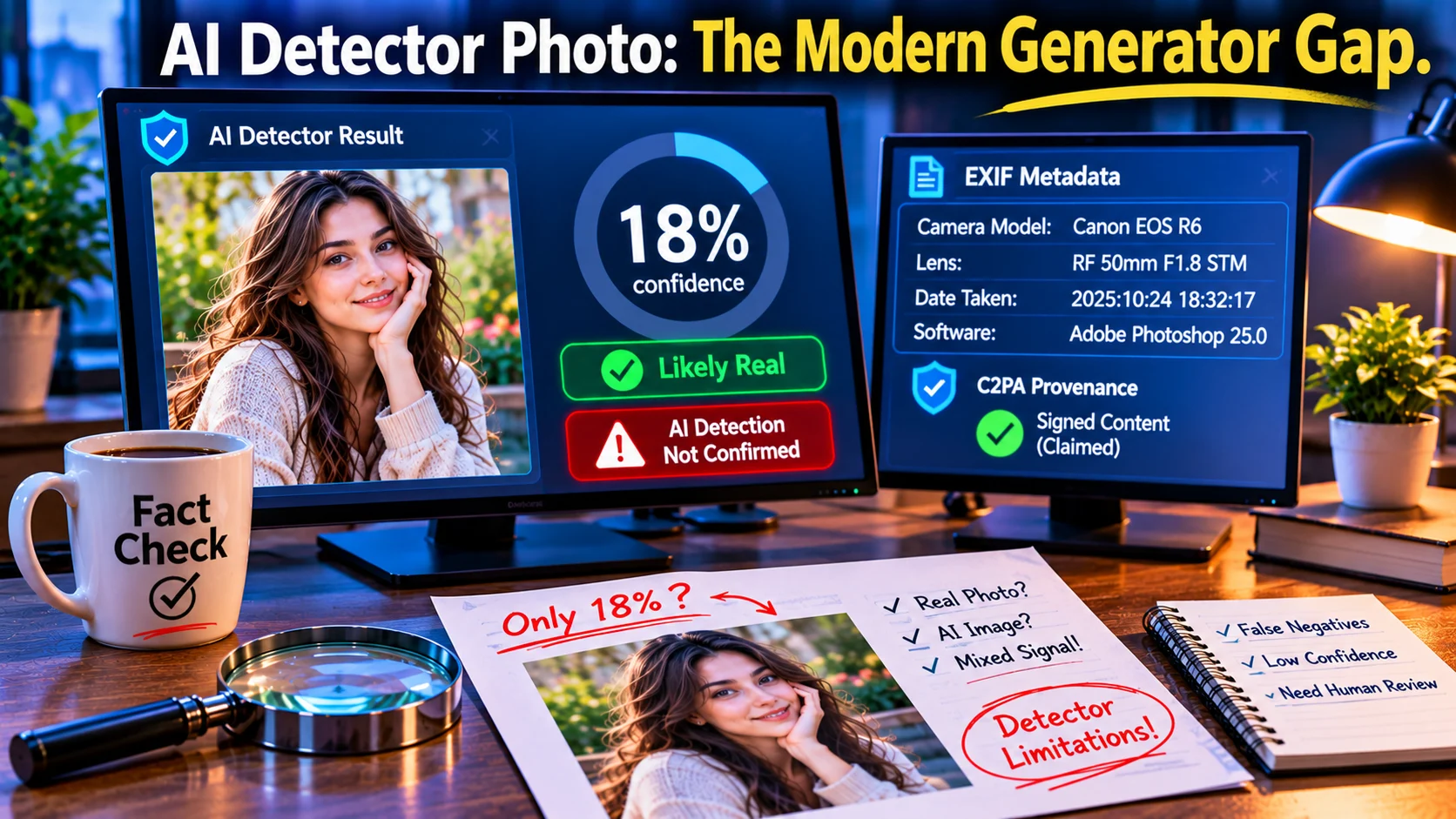
An AI detector photo tool estimates whether an image was generated by artificial intelligence, but performance collapses on modern generators. A 2026 benchmark found commercial models like Flux Dev, Firefly v4, and Midjourney v7 defeat most detectors, achieving only 18-30% average accuracy. No universal winner exists, and detector rankings shift wildly across datasets.
At-a-Glance: Key Takeaways
- Modern generators defeat detectors. Flux Dev, Firefly v4, and Midjourney v7 achieved only 18-30% average detection accuracy in a comprehensive benchmark of 23 detector variants .
- No universal winner exists. Detector rankings show substantial instability, with Spearman correlations ranging from 0.01 to 0.87 across dataset pairs .
- Text-rich images are a blind spot. No detector exceeded 80% accuracy on fabricated screenshots and documents, with some dropping over 60% from natural-image benchmarks .
- Metadata is more reliable than visual analysis. Camera EXIF tags and C2PA provenance provide stronger signals than deep learning detectors alone .
- Smaug AI Image Detector leads open-source options, catching 86.7% of AI images on Reddit at a 5% false-alarm rate .
- Commercial APIs outperform open-source, but even the best struggle with operating-point reliability .
What Is an AI Detector Photo Tool?
An AI detector photo tool is software that estimates whether an image was generated by artificial intelligence rather than captured by a camera. The category spans commercial APIs, open-source models, and free browser tools.
The search intent is commercial investigation mixed with informational. Users want to know which tools work, how accurate they are, and whether they can trust the results. The answer is more complicated than vendors suggest.
The fundamental problem is that detectors are trained on patterns from past generators. When a new generator produces images with different artifacts, the detector fails. As one benchmark noted, “training data alignment critically impacts generalization,” causing up to 20-60% performance variance within architecturally identical detector families .
How AI Photo Detectors Work
The Visual Artifact Approach
Most detectors analyze visual features: frequency patterns, compression artifacts, noise distributions, and structural inconsistencies. Early detectors focused on GAN-generated images, which left distinctive fingerprints. Diffusion models produce different artifacts, and modern commercial generators have minimized them further.
A 2026 paper on self-supervised detection noted that camera-captured photographs carry intrinsic features that AI-generated images lack. The researchers trained a model to classify EXIF tags like camera model and scene type, then flagged images that deviated from the photographic distribution . This metadata-based approach proved more robust than pure visual analysis.
The Metadata Approach
Metadata inspection is the most reliable signal. Camera EXIF tags, C2PA Content Credentials, and SynthID watermarks provide direct evidence of provenance.
The issynthetic Python library uses a four-layer system starting with metadata inspection: C2PA, PNG chunks, EXIF/XMP, and video metadata . This is more reliable than guessing from pixels because it checks what the file itself declares.
The limitation is that metadata can be stripped. Social media platforms often remove EXIF data during upload. Screenshots lose provenance. Malicious actors can strip or forge metadata.
The Multimodal LLM Approach
A newer approach uses vision-language models to detect structural or physical inconsistencies. A 2026 study tested GPT-4o, GPT-5, GPT-5.2, Gemini 2.5, Gemini 3, and Seed 1.6 on 400 images. GPT-5.2 reached 97.9% accuracy in pairwise comparison, with an overall mean of 82.5% .
The study found that MLLMs detect fakes by identifying physical impossibilities, not digital artifacts. However, the presence of SynthID watermarks reduced Gemini’s detection accuracy by 10%, suggesting watermarks can suppress the artifacts models rely on .
The Accuracy Problem in Numbers
The Modern Generator Problem
The most comprehensive 2026 benchmark evaluated 23 pretrained detector variants across 12 datasets with 2.6 million images from 291 generators. Key findings :
| Best detector | 75.0% mean accuracy |
| Worst detector | 37.5% mean accuracy |
| Performance gap | 37 percentage points |
| Modern commercial generators | Only 18-30% average accuracy |
| Ranking instability | Spearman correlations 0.01-0.87 |
The detectors that performed well on older benchmarks failed on the generators people actually use today: Flux Dev, Firefly v4, and Midjourney v7 .
The Text-Rich Blind Spot
The TextFake benchmark tested 14 specialized detectors and 3 frontier VLM APIs on 20,000 text-rich images across 28 languages. No method exceeded 80% accuracy. Some dropped over 60% from their natural-image benchmark performance .
The failure modes were identified as:
- Text Density Curse: dense glyphs overwhelm low-level detectors
- Cloaking via Rendering Fidelity: stronger text rendering suppresses generative artifacts
- Threshold Collapse: routine perturbations drive detectors toward chance-level performance
The Open-Source Leader
Smaug AI Image Detector, released in October 2026, claims the strongest open-source performance on real-world images. On the OpenFake Reddit benchmark, it caught 86.7% of AI images at a 5% false-alarm rate, compared to 77.4% for the next best open-source detector .
Smaug covers modern generators including GPT-Image 2, Nano Banana Pro, Midjourney 7, Seedream 5, FLUX.2, and frames from Sora 2 and Veo 3. It runs on a single consumer GPU with about 1 GB of memory, or on CPU .
The Commercial API Advantage
A cross-paradigm benchmark of 36 models found that commercial APIs achieve the strongest median performance, followed by vision LLMs and open-source detectors . However, individual open-source models remain competitive with the best vision LLMs.
The benchmark’s central finding was a “consistent divergence between ranking ability (ROC-AUC) and operating-point quality (MCC),” meaning a model that ranks well may still produce unreliable default-threshold decisions .
The Evasion Problem
Detectors can be defeated with simple image processing. A 2026 benchmark introduced 156 executable image-processing tools derived from 220 public sources. The strongest individual tools achieved attack success rates of 25.25% to 100% across detectors. An eight-tool pool achieved worst-case coverage above 80% for every detector tested .
This means anyone motivated to evade detection can do so with publicly available tools. The detectors are not robust to adversarial manipulation.
What Works and What Doesn’t
| Metadata (C2PA, EXIF) | High when present | Stripped by platforms, absent in screenshots |
| SynthID watermarks | High when present | Only for Google-generated images; may suppress other signals |
| Open-source detectors (Smaug) | Moderate on real-world images | Struggles on modern commercial generators |
| Commercial APIs | Best median performance | Expensive; operating-point reliability varies |
| Vision LLMs | Good on physical inconsistencies | Inconsistent across model generations |
| Free browser tools | Low | High false negatives; limited testing |
Who Should Use an AI Detector Photo Tool
Journalists and fact-checkers should use detectors as one signal among many. The New York Times tested 12 services and found that many struggled with AI-generated images, though all correctly identified real photos . The recommendation was to corroborate detector conclusions with other research.
Platforms and moderation teams should invest in metadata infrastructure rather than relying on visual detection. C2PA provenance and SynthID watermarks provide stronger signals than pixel analysis.
Researchers should use benchmark results to select detectors for their specific threat model. The 2026 benchmark explicitly warns that practitioners “must carefully select detectors based on their specific threat landscape rather than relying on published benchmark performance” .
Casual users should treat free detector scores as suggestions, not verdicts. The tools fail on modern generators and can be easily evaded.
Anyone needing definitive proof should understand that no current detector provides it. Visual detection is probabilistic and unreliable. Metadata is stronger but often absent.
Common Mistakes and Cautions
Assuming high benchmark scores transfer to real-world images. Detectors reporting 91-96% on GenImage dropped to 60-76% on newer benchmarks .
Trusting free browser tools. The AIMultiple evaluation found all tested tools tended to misclassify AI-generated images as real, with no explanation for their confidence scores .
Ignoring the generator gap. A detector that works on Stable Diffusion may fail entirely on Midjourney 7 or Flux. The training data determines what the model can recognize.
Forgetting that metadata can be stripped. Social platforms remove EXIF. Screenshots lose provenance. The most reliable signal is often absent.
Overlooking adversarial evasion. Simple image processing can defeat most detectors with success rates up to 100% .
Frequently Asked Questions
How accurate are AI photo detectors?
Accuracy varies widely. A 2026 benchmark found the best detector achieved 75% mean accuracy, while modern commercial generators (Flux Dev, Firefly v4, Midjourney v7) defeated most detectors, achieving only 18-30% average accuracy .
What is the best AI image detector?
Smaug AI Image Detector leads open-source options, catching 86.7% of AI images on Reddit at a 5% false-alarm rate . Commercial APIs achieve the strongest median performance overall, but operating-point reliability varies . The best choice depends on your specific threat model.
Can AI detectors detect Midjourney images?
Poorly. The comprehensive benchmark found Midjourney v7 achieved only 18-30% average detection accuracy against most detectors . Modern commercial generators have minimized the artifacts detectors rely on.
Is metadata more reliable than visual detection?
Yes, when present. Camera EXIF tags and C2PA Content Credentials provide direct evidence of provenance . The limitation is that metadata is often stripped by platforms or absent in screenshots.
Can AI photo detectors be fooled?
Yes, easily. A 2026 benchmark found that simple image processing tools achieved attack success rates of 25.25% to 100% across detectors . Anyone motivated to evade detection can do so with publicly available tools.
Conclusion
AI detector photo tools are unreliable on the images people actually encounter. Modern commercial generators defeat most detectors. Text-rich fakes, the most common vector for misinformation, are a systematic blind spot. And simple image processing can evade detection entirely.