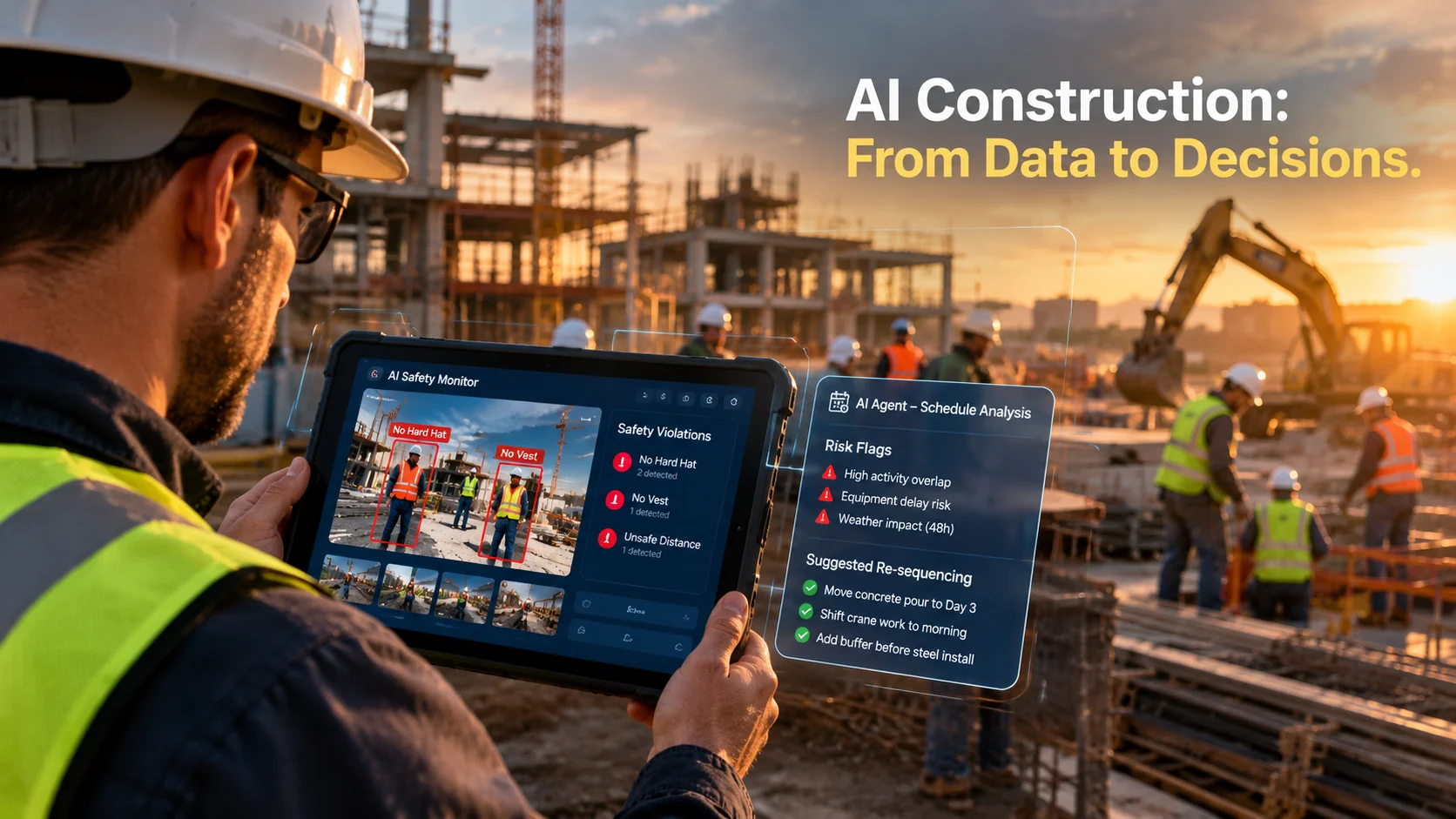
Quick Answer: AI construction refers to the use of artificial intelligence across the building lifecycle, from design and estimating to on-site safety monitoring and project management. The global AI in construction market was valued at roughly $3.9 billion in 2025 and is projected to grow at over 20% annually through 2035 .
At-a-Glance: Key Takeaways
- Adoption is accelerating. 38% of contractors report measurable business impact from AI in 2026, up from 17% a year earlier .
- Agentic AI is the new frontier. Systems like Procore’s Digital Coworker packages deploy autonomous agents for RFI review, safety monitoring, and schedule analysis .
- Safety applications deliver measurable results. Deployed systems show violation rectification rates increasing over 70% and repeat violations dropping 45% .
- Data quality remains the biggest bottleneck. Roughly 85% of failed AI pilots trace back to unreliable or fragmented data .
- Cost remains a barrier. Comprehensive AI rollouts often exceed $100,000 before benefits materialize, sidelining many subcontractors .
- The market is dividing. Contractors running AI in production are pulling ahead of firms still experimenting, particularly in estimating and bid management .
What Is AI Construction?
AI construction describes the application of artificial intelligence technologies across the architecture, engineering, and construction (AEC) industry. It spans the full project lifecycle: design optimization, cost estimating, scheduling, safety monitoring, quality control, and closeout documentation.
The technology is not a single product. It is a category that includes computer vision systems that watch for safety violations, large language models that review contracts, predictive analytics that forecast cost overruns, and autonomous agents that coordinate workflows across multiple systems.
Global construction output reached roughly $15 trillion in 2025, with demand projected to hit $22 trillion by 2040 . Yet productivity grew only 0.4% annually from 2000 to 2022, compared to 3.0% in manufacturing. This productivity gap explains why the industry is investing heavily in AI. McKinsey estimates AI and automation could unlock $228 billion in annual value in the U.S. alone by 2030 .
How AI Construction Works
Core Technologies in Deployment
AI construction systems rely on several technical foundations working together.
Computer vision processes site photos and video feeds to detect safety hazards, track progress, and identify quality deviations. Systems like WorkSafe Agent use YOLO-based models trained on construction safety datasets to detect personal protective equipment violations with over 91% accuracy .
Large language models handle document-heavy tasks. Contracts, RFIs, submittals, and specifications get parsed, summarized, and cross-referenced. Procore’s AI agents can review submittals and identify risks, with one customer reducing submittal review time from seven days to ten minutes .
Predictive analytics models schedule variations against resource constraints, weather patterns, and supply chain data. These systems flag potential delays and cost overruns weeks before they materialize .
Agentic AI represents the newest layer. Rather than passive monitoring, agents take action: locking machinery when a safety violation is detected, generating compliance reports, or re-sequencing schedules after a delay input .
BIM and AI Integration
Building Information Modeling provides the data foundation. A 2026 paper proposed a framework where LLMs query BIM models and construction documents through natural language, reducing manual information retrieval for sustainability tasks . Another study demonstrated automated progress monitoring using a single site photograph, where Claude matched the image to a 4D BIM model and calculated a 91.4% completion rate .
The challenge is data preparation. BIM parameters, classification codes, and document metadata must be explicitly structured for AI systems to query reliably .
Key Use Cases for AI in Construction
Estimating and Bid Management
This is the most active deployment zone. 24% of contractors use AI for cost estimating, and 22% for bid management . AI systems process historical project records to generate early-stage estimates and flag variance against forecasts. The functions are data-heavy and repetitive, making them well-suited to automation.
Safety Monitoring and Compliance
Computer-vision systems detect PPE violations, unsafe proximity to equipment, and other hazards in real time. The WorkSafe Agent framework combines vision detection, risk scoring, intervention, and reporting into an end-to-end system . Deployment results show measurable impact: over 70% increase in violation rectification rates, rectification delays reduced from hours to minutes, and 45% decline in repeat violations .
Schedule Optimization
Only 16% of contractors apply AI to scheduling, with 60% reporting no plans to adopt . This represents the widest opportunity gap. AI schedule agents reason over dependencies, resource calendars, and live progress data to re-sequence activities when delays occur, preventing cascading slippage.
Document Intelligence
Construction projects generate massive document volumes. AI agents review contracts, RFIs, submittals, and change orders to identify scope impacts, cost exposure, and required follow-up actions . Document Crunch and Trunk Tools focus specifically on this segment .
Progress Tracking
Automated progress monitoring compares site photos against BIM models to calculate completion percentages. Buildots, OpenSpace, and DroneDeploy offer field observation platforms that track installation progress against schedules .
Benefits of AI Construction
Measurable productivity gains. Contractors report 37% labor productivity gains and 41% fewer change orders when predictive planning flags clashes before crews mobilize .
Safety incident reduction. Computer-vision safety systems cut incident rates by 67.5% and insurance claims by 36.8% according to market analysis .
Administrative time savings. Pilot contractors cut admin time 30% to 50% through automated field reports and invoice processing. 68% report at least $50,000 in savings .
Knowledge preservation. AI Skills capabilities codify institutional knowledge as experienced workers retire, ensuring company standards persist across projects .
Limitations and Barriers
Data Quality and Integration
The technology works. The data feeding it often does not. Roughly 85% of failed AI pilots trace to unreliable data: inconsistent cost coding, fragmented storage, delayed field input, and duplicate records . Only 20% of contractors run on a single platform, making AI implementation harder at every step .
Cost and ROI Uncertainty
Comprehensive AI rollouts frequently exceed $100,000 before benefits materialize . Project-based revenue models complicate payback calculations. Thin profit margins make contractors wary of investing in technology that may not deliver near-term returns .
Workforce Resistance
Research suggests only one-third of white-collar staff at large contractors have tried AI at work . Fears about job redundancy fuel hesitance. Industry roundtables note that adoption needs to address job security concerns, not just productivity gains .
Interoperability Problems
IT vendors “aren’t interested in interoperability,” according to one roundtable participant. “Each provider has a different operating environment. It’s a massive mess” . Data-sharing reluctance compounds the problem.
Human Oversight Requirements
AI outputs require expert evaluation. “There’s no substitute for experience and knowledge to evaluate the outputs,” said one digital construction lead. “Tech can add great value, but we must use it with care” .
Pricing and Access Models
AI construction tools use varied pricing structures.
Information gain note: Procore’s Digital Coworker Enterprise tier includes Agent Studio and Control Tower for usage visibility by agent, project, or team member. Credit consumption is tracked at granular levels, allowing administrators to monitor AI costs across the organization .
Privacy and Security Considerations
AI construction tools process sensitive project data: financial records, proprietary designs, and personnel information. Data handling practices vary significantly.
Procore’s platform includes Control Tower for visibility into AI usage and credit consumption, giving administrators governance over deployment . Autodesk operates within its established cloud infrastructure.
Important distinction: Platform security claims should be evaluated independently. SOC 2 certification does not automatically mean zero data retention. Contractors should verify where project data is processed, how long it persists, and whether it is used for model training.
The ICE roundtable highlighted data-sharing reluctance as a significant barrier. One participant described a “fierce, illogical, fact-denying mentality that data is too valuable to share” . This cultural resistance complicates AI implementation, which requires clean, accessible data to function.
Who Should Use AI Construction Tools
Large general contractors with dedicated technology budgets and existing platform infrastructure benefit most from agentic AI deployments. The $100,000+ investment threshold is more manageable for firms with substantial project volumes .
Mid-tier contractors should focus on specific high-value use cases. Estimating and bid management deliver the clearest returns with lower implementation complexity. Starting with one function before expanding reduces risk .
Subcontractors face higher barriers due to cost and integration complexity. Simpler tools with free tiers or low per-seat pricing may provide a starting point .
Safety-focused organizations have strong justification for AI investment, given measurable incident reduction and insurance claim savings .
Common Mistakes and Cautions
Starting with technology instead of data. Audit where project data lives and whether it is clean enough to trust before selecting tools .
Expecting immediate ROI. AI benefits compound over time as models learn from project data. Early returns may be modest.
Ignoring integration costs. Tools that do not connect to existing project management and financial systems create data silos and add burden .
Underestimating change management. Workforce resistance is real. Addressing job security concerns and providing training are essential .
Assuming one platform solves everything. Only 20% of contractors run on a single platform. Fragmented systems complicate AI implementation at every step .
Latest Developments
Procore Digital Coworker launch (July 2026). Three packages introduced with 20+ pre-built AI agents covering RFI review, submittal analysis, safety monitoring, schedule analysis, and change management .
BuiltWorlds AI Top 50 (September 2026). Inaugural list recognizing companies advancing AI across construction, including ALICE Technologies, Buildots, Trunk Tools, and nPlan .
WorkSafe Agent research (IEEE 2026). Agentic AI framework demonstrates end-to-end safety monitoring with autonomous intervention capabilities .
ConstructAI deployment (AAAI 2026). Power grid construction safety system shows 70%+ improvement in violation rectification and 45% reduction in repeat violations .
Autodesk Forma Build launch. AI and construction tools bundled for automated workflows and accelerated closeout .
Frequently Asked Questions
What is AI construction?
AI construction refers to artificial intelligence applications across the building lifecycle. It includes computer vision for safety monitoring, LLMs for document review, predictive analytics for scheduling, and agentic systems that automate workflows. The goal is reducing manual work and improving decision speed .
How much does AI construction software cost?
Costs vary widely. PlanSwift charges $2,000-$3,000 annually per seat. Autodesk Forma Build runs $800-$1,400 per user annually. Procore’s Digital Coworker uses credit-based pricing. Comprehensive enterprise rollouts often exceed $100,000 before benefits materialize .
What are the biggest barriers to AI adoption in construction?
Data quality is the primary bottleneck. Roughly 85% of failed AI pilots trace to unreliable data. Other barriers include integration difficulty, workforce resistance, thin profit margins, and vendor interoperability problems .
Can AI replace construction workers?
No. AI automates administrative and analytical tasks, but human judgment remains essential. Experts emphasize that AI outputs require experienced evaluation. The technology addresses labor shortages by augmenting existing teams, not replacing them .
Which construction tasks benefit most from AI?
Estimating and bid management show the clearest returns, with 24% and 22% adoption respectively. Safety monitoring and document review also deliver measurable impact. Scheduling represents the largest opportunity gap, with only 16% adoption .
Conclusion
AI construction has moved past experimentation. The market was valued at roughly $3.9 billion in 2025 and is growing at over 20% annually . Agentic AI systems now handle end-to-end workflows from detection through reporting. Deployed safety systems show measurable reductions in incidents and violations.
What matters most is execution. The technology works when the data feeding it is reliable. Contractors who audit their data infrastructure before selecting tools position themselves for success. Those who chase shiny products without addressing data quality will join the 85% of failed pilots.
AI construction may suit large contractors with dedicated technology budgets and mid-tier firms focusing on estimating and bid management. It may not suit subcontractors without resources for integration or organizations unwilling to address workforce concerns.
Before investing, evaluate your data readiness. Calculate realistic payback periods. Address job security concerns directly. And remember that AI outputs require experienced human evaluation. The winners in this market will be firms that use AI to amplify human judgment, not replace it