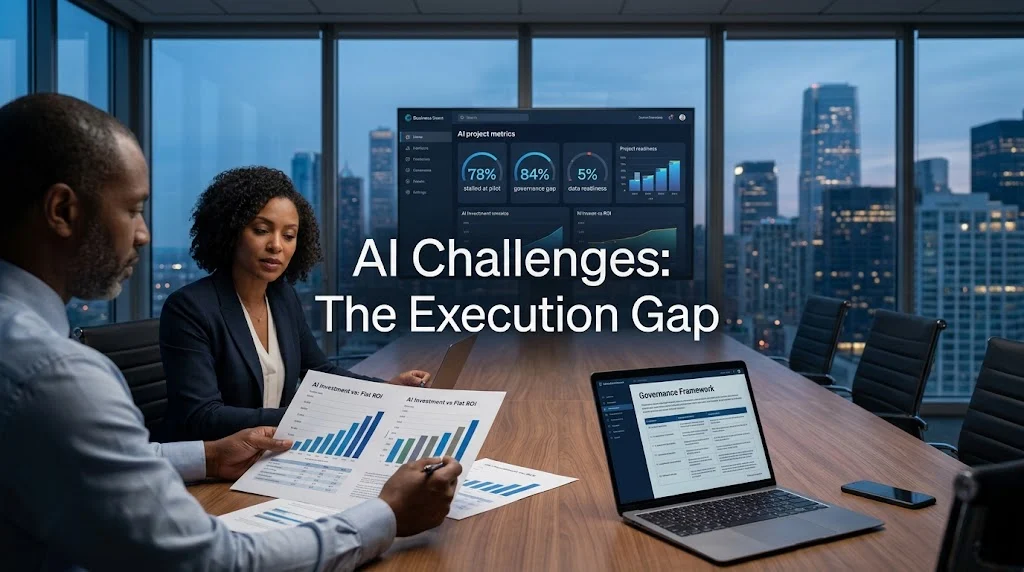
The biggest AI challenges in 2026 are not model capability but organizational execution. 78% of AI projects fail or stall at the pilot stage, 84% of CIOs say IT cannot keep pace with AI agent rollout, and only 5% of organizations say their data is fully ready for AI.
At-a-Glance: Key Takeaways
- 78% of organizations have seen AI projects fail or stall at the pilot stage, with 35% reporting outright failures and 43% stuck in pilot .
- 84% of CIOs say employees are building AI agents faster than IT can manage them, creating governance gaps that multiply risk .
- Only 5% of organizations say their data is fully ready for AI, with 50% citing limited data access as a leading obstacle .
- Gartner predicts 40% of agentic AI projects will be canceled by 2027 due to escalating costs, unclear business value, or inadequate risk controls .
- Skills shortages are the most cited barrier to AI adoption, ahead of costs or infrastructure, with over 40% of non-adopters identifying this as their main obstacle .
- 77% of executives say people and processes, not technology, now limit AI value—organizational friction has replaced technical capability as the bottleneck .
The Seven Barriers Blocking AI Adoption
The AI challenges of 2026 are organizational, not technical. Models can reason, generate, and automate. The difficulty lies in connecting them to enterprise reality.
1. The Data Readiness Gap
Dun & Bradstreet’s global survey of 10,000 businesses found that 97% of organizations have active AI initiatives, but only 5% say their data is adequately ready to support them . This gap explains why pilots that work in sandboxed environments fail when deployed against real corporate data.
The specific obstacles are measurable: 50% cite limited data access as a leading obstacle, 44% identify privacy and compliance risks, 40% report data quality and integrity concerns, and 38% point to a lack of integration across systems .
Data trapped in silos compounds the problem. Business units hoard data in ERP platforms, CRM instances, and localized file shares. When IT attempts to unify this data for AI workflows, it hits institutional resistance and undocumented permission structures .
Editorial interpretation: The data problem is not new. What has changed is the consequence. AI systems that operate on fragmented, unverified data produce probabilistic outputs that look confident but lack reliability. The organizations that solve this first will be the ones whose agents actually work.
2. The Governance Vacuum
Dataiku and Harris Poll surveyed 685 CIOs across eight countries. The findings reveal a governance crisis: 84% of CIOs say employees are developing AI agents and applications faster than IT can manage, 83% lack a standardized AI agent lifecycle management framework, and 60% lack a centralized AI governance system .
The consequences are visible in the numbers. Only 28% of CIOs continuously measure the operational and business performance of all AI agents. And 76% say they do not have a mature ROI measurement system for all or most AI projects .
The pressure is personal. 88% of CIOs say AI performance will affect their professional reputation, and 76% say their role could be at risk if they fail to produce measurable results by the end of 2027 .
Important distinction: Governance gaps are not abstract. They translate into unmonitored spending, security exposure, and unpredictable failures that scale with adoption.
3. The Pilot-to-Production Chasm
Orgvue surveyed 1,163 senior decision-makers and found that 78% of organizations have seen AI projects fail or stall at the pilot stage. 35% reported project failures, 43% said projects remain stuck in pilot, and 32% said they still do not understand how to make AI work .
Competitive pressure drives rushed deployments. 57% of business leaders said they deployed AI because competitors had done so, and that projects stalled or failed because deployments were rushed .
HCLTech’s survey of 467 senior executives found that 43% of major AI initiatives are expected to fail. The median payback period expected is 18 months, leaving little margin for error .
Editorial interpretation: The rush to deploy because competitors did is a predictable failure mode. AI adoption without workflow redesign produces the illusion of progress. The technology is deployed, but the underlying work remains unchanged.
4. The Accountability Problem
Gartner predicts that by the end of 2027, 40% of agentic AI projects will be canceled due to escalating costs, unclear business value, or inadequate risk controls . The research identifies a specific structural issue: accountability.
Agents can perform work, make recommendations, and trigger actions, but they are not legal entities. Responsibility for outcomes falls to people and organizations. Without clear human accountability, the risks multiply .
Gartner predicts that through 2028, more than 50% of AI initiatives will halt because of unresolved agentic identity challenges . The mismatch is structural: decades of access control were built around humans, who receive slow, heavily scrutinized authorization in exchange for broad access. Agents need fast, narrow, and easily revoked permissions. Those standards do not fully exist yet .
5. The Cost Volatility Risk
Gartner researchers warn that AI costs are becoming a “material margin risk” for companies. Rising token consumption and fluctuating vendor pricing complicate forecasting. A single unmonitored employee prompt library or unrestricted license rollout can spike millions of dollars in additional expense .
CFOs face pressure to deliver results. 83% say fewer than half of their organizations’ AI initiatives have produced measurable gains . KPMG’s survey found that 29% of organizations struggle to understand and control AI operating costs, and nearly half have been forced to adjust deployment plans due to cost challenges .
Gartner recommends treating AI costs as an architecture issue, not a budget problem. Token consumption is determined by system design decisions: context management, workflow design, orchestration patterns, and retrieval strategies .
6. The Skills Shortage
The World Bank’s survey of 1,666 frontier firms in emerging markets found that skills constitute the most frequently cited constraint, ahead of costs or technical infrastructure. More than four in ten non-adopters identified skills shortages as their main obstacle .
The skills needed are not monolithic. Firms require a spectrum: basic AI literacy for daily tool use, the ability to integrate AI into business processes, and advanced expertise to build and adapt models internally. While around 70% of firms report staff regularly using AI applications, only about half have integration capabilities, and just 30% can build AI solutions in-house .
Editorial interpretation: The skills gap is not about hiring AI researchers. It is about enabling existing employees to work alongside AI systems and redesigning workflows around new capabilities.
7. The ROI Measurement Problem
HTEC’s survey of 1,500 C-suite executives found that 79% increased AI investment over the past year, with spending up 31% on average. Yet 71.5% of organizations lack comprehensive enterprise-wide visibility into AI adoption, usage patterns, and outcomes .
The measurement gap has consequences. Around a quarter of executives said insufficient tracking led to higher AI usage costs. 26% cited increased reliance on external partners as an unexpected consequence .
McKinsey’s global survey paints the bottom-line picture: only 37% of leaders can attribute any positive EBIT effect to AI, a statistic unchanged from the previous year. Just 6% of organizations qualify as AI high performers, meaning AI accounts for at least 5% of their EBIT .
What High Performers Do Differently
The organizations capturing value from AI are not using secret models. McKinsey’s data shows that nearly three-quarters of AI high performers fundamentally redesign their business workflows around AI, compared with only about one-quarter of other respondents .
The pattern is consistent across research. HTEC found that 77% of executives say AI value is now constrained more by people and processes than by technology . Orgvue’s CEO stated it plainly: “Failed AI deployments are not a technology problem; they’re a workforce design problem” .
Information gain: The distinction between AI adopters and AI high performers is not access to better models. It is the willingness to redesign work. High performers connect AI to data, systems, permissions, and workflows. They treat evaluation, governance, and human oversight as infrastructure requirements, not afterthoughts.
Who Should Care About AI Challenges
CIOs and technology leaders face the direct pressure of adoption outpacing governance. The Dataiku survey shows 88% say AI performance will affect their professional reputation .
CFOs are managing cost volatility and ROI pressure simultaneously. Gartner’s warning about material margin risk is directed at them .
Business unit leaders are often the source of shadow AI deployments. The governance gap exists because employees adopt tools faster than IT can approve them .
Organizations in regulated industries face the compounding challenge of compliance. 76% of HCLTech respondents said responsible AI has delayed deployments .
Frequently Asked Questions
Why do most AI projects fail?
78% of AI projects fail or stall at the pilot stage . The primary causes are data readiness gaps (only 5% say data is fully ready) , governance vacuums (84% of CIOs can’t keep pace with agent rollout) , and rushed deployments driven by competitive pressure (57% deployed because competitors did) .
What is the biggest barrier to AI adoption in 2026?
Skills shortages are the most frequently cited barrier, ahead of costs or infrastructure. Over 40% of non-adopters identify skills as their main obstacle . However, 77% of executives say people and processes, not technology, now limit AI value .
How much do AI projects cost?
AI cost volatility poses a “material margin risk” according to Gartner. A single unmonitored prompt library can spike millions in expense . KPMG found that 29% of organizations struggle to control AI operating costs, and nearly half have adjusted deployment plans due to cost challenges.
What is the “Goldilocks zone” for AI agents?
Gartner’s Goldilocks zone refers to use cases where AI agents deliver value while keeping risk manageable—typically scenarios with multiple acceptable outcomes and clear human oversight. Most agents are not reliable enough for business-critical environments where only one correct answer exists .
How do high performers succeed with AI?
Nearly three-quarters of AI high performers redesign business workflows around AI, compared to about one-quarter of others . They treat evaluation, governance, and human oversight as infrastructure requirements, not afterthoughts. The advantage is not better models; it is better orchestration and execution.
Conclusion
The AI challenges of 2026 are organizational, not technical. Models can reason, generate, and automate. The difficulty lies in connecting them to enterprise reality: clean data, clear governance, accountable oversight, and redesigned workflows.
What matters most is recognizing where the bottlenecks actually are. 78% of projects stall at pilot not because the technology fails, but because the surrounding systems are not ready. 84% of CIOs cannot keep pace with agent adoption because governance frameworks do not exist. Only 5% of organizations have AI-ready data because data remains trapped in silos.
These challenges may feel overwhelming, but they are also the reason high performers pull ahead. McKinsey’s data shows that just 6% of organizations qualify as AI high performers. Those that do are not using secret models. They are doing the unglamorous work of redesigning workflows, establishing governance, and connecting AI to enterprise execution.
Before pursuing AI adoption, assess your data readiness. Establish governance before agents proliferate. Measure value by business outcomes, not license counts. And remember that the gap between AI intelligence and enterprise execution is where most projects die.