Image AI refers to artificial intelligence systems that generate, edit, analyze, or understand images. The field spans text-to-image generators like Gemini’s Nano Banana Pro and Ideogram, open-source models like HiDream-O1-Image with strong text rendering, and editing tools that transform existing photos. The best choice depends on whether you need generation, editing, text rendering, or local processing.
At-a-Glance: Key Takeaways
- Image AI covers four distinct capabilities: generation from text, editing existing images, analyzing visual content, and understanding image structure for downstream tasks.
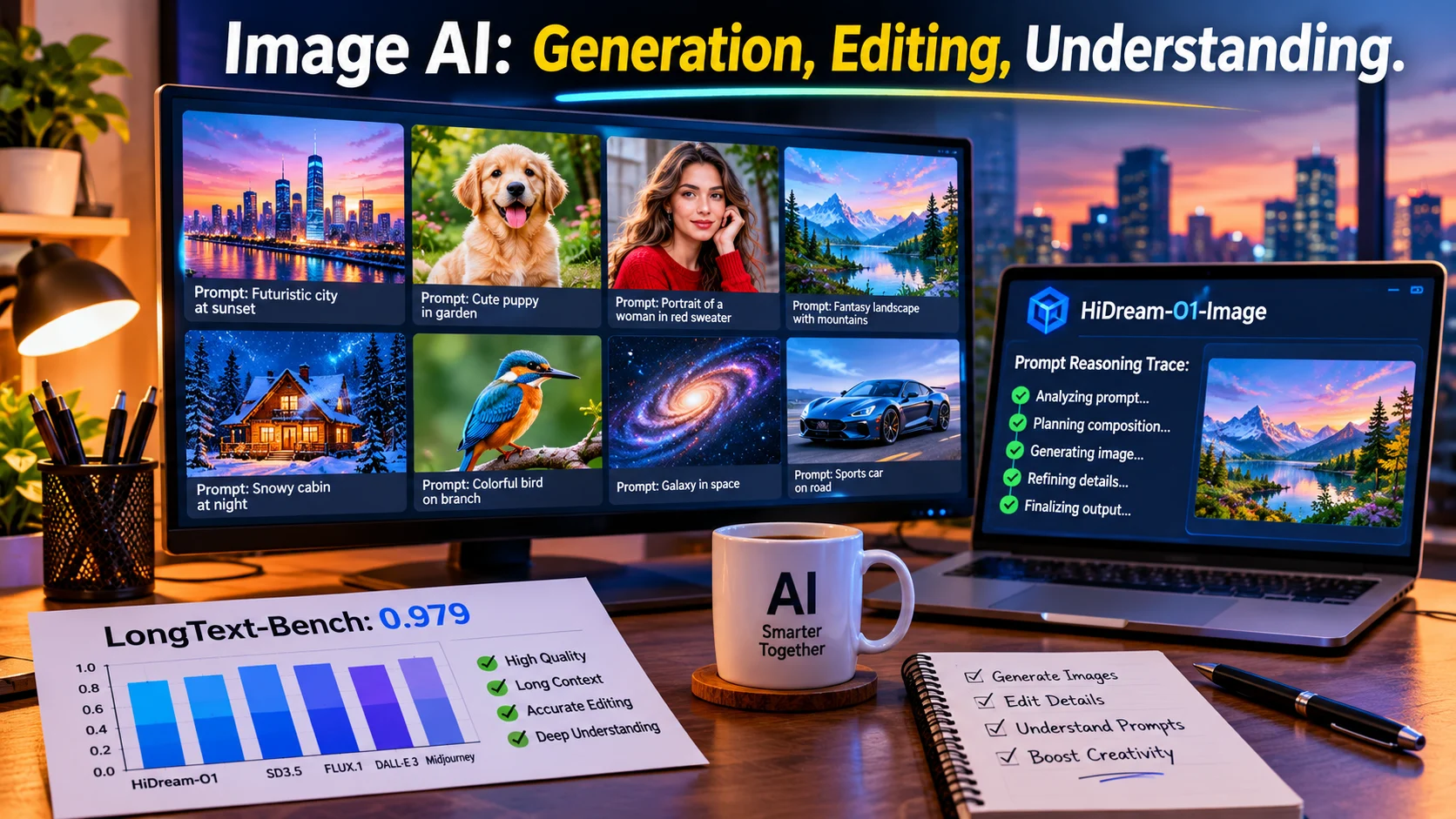
- Text rendering is the new frontier. HiDream-O1-Image achieves 0.979 on LongText-Bench for English text rendering, an open-source model under MIT license .
- Open-source options exist for local processing. HiDream-O1-Image ships with inference code, a reasoning-driven prompt agent, and a Flask web app .
- Commercial rights vary dramatically. Some free tiers permit commercial use with indemnification, others prohibit it entirely.
- Privacy depends on where processing happens. Cloud tools train on user data by default. Local models eliminate transmission but require hardware.
What Is Image AI?
Image AI describes artificial intelligence systems that work with visual content. The category spans four distinct capabilities that are often conflated but serve different purposes.
Image generation creates new images from text descriptions. You describe what you want, and a model like Gemini’s Nano Banana Pro or Ideogram produces a visual interpretation.
Image editing transforms existing photos. This includes background removal, object replacement, style transfer, and upscaling. Tools like Adobe Firefly and Canva’s Magic Studio operate in this space.
Image analysis extracts information from visuals. Models can identify objects, read text, assess quality, and describe content. This powers accessibility features, content moderation, and visual search.
Image understanding goes deeper. It involves models that reason about spatial relationships, count objects accurately, and interpret charts or diagrams. This capability feeds into robotics, autonomous systems, and document processing.
The search intent for “image AI” is primarily informational with commercial investigation. Users want to understand the landscape, identify the right tool for their task, and know the limitations before committing time or money.
How Image AI Works
The Generative Pipeline
Text-to-image models use diffusion or transformer-based architectures trained on massive datasets of paired images and text. The model learns statistical associations between words and visual features. When you provide a prompt, it generates an image that matches the described content.
The quality of output depends on three factors: the model’s training data and architecture, the specificity of your prompt, and the generation settings (resolution, steps, guidance scale). Vague prompts produce generic results. Detailed prompts yield more controlled output.
The Text Rendering Challenge
Rendering legible text within generated images is one of the hardest problems in the field. Most models produce garbled letterforms when asked to include words. This is because text requires precise spatial arrangement that diffusion models struggle to maintain.
HiDream-O1-Image addresses this directly. The open-source model scores 0.979 on LongText-Bench for English text rendering and 0.978 for Chinese . It ships with a Reasoning-Driven Prompt Agent that explicitly reasons through layout, subject attributes, physical logic, and text-rendering details before rewriting the user’s instruction into a self-contained prompt .
The Open-Source Path
For users who need local processing or custom integration, open-source models offer an alternative to cloud APIs. HiDream-O1-Image is licensed under MIT, includes inference code, and provides a Flask web app that exposes all generation modes . The model is available in an 8B parameter version and a 200B+ Pro variant .
The trade-off is hardware. Running an 8B model locally requires a capable GPU. The 200B+ Pro variant requires substantially more resources. Cloud APIs eliminate that barrier but introduce data transmission and usage costs.
The Major Image AI Capabilities Compared
Key Tools and Models
For Generation: Gemini and Ideogram
Gemini’s Nano Banana Pro offers strong overall quality with good prompt adherence. Ideogram leads on text rendering for consumer tools. Both offer free tiers with usage limits and commercial use within terms.
For Editing: Adobe Firefly
Firefly integrates directly into Creative Cloud apps and offers IP indemnification on commercial output. The free tier provides 25 monthly credits. The strength is legal safety, not volume.
For Open-Source: HiDream-O1-Image
HiDream-O1-Image is the most capable open-source option for text rendering. The MIT license permits commercial use, modification, and redistribution. The Reasoning-Driven Prompt Agent improves output quality by rewriting prompts with explicit layout and text details .
The model’s benchmark scores are strong: 0.9128 average across region counts, 0.9561 NED, and 0.8076 CLIP Score . These numbers indicate competitive performance against proprietary alternatives.
For Local Processing: Privacy-First Options
Local models eliminate data transmission. You run everything on your hardware. The trade-off is capability ceiling and setup complexity. HiDream-O1-Image is one option. Other open-source models exist for different use cases.
Where the Paywall Actually Lands
Across image AI tools, the pattern is consistent.
Usage caps limit volume. Free tiers impose daily or monthly limits. Gemini meters by compute. Ideogram uses daily credits. Firefly provides 25 monthly credits.
Commercial rights are gated. Some free tiers permit commercial use within terms. Others prohibit it. Firefly offers indemnification on paid plans. Open-source models like HiDream-O1-Image permit commercial use under MIT .
Resolution is capped. Free output is lower resolution than paid. Suitable for web and social media, not print.
Advanced features are paid. Higher resolution, batch generation, custom model training, and API access typically require payment.
Privacy and Security Considerations
Image AI tools process visual content on remote servers unless you use local models. The privacy implications vary.
Cloud tools train on user data by default. Gemini and ChatGPT require manual opt-outs. Adobe Firefly trains only on licensed content and offers indemnification.
Local models eliminate transmission. HiDream-O1-Image runs entirely on your hardware . No data leaves your device.
What to check before uploading:
- Whether your images are used for training
- How long generated images are stored
- Whether you can delete your data
- The tool’s terms for ownership
Important distinction: No SOC 2 certification or similar compliance framework is typically referenced for consumer image AI tools. They are not enterprise-grade by default.
Who Should Use Which Image AI
Social media creators should use Gemini for overall quality or Ideogram for text-heavy graphics. Both offer free tiers with commercial use within terms.
Commercial designers should use Adobe Firefly for client work where legal safety matters. The IP indemnification is valuable.
Developers and technical users should explore HiDream-O1-Image for local processing and text rendering. The MIT license permits commercial integration .
Anyone needing print quality or high volume must upgrade. Free tiers are insufficient for production.
Privacy-sensitive users should use local models. The trade-off is capability and setup complexity.
Common Mistakes and Cautions
Assuming all image AI is the same. Generation, editing, analysis, and understanding are different capabilities. A tool that excels at one may fail at another.
Overlooking text rendering limitations. Most models cannot produce legible text. HiDream-O1-Image is an exception, not the rule .
Ignoring commercial restrictions. Some free tiers prohibit commercial use. Open-source models like HiDream-O1-Image permit it under MIT . Always verify terms.
Expecting print quality from free tiers. Resolution is capped. Output is suitable for web and social media, not for print.
Uploading sensitive images without checking privacy. Cloud tools train on user data by default. Local models eliminate this risk.
Frequently Asked Questions
What is image AI?
Image AI refers to artificial intelligence systems that generate, edit, analyze, or understand images. The category spans text-to-image generation, photo editing, visual analysis, and spatial reasoning. Different tools serve different purposes.
What is the best open-source image AI model?
HiDream-O1-Image is a strong open-source option for text rendering, scoring 0.979 on LongText-Bench for English. It is MIT licensed, includes inference code and a prompt agent, and is available in 8B and 200B+ parameter versions . The best model depends on your specific use case.
Can I use image AI commercially?
It depends on the tool. Adobe Firefly permits commercial use with IP indemnification. Gemini, Ideogram, and Canva permit it within terms. Open-source models like HiDream-O1-Image permit it under MIT . Always verify current terms before using output for client work.
What is the hardest problem in image AI?
Rendering legible text within generated images is one of the hardest problems. Most models produce garbled letterforms. HiDream-O1-Image addresses this with a Reasoning-Driven Prompt Agent that reasons through layout and text details . Ideogram is the strongest consumer tool for text rendering.
Is image AI private?
Cloud tools process images on remote servers and train on user data by default. Local models like HiDream-O1-Image eliminate transmission entirely . Privacy depends on where processing happens, not on the tool’s marketing claims.
Conclusion
Image AI spans generation, editing, analysis, and understanding. The best tool depends on what you need to do. Gemini and Ideogram serve generation and text rendering. Adobe Firefly serves commercial editing with legal safety. HiDream-O1-Image serves open-source text rendering and local processing .