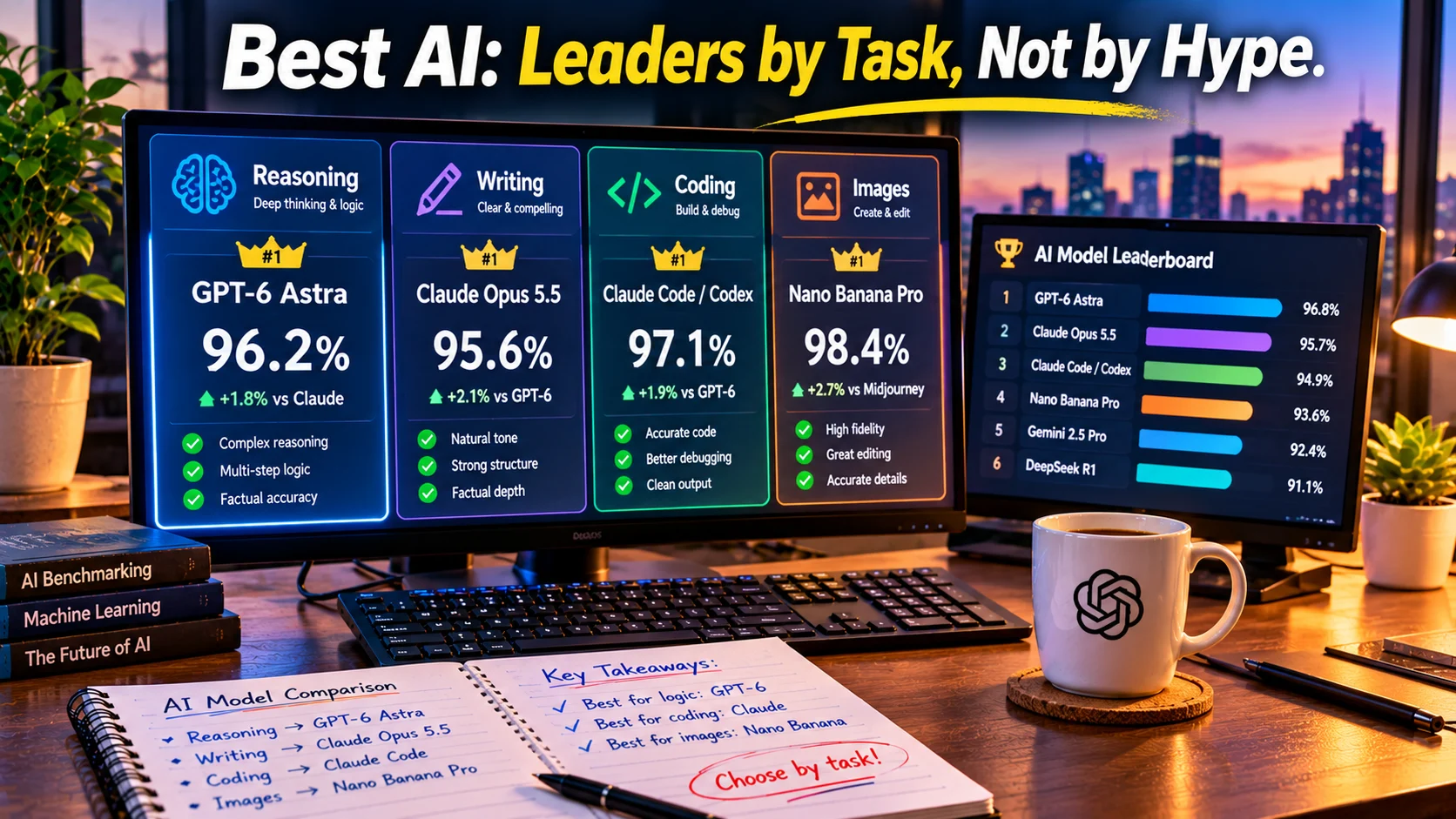
There is no single “best AI.” GPT-6 Astra leads on reasoning benchmarks like GPQA Diamond at 96%, Claude Opus 5.5 tops creative writing preference votes, Gemini offers the strongest free tier and best image generation with Nano Banana Pro, and specialized tools like Cursor and Perplexity lead their categories. The right choice depends on whether you prioritize reasoning, writing, value, or a specific workflow.
At-a-Glance: Key Takeaways
- GPT-6 Astra leads on reasoning with 96.0% on GPQA Diamond, the most discriminating frontier benchmark .
- Claude Opus 5.5 leads creative writing with 1,520 Elo on Arena’s creative-writing votes, tied with Gemini 4 Argon .
- Gemini offers the best free tier and image generation, with Nano Banana Pro described as “the best of its kind” by CNET .
- Coding has no single winner. Claude Code leads on real-world code review quality, while Codex leads Terminal-Bench at 89.5% .
- Perplexity remains the research leader for cited, source-grounded answers .
- ChatGPT is the versatile generalist, but CNET notes it “lacks a killer feature” compared to newer competition .
What “Best AI” Actually Means
The search intent behind “best ai” is commercial investigation. Users want a recommendation, but they have not specified a use case. This creates a problem: the answer changes completely depending on whether you need a chatbot for everyday questions, a coding agent for software development, an image generator for creative work, or an enterprise platform for regulated data.
The current market is not a single race. It is a set of parallel races, each with different leaders. A model that tops a reasoning benchmark may rank poorly on creative writing preference. A tool that wins on coding benchmarks may fail on real-world code review. The honest framing is that “best” is a category-specific question, and the rest of this article answers it by category.
Best AI for Reasoning: GPT-6 Astra
On GPQA Diamond, the benchmark that most sharply separates frontier models on graduate-level reasoning, GPT-6 Astra leads at 96.0% . This is the strongest evidence available that OpenAI’s flagship remains at the frontier for difficult, multi-step problems.
LLM Stats, which aggregates public benchmarks and live API metrics, ranks GPT-6 Astra at the top of its leaderboard on this basis . The same leaderboard places Anthropic’s Claude Opus 5 and Google’s Gemini 3.1 Pro in the top tier, but Astra’s reasoning margin is the clearest single claim to “best” in any category.
Editorial interpretation: If your work involves complex analysis, scientific reasoning, or multi-step logic where correctness matters more than style, GPT-6 Astra is the model to evaluate first. Benchmark leadership does not guarantee it will fit your workflow, but it is the most objective signal available.
Best AI for Writing: Claude Opus 5.5
On Arena’s creative-writing preference votes, Claude Opus 5.5 and Gemini 4 Argon are statistically tied at the top, with margins that overlap . ChatGPT’s GPT-6.1 Sol sits further back. The practical takeaway is that Claude and Gemini are both excellent for writing, and the choice between them depends on your ecosystem.
CNET’s testing highlights ChatGPT’s strength in adapting to instructed tone, calling it a highlight for drafting emails, texts, and legal documents . But for fiction and long-form creative work, the preference data favors Claude.
Important caveat: Arena votes measure what users preferred, not whether a draft followed a brief or kept facts straight. For business writing where accuracy and brand voice matter, test on your own material before committing.
Best AI for Value and Free Access: Gemini
CNET’s verdict is direct: “Google unquestionably wins in the overall value of what it offers with its subscription tiers” . Even the lowest Plus plan includes 400GB of cloud storage shareable with up to five people. A free Google account provides access to Gemini 3 Flash, limited Gemini 3 Pro, Nano Banana image generation, and daily credits for Flow and Whisk .
PCMag and Yahoo both name Gemini the best free chatbot, citing access to latest models, deep research, voice chat, and 15GB of storage at no cost . Most competitors gate their most advanced models behind paywalls.
Editorial interpretation: If the question is “best AI I can use without paying,” Gemini is the answer. The trade-off is data: you are giving more of it to Google, and the free tier carries significant guardrails around certain topics .
Best AI for Image Generation: Gemini (Nano Banana Pro)
PCMag’s testing names Gemini and ChatGPT as current favorites for image accuracy and detail, but CNET is more specific: Nano Banana Pro is “the best” image generator, having moved Gemini from decent to best “seemingly overnight” .
On Artificial Analysis’s text-to-image leaderboard, OpenAI’s GPT Image 2 (high) leads on Elo, followed by Reve 2.0, Microsoft’s MAI-Image-2.5, and HiDream . The leaderboard and the reviewer verdicts point to different winners, which is typical: benchmark Elo measures pairwise preference, while reviewers test specific use cases.
Practical guidance: For photorealistic images with strong prompt adherence, GPT Image 2 and Nano Banana Pro are the top candidates. Test both on your actual prompts before deciding.
Best AI for Coding: A Split Decision
Coding has no single winner. The leaders specialize.
Claude Code is the choice for developers who hand off whole tasks and review the result. Cubic’s Bug Bench, which measures the percentage of AI-written code that contains bugs, found Cursor (which runs Claude Opus 5 among other models) at 1.6% bug rate, down from 9.4% in June . Claude Pro at $20/month includes Claude Code .
OpenAI Codex leads on benchmark ceiling. GPT-5.6 Sol at extra-high effort tops Terminal-Bench 2.1 at 89.5% . It is included in ChatGPT plans, with a free tier offering GPT-6 Luna in the desktop app .
OpenCode leads on openness and price. It is free and open source, connects to 75+ providers, and had a 0.7% bug rate in Cubic’s testing .
Editorial interpretation: For most developers, the deciding factor is not benchmark score but workflow fit. Claude Code for task handoff and review. Codex for ChatGPT subscribers who want a sandbox by default. OpenCode for those who want open source and provider flexibility.
Best AI for Research: Perplexity
CNET’s research verdict remains Perplexity: “It still breaks all of the sources down, right next to the point it makes, making it easy to discern which claim came from where” . It is great for comparing products and organizing trips, though some of its best features are locked behind a premium subscription.
The caveat is that Perplexity still cites YouTube and Reddit as sources by default too often, and it is not immune to hallucinations despite providing sources . Use it as a starting point, not a final authority.
The Comparison Table
Who Should Choose Which
General users who want one tool should start with Gemini for its free tier and ecosystem integration, or ChatGPT for its versatility. Neither is “best” at everything, but both are good at most things.
Writers and creative professionals should evaluate Claude Opus 5.5 against Gemini 4 Argon on their own drafts. The preference data shows a tie; your material will break it.
Developers should test Claude Code and Codex on a real task from their codebase. The benchmark gap between them is smaller than the workflow gap.
Researchers and analysts should use Perplexity for source-grounded answers and GPT-6 Astra for deep reasoning on documents they already trust.
Budget-conscious users have a clear answer: Gemini’s free tier is the most generous in the market .
Common Mistakes and Cautions
Assuming one model is best at everything. GPT-6 Astra leads reasoning but not creative writing. Claude leads writing preference but not GPQA. The categories are real.
Treating benchmark scores as guarantees. A model that tops a benchmark may perform differently on your specific task. Test on your own material.
Ignoring the free-tier difference. Gemini’s free tier is materially better than most competitors. If cost matters, this is the deciding factor .
Overlooking workflow fit for coding. The best coding tool is the one that fits how you work. A benchmark leader that disrupts your workflow is not the best tool for you.
Confusing preference votes with accuracy. Arena votes measure what users liked, not whether the output was correct. For factual work, verify.
Frequently Asked Questions
What is the best AI overall?
There is no single best AI. GPT-6 Astra leads on reasoning benchmarks. Claude Opus 5.5 leads on creative writing preference. Gemini offers the best free tier and image generation. The “best” depends on whether you prioritize reasoning, writing, value, or a specific workflow .
What is the best free AI?
Gemini. CNET, PCMag, and Yahoo all name it the best free chatbot, citing access to latest models, deep research, voice chat, and 15GB of cloud storage at no cost. Most competitors gate their best models behind paywalls .
What is the best AI for coding?
It depends on workflow. Claude Code leads on real-world code review quality (1.6% bug rate in Cursor testing). Codex leads on Terminal-Bench at 89.5%. OpenCode is the best open-source option .
What is the best AI for writing?
Claude Opus 5.5 and Gemini 4 Argon are statistically tied at the top of Arena’s creative-writing preference votes. ChatGPT is strong at adapting to instructed tone. Test on your own drafts to break the tie .
Is ChatGPT still the best AI?
ChatGPT remains the most popular and versatile chatbot, but CNET notes it “lacks a killer feature” compared to newer competition. It is good at most things but not the clear leader in any single category .
Conclusion
The search for the “best AI” produces a fragmented answer because the market has specialized. GPT-6 Astra leads reasoning. Claude Opus 5.5 leads creative writing. Gemini leads on value, free access, and image generation. Perplexity leads research. Claude Code and Codex split the coding crown.