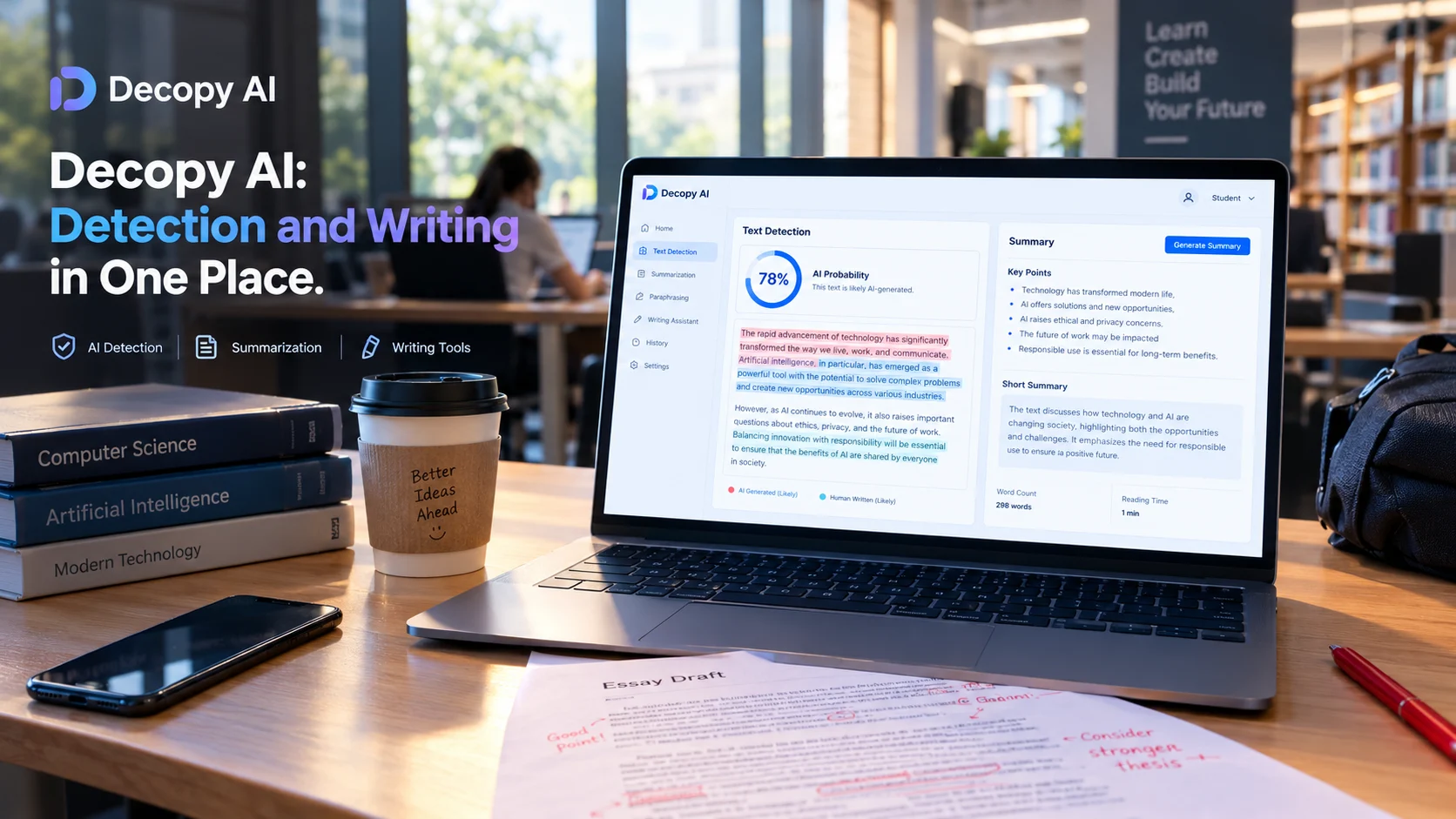
Decopy AI is an online platform that combines AI content detection, text humanization, summarization, transcription, and study tools into a single workspace. It operates on a credit-based pricing system with free monthly quotas, and third-party research shows its AI image detector tends to produce high-confidence errors on false positives.
At-a-Glance: Key Takeaways
- Decopy AI bundles detection, humanization, summarization, and transcription tools into one workspace, targeting students, writers, and professionals .
- The platform runs on a credit and quota system. Logged-in free users receive 10 quotas monthly, while paid plans offer 1,100 to unlimited quotas .
- A 2026 academic study found Decopy AI’s deepfake detector assigns 94% confidence to false positives, higher than its confidence on correct detections .
- Privacy policy claims three-month retention limits after account termination and explicitly states content is not sold to third parties .
- AlternativeTo lists ZeroGPT, Smodin, and MyDetector as the closest alternatives for AI content detection .
- Domain registered in May 2024, making it a relatively new entrant compared to established AI writing platforms .
What Is Decopy AI?
Decopy AI is a multi-tool platform built around writing assistance and content verification. The service combines AI detection, humanization, summarization, transcription, and study utilities into one interface . It targets students, content creators, marketers, and professionals who need to check content originality or improve draft quality.
The platform is operated by ZINGKODE LTD., a company whose privacy policy lists a last update of March 2026 . The site supports multiple languages including English, Chinese, Spanish, Portuguese, Russian, and French, indicating a broad international target audience.
Unlike single-purpose tools, Decopy AI positions itself as a workspace. Users can move between detecting AI content, summarizing a YouTube video, and checking plagiarism without switching services. This aggregation strategy is common among newer AI platforms seeking to capture multiple use cases.
How Decopy AI Works
Decopy AI operates on a freemium model with two distinct usage currencies: quotas and credits.
Quotas and Credits Explained
Quotas are periodic free usage allowances. They do not cost anything and reset each period. Non-logged-in users receive 5 free quotas. Logged-in users on the free plan receive 10 quotas per month .
Credits are the paid currency. Standard pricing runs at $1 for 333 credits. Subscription plans bundle credits that expire within the billing period, while separately purchased credit packs remain valid permanently .
This dual system creates a layered access model. Casual users can accomplish basic tasks with free quotas. Heavy users or those needing premium models purchase credits.
Detection Mechanism
Decopy AI’s content detector analyzes text patterns, sentence variation, and phrasing uniformity to estimate AI likelihood. The interface displays an “AI Content Level” percentage alongside detected signals such as repeated sentence patterns and low sentence variation .
The platform claims to detect content from ChatGPT, GPT-4, Claude, and other models, including paraphrased or humanized text . However, independent verification of these claims is limited.
Summarization and Transcription
The summarizer processes YouTube videos, PDFs, Word documents, PPT files, audio, and images. Pricing follows usage-based metering. YouTube video summarization costs 1 credit per 20 seconds. PDF summarization costs 2 credits per page, capped at 10 pages per document. Audio transcription with speaker diarization costs 1 credit per 5 seconds .
Key Features
AI Content Detection
The flagship feature. Users paste text and receive an AI probability score with detected signals. The tool flags specific sentences and provides rewriting suggestions .
AI Humanizer
Decopy AI offers a humanization tool that rewrites stiff or formal text to sound more natural. The interface includes settings for tone, length, output format, and language. A Chrome extension review noted the tool helps “make the wording smoother, clearer, and more natural for everyday readers” .
Editorial interpretation: A forum review from April 2026 noted that Decopy’s humanizer functions more as a “surface editor” than a true authorship tool. The reviewer observed that while the tool de-stiffens sentences, it does not add genuine voice or narrative texture .
Summarization Suite
Supports multiple input types: text, documents, web links, images, audio, video, and YouTube URLs. Outputs include bullet points, FAQs, diagrams, and mind maps .
Study and Math Tools
Step-by-step math problem solving, flashcard creation, and homework assistance target student users .
Chrome Extension
A YouTube summarizer extension with a 5.0 rating from 120 reviews and approximately 2,000 users. The extension operates in the YouTube sidebar and claims not to collect user data .
Pricing and Usage Costs
Decopy AI uses a credit system with tiered subscription quotas. The pricing structure has several layers that users should understand before committing.
Credit pricing: $1 = 333 credits. Subscription credits expire each billing period. Purchased credit packs remain valid permanently .
Consumption examples:
- AI detection: 200 characters per credit
- PDF summarization: 2 credits per page
- Audio transcription (no diarization): 1 credit per 20 seconds
- GPT-4.1 queries: 5 credits per 1,000 characters
Refund policy: Credits are non-transferable and cannot be exchanged for cash. Refunds are available upon request if purchased credits remain unused, reviewed based on account usage records .
Accuracy and Reliability: What Research Shows
A March 2026 arXiv study evaluated Decopy AI’s deepfake image detector alongside FaceOnLive and Bitmind . The findings raise important questions about confidence calibration.
The False Positive Problem
Decopy AI assigned an average confidence score of 94.02% to false positives, higher than its 88.29% average confidence on true positives. This means the tool expresses more certainty when incorrectly flagging real images than when correctly identifying deepfakes .
Bimodal Confidence Distribution
The study found Decopy AI and FaceOnLive operate as “near-binary classifiers” that cluster confidence scores at the extremes. 97 of Decopy AI’s confidence scores fell in the 0-20% bin, with 36 in the 80-100% bin. Intermediate scores were rare. The human evaluator in the study distributed confidence across all five bins, acknowledging uncertainty where appropriate .
Practical Implication
For practitioners, this creates a risk. A false positive with 94% confidence appears authoritative. Users receiving this output would have no reason to suspect tool failure. The study notes that “a tool that expresses high confidence on incorrect predictions is actively misleading” .
Editorial note: This research specifically evaluated the deepfake image detector, not the text-based AI content detector. However, the calibration issues suggest users should treat all confidence scores with appropriate skepticism.
Privacy and Data Handling
Decopy AI’s privacy policy, last updated March 2026, outlines several commitments and limitations .
What the Policy States
- Data retention: Personal information is not retained more than three months after account termination unless legally required .
- Third-party sharing: Information may be shared during business transfers, mergers, or acquisitions .
- Social login: Google login access may retrieve name, email, friend list, and profile picture .
- Security: The policy states “appropriate and reasonable technical and organizational security measures” are implemented but does not claim specific certifications like SOC 2 or ISO 27001 .
What the Policy Does Not State
- No mention of Zero Data Retention (ZDR) guarantees
- No SOC 2, ISO 27001, or similar compliance certifications referenced
- No independent third-party audits mentioned
Important clarification: SOC 2 certification does not automatically mean zero data retention. Decopy AI’s policy does not claim either.
Chrome Extension Privacy
The Chrome extension’s privacy disclosure states the developer “does not collect or use your data” and that data is not sold to third parties or used for creditworthiness purposes . This applies only to the extension, not the web platform.
Alternatives and Competitors
Who Should Use Decopy AI?
Decopy AI may suit several user profiles.
Students who need to summarize research papers, check if AI-assisted drafts are detectable, or get step-by-step math help. The free quota system provides a low-risk entry point .
Content creators who want to verify originality before publishing or de-stiffen AI-assisted drafts. The summarization tools for YouTube videos and long documents can accelerate research workflows .
Professionals who need multi-format content processing. The ability to summarize PDFs, Word documents, audio files, and images from one interface reduces tool sprawl.
Users with strict privacy requirements should approach with caution. The lack of third-party security certifications and the business transfer clause in the privacy policy may concern enterprise or regulated users .
Common Mistakes and Cautions
Over-relying on detection scores. Research shows Decopy AI’s image detector produces high-confidence false positives. Text detection scores likely face similar calibration limits .
Confusing credits with quotas. Quotas are free periodic allowances. Credits cost money. Subscription credits expire. This distinction matters for budgeting .
Ignoring subscription credit expiration. Subscription-bundled credits expire within the billing period. Purchased credit packs do not .
Assuming “AI detection” means definitive proof. No AI detector is 100% accurate. Decopy AI’s own claim of detecting “even after paraphrasing” should be treated as a marketing claim, not a verified fact .
Missing the business transfer clause. The privacy policy allows data sharing during mergers or acquisitions. Users with sensitive content should factor this into their risk assessment .
Frequently Asked Questions
Is Decopy AI free to use?
Decopy AI offers a free tier with limitations. Non-logged-in users receive 5 quotas. Logged-in free users receive 10 quotas per month. Paid plans range from Lite (1,100 quotas) to Premium (unlimited). Credits for premium features cost $1 per 333 credits .
How accurate is Decopy AI’s detection?
A March 2026 study found Decopy AI’s deepfake image detector assigns 94% confidence to false positives, higher than its confidence on correct detections. The tool operates as a near-binary classifier with no uncertainty signal. Text detection accuracy has not been independently verified in available research .
Is Decopy AI safe and private?
The privacy policy claims three-month retention limits after account termination and states content is not sold to third parties. However, no SOC 2 or ISO certifications are mentioned, and the policy allows data sharing during business transfers. Users with strict privacy needs should review the full policy .
Can Decopy AI bypass AI detectors?
Decopy AI offers a humanization tool that rewrites text to sound more natural. A forum review noted it functions as a “surface editor” that de-stiffens sentences without adding genuine voice. The tool may reduce detection scores but does not guarantee undetectability .
What are the best Decopy AI alternatives?
AlternativeTo lists ZeroGPT, Smodin, and MyDetector as the closest alternatives. ZeroGPT is free for personal use. Smodin targets academic and professional writing. MyDetector offers similar features to Decopy AI, including humanization and grammar checking .
Conclusion
Decopy AI is an all-in-one content platform that combines AI detection, humanization, summarization, and transcription. Its credit-based pricing and free quota system make it accessible for casual users. The Chrome extension and multi-format support add practical value.
What matters most is understanding the tool’s limits. Independent research shows its image detector produces high-confidence errors, which means users should treat detection scores as signals, not verdicts. The humanizer can de-stiffen text but does not add genuine authorship.
Decopy AI may suit students, content creators, and professionals who need a Swiss Army knife for content verification and summarization. It may not suit users with strict privacy requirements or those seeking definitive AI detection.
Before subscribing, evaluate whether the credit costs align with your usage patterns. Read the privacy policy carefully. And remember that no AI detector, including Decopy AI, provides certainty.