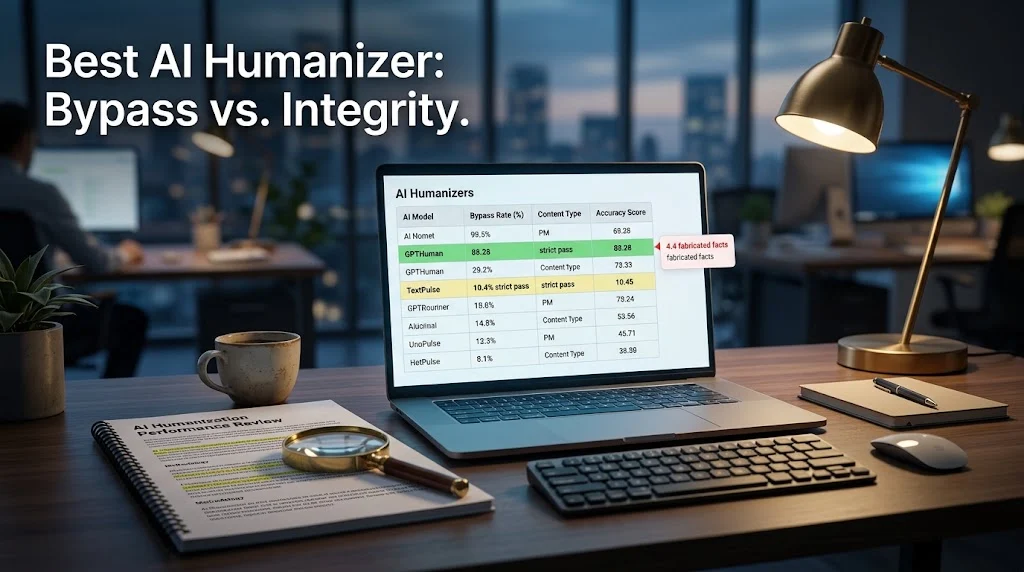
The “best” AI humanizer depends on whether you value bypass rate or content preservation. GPTHuman leads one September 2026 benchmark with an 88.28 overall score and a 92.6 bypass score, but a separate controlled study found TextPulse had the highest strict pass rate at 10.4% because it preserves meaning while passing detectors, while tools with higher raw pass rates fabricated numbers and introduced grammar errors .
At-a-Glance: Key Takeaways
- GPTHuman leads the Humanizer Benchmark 2026 with an 88.28 overall score and a 92.6 detection bypass score across 150 texts .
- Raw bypass rates are misleading. A controlled academic study found Walter Writes passed 60% of GPTZero checks but fabricated 4.4 numbers or names per 300-word text, while Phrasly passed 38% but introduced 3.6 grammar errors per 1,000 words .
- TextPulse had the highest strict pass rate at 10.4% when a pass required preserving meaning, citations, and facts, not just evading detection .
- Undetectable AI’s free trial is only 250 words on annual plans, requiring payment for meaningful evaluation .
- StealthWriter offers 10 free humanizations daily at up to 1,000 words each, the most usable free tier for testing .
- AI detectors themselves are unreliable, and honest AI editing is flagged at higher rates than humanized evasion in some studies .
What Makes an AI Humanizer “Best”?
The search for the best AI humanizer typically starts with one question: which tool bypasses detectors most reliably? But that framing misses the more important question: what does the tool do to your text in the process?
A humanizer that achieves a 0% detection score by changing what your text says is worse than useless for professional work. The benchmark data confirms this tension. Tools with the highest raw bypass rates often have the weakest content integrity .
The “best” humanizer depends on your priority. If you need maximum evasion for low-stakes content, bypass rate matters most. If you need to preserve meaning, citations, and facts, a different tool wins.
The Benchmarks Compared
Two independent evaluations provide the most reliable data available.
The Humanizer Benchmark 2026
Published on Zenodo in September 2026, this benchmark evaluated seven tools across 150 English source texts, producing 1,050 rewrites and 5,250 detector assessments against GPTZero, Originality.ai, Copyleaks, Winston AI, and ZeroGPT .
The benchmark was run independently by Terry Smith, an English professor at the University of Texas at El Paso .
The Controlled Academic Comparison
A separate August 2026 study passed 48 AI-generated academic texts through eleven humanizers, scoring 432 outputs on meaning preservation, citation retention, fabricated facts, grammar errors, and detector evasion .
The findings were stark:
Walter Writes passed 60% of GPTZero checks but fabricated 4.4 numbers or names per 300-word text. Phrasly passed 38% but introduced 3.6 grammar errors per 1,000 words. TextPulse rewrote 52% of words while preserving 97% of document meaning, 99% of citations, and 87% of numbers, introducing only 0.65 grammar errors per 1,000 words .
On a strict pass rate, counting only outputs that also preserved meaning, citations, and facts, TextPulse led at 10.4%. Phrasly and GPTinf had 2.1%. Eight tools had none .
The Major AI Humanizers Compared
The Content Preservation Problem
The most important finding for anyone choosing a humanizer is that bypass rates alone are misleading. The controlled study’s strict pass metric, which requires both detection evasion and content integrity, tells a different story than the raw pass rates .
TextPulse had the highest strict pass rate at 10.4%, despite not leading on raw bypass. It rewrote more deeply (52% of words) while preserving meaning and citations. Walter Writes, which passed 60% of GPTZero checks, had a strict pass rate of 0% because it fabricated facts .
The study’s conclusion was direct: “Detector pass rate on its own is an incomplete measure of a humanizer, since the easiest approach to pass is to change what the text says, or even intentionally inject grammar errors” .
Editorial interpretation: If a humanizer promises a 100% bypass rate, it is likely achieving that by changing what your text says. For any content where accuracy matters, that is worse than being flagged.
The Detector Reliability Problem
Humanizers exist because detectors flag text. But detectors themselves are unreliable, and the relationship between humanization and detection is more complex than it appears.
A 2026 ArXiv paper found that base models (without instruction tuning) are often judged overwhelmingly human by GPTZero and Pangram, while their instruction-tuned counterparts are not. The authors concluded that detectors are “tracking artifacts of instruction tuning and local context more than any invariant notion of machine-generated text” .
A separate study on academic integrity found that honest AI editing (refining an abstract) was flagged at 38-80% rates, while humanized evasion reduced detection to under 4%. The authors concluded that “honest AI-editing results in a higher sanction risk than humanizer-assisted evasion” and that detector scores should not serve as standalone misconduct evidence .
What this means for humanizer users: You may be using a humanizer to avoid a detector that would have flagged you incorrectly anyway. And the humanizer may not reliably prevent flagging even when your text is genuinely human-edited.
Pricing and Free Tiers
Important pricing caution: Undetectable AI’s trial is capped at 250 words and available only on annual plans, meaning full evaluation requires payment . StealthWriter’s daily renewal makes it the most practical free option for testing .
Privacy and Security Considerations
Free humanizers process text on remote servers. Most do not publish security certifications, data retention policies, or zero-retention guarantees.
What to check before pasting:
- Whether the tool stores submitted text
- Whether text is used for model training
- Whether you can delete your data
- The tool’s privacy policy and terms
Important distinction: No SOC 2 certification or similar compliance framework is referenced for any AI humanizer in this comparison. They are consumer-grade products. Assume any text pasted into a free web tool passes through third-party infrastructure and should not contain sensitive information.
Who Should Use Which Humanizer
Users prioritizing benchmark performance should evaluate GPTHuman, which leads the Humanizer Benchmark 2026 on overall score and bypass rate . However, independent verification of its content preservation is limited.
Users needing meaning preservation for professional work should consider TextPulse, which had the highest strict pass rate and best composite score for rewrite depth, faithfulness, and content integrity . Availability and pricing require direct verification.
Users wanting the most usable free tier should start with StealthWriter, which offers 10 daily humanizations at up to 1,000 words each .
Users seeking word-metered pricing with an API should evaluate Undetectable AI, which publishes clear per-word rates and a documented API, though its trial is too small for meaningful evaluation .
Anyone needing reliable, professional-quality output should not rely on any humanizer alone. The content preservation risks are real, and the strict pass rates are low across the category .
Common Mistakes and Cautions
Trusting bypass claims without checking content quality. A tool that achieves 0% detection may have fabricated facts or introduced grammar errors to get there .
Assuming the benchmark leader is best for your use case. GPTHuman leads the Humanizer Benchmark, but TextPulse leads on strict pass rate when content preservation is counted. The “best” depends on your priority .
Ignoring the tiny trial sizes. Undetectable AI’s 250-word trial and WriteHuman’s 750-word monthly allowance are insufficient for evaluating a tool on real content .
Using humanizers for sensitive content. Free web tools process text remotely. Do not paste confidential, personal, or proprietary information.
Forgetting that detectors are unreliable. Honest AI editing is flagged at higher rates than humanized evasion in some studies. A detector flag is not proof of AI generation .
Frequently Asked Questions
What is the best AI humanizer overall?
GPTHuman leads the Humanizer Benchmark 2026 with an 88.28 overall score and a 92.6 bypass score. However, a separate controlled study found TextPulse had the highest strict pass rate when content preservation was counted. The “best” depends on whether you prioritize bypass rate or meaning preservation .
Do AI humanizers actually work?
They can reduce detection scores, but results are inconsistent and content preservation varies dramatically. Some tools with high bypass rates fabricate facts or introduce grammar errors. A simple vocabulary adjustment can also render detectors unreliable .
What is the best free AI humanizer?
StealthWriter offers the most usable free tier with 10 daily humanizations at up to 1,000 words each. Undetectable AI and WriteHuman have trials that are too small for meaningful evaluation .
Are AI humanizers ethical?
Using them to disguise AI-generated work in academic or professional settings is a form of deception. Research shows honest AI editing is flagged at higher rates than humanized evasion, which creates a perverse incentive. The ethical concerns are significant regardless of tool effectiveness .
What is the safest AI humanizer for preserving meaning?
TextPulse had the highest strict pass rate at 10.4% when a pass required preserving meaning, citations, and facts. It rewrote 52% of words while keeping 97% of document meaning and 99% of citations .
Conclusion
The search for the best AI humanizer reveals a category defined by trade-offs. GPTHuman leads the Humanizer Benchmark on overall score and bypass rate. TextPulse leads on strict pass rate when content preservation is counted. StealthWriter offers the most usable free tier. Undetectable AI provides the most transparent word-metered pricing.