Quick Answer: AI financial refers to artificial intelligence applications across banking, financial services, and corporate finance departments. In 2026, 88% of CFOs report AI deployed in their organizations, up from 17% six months earlier, while financial regulators have finalized 12 sound practices for responsible AI adoption .
At-a-Glance: Key Takeaways
- CFO adoption surged from 17% to 88% in six months, driven by model accuracy improvements and maturing application layers .
- Adoption outpaces impact. While 84% of finance departments invest in AI, only 7% report significant business impact .
- Data quality is the primary barrier. CFOs consistently cite data governance as the biggest obstacle to scaling AI .
- Regulators finalized 12 sound practices covering governance, risk management, and third-party dependencies .
- Agentic AI adoption reached 52% among financial institutions, but only 28% among regulators, creating a supervisory gap .
- Audit-bound workflows resist horizontal AI. Revenue recognition and tax planning remain the least penetrated by general-purpose models .
What Is AI Financial?
AI financial describes the application of artificial intelligence across banking, investment, insurance, and corporate finance operations. The term encompasses a wide spectrum: fraud detection systems that analyze transactions in real time, large language models that draft investment research, and autonomous agents that execute trades or manage treasury workflows .
The market has matured significantly. What began as decision-support tools requiring heavy human input has evolved toward autonomous systems capable of self-directed optimization . Financial institutions now deploy AI across internal operations, customer service, risk management, and compliance functions .
The technology stack includes machine learning for pattern recognition, natural language processing for document analysis, generative AI for content creation, and agentic AI for autonomous task execution . Each layer addresses different financial workflows with varying degrees of maturity and regulatory acceptance.
How AI Financial Adoption Has Accelerated
The CFO Suite Transformation
Battery Ventures’ CFO survey captured a dramatic shift in adoption rates. In April 2026, only 17% of surveyed CFOs had AI deployed in their organizations. By August, that figure reached 88% .
Two barriers dissolved simultaneously. Model accuracy improved to the point where AI models now outperform junior accountants on month-end close tasks. And data readiness concerns were addressed by a maturing application layer that consolidates fragmented tool stacks onto modern systems of record built for the AI era .
Banking Sector Adoption
Taiwan’s Financial Supervisory Commission survey found that 43% of financial institutions have adopted AI, up from 29% three years ago. Domestic banks lead at 87% adoption, followed by life insurers at 65% and securities investment trust firms at 56% .
Generative AI adoption jumped even more dramatically. Among institutions using AI, the proportion deploying generative AI rose from 27% in 2024 to 76% in 2026 . The primary purpose shifted from improving customer experience to enhancing analytical and decision-making efficiency.
Global Financial Services Adoption
Cambridge Centre for Alternative Finance’s 2026 report, drawing on 628 respondents across 151 jurisdictions, found that 40% of financial institutions have reached advanced stages of AI adoption. However, only 20% of regulators have done so, with 48% still exploring or not engaged .
Key Applications of AI in Finance
Fraud Detection and Risk Management
Fraud detection remains the dominant application in banking AI markets. Machine learning algorithms analyze transaction data in real time, identifying patterns indicative of fraudulent activity . The technology detects anomalies, flags suspicious transactions, and mitigates risks before losses materialize.
The FSB’s final report identifies fraud detection as a case study illustrating benefits reported by financial institutions .
Agentic AI for Trade Lifecycle
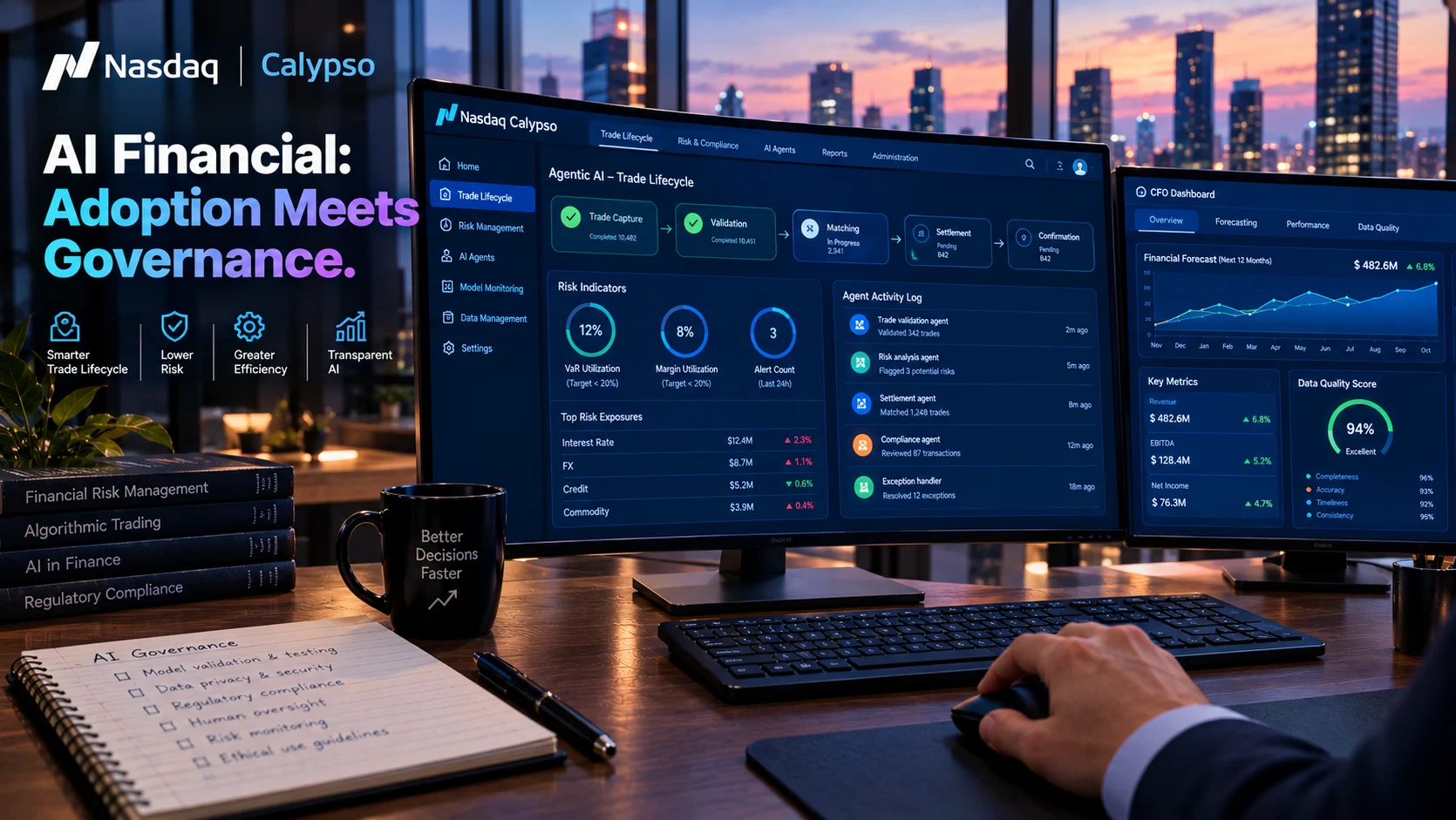
Nasdaq Calypso launched an agentic AI operating environment in September 2026, providing financial institutions with a governed space to run AI agents across the trade lifecycle. The environment uses Model Context Protocol to connect proprietary AI infrastructure, with strict sandboxing and no external data retention .
The platform addresses a specific bottleneck: almost half of surveyed institutions highlighted challenges with manual intervention in post-trade operations, while 56% said they risk losing ground to competitors without AI integration in clearing operations .
Investment Research and Analysis
Major model providers have entered financial services. Anthropic reported that financial services and insurance accounted for 25% of its annual recurring revenue as of July 2026, second only to programming. The company projects finance may surpass programming as its largest vertical market by 2027 .
Kimi launched a financial industry solution covering institutional research, IPO tracking, valuation comparison, and credit analysis, integrating data from Wind, S&P Global, and over ten other sources .
AI Financial Assistants
Visa introduced an AI Financial Assistant in July 2026 that brings conversational guidance into banking apps. The assistant provides proactive spending insights, answers natural-language questions grounded in cardholder activity, and enables actions like locking a card directly within the conversation .
The feature operates under Visa’s AI governance standards, informed by more than 300 billion annual transactions .
AI Financial Adoption vs. Impact: The Gap
Robert Walters’ global research reveals a striking disconnect. While 84% of finance departments invest in AI, only 7% report significant business impact .
Data Quality as the Bottleneck
The research identifies data quality and governance as the most frequently cited barriers to scaling AI. A new AI tool can be implemented quickly, but without reliable data, its impact remains limited .
Faye Walshe, Global Director of Innovation at Robert Walters, noted: “The AI market has moved beyond the stage where the key question is which tool a finance function should buy. The more difficult question is whether the organisation is ready to derive value from it” .
The Confidence Gap
Only 36% of surveyed CFOs are confident in their ability to make an organization-wide impact using AI. 44% are confident in accelerating adoption within finance, and barely 42% are confident in attracting and retaining the digital finance talent required .
Audit-Bound Workflows Resist Horizontal AI
Battery Ventures’ survey found a clear pattern: AI spreads fastest where workflows are simplest and audit consequences are lowest. FP&A forecasting, management reporting, and accounts-payable automation top the penetration list. Revenue recognition, tax planning, and compliance remain the least penetrated .
The more audit-bound a workflow is, the more likely CFOs are to require native, in-ERP AI rather than horizontal models. This creates opportunity for vertical vendors with deep domain integration .
Regulatory Framework: FSB Sound Practices
The Financial Stability Board finalized 12 sound practices for responsible AI adoption in October 2026, following public consultation .
Governance Practices
The first group emphasizes organization-wide AI governance:
- Board and senior management set alignment between AI adoption and business model, risk appetite, and strategy
- Maintain a governance framework with well-defined roles and responsibilities
- Incorporate AI risks into the risk management framework
- Undertake continuous learning and adaptation
Lifecycle Risk Management
The second group addresses risks throughout the AI lifecycle:
- Systematic assessment of materiality and risks at inception
- Appropriate selection of AI technologies
- Data governance
- Explainability and compensating controls
- Performance evaluation
- Human oversight
- Management of AI-related cyber and ICT risks
- Management of risks from third-party AI dependencies
The FSB encourages boards and senior management to reference these practices when developing AI governance frameworks .
Regulatory Gap and Supervisory Challenges
Cambridge’s 2026 report identifies a widening supervisory gap. While 40% of financial institutions have reached advanced AI adoption, only 20% of regulators have done so .
Risk Concerns
Regulators’ top concerns include data privacy and protection (80%), model hallucinations (70%), adversarial AI and cyber threats (57%), and critical third-party concentration (43%) .
A structural challenge looms: 79% of regulators consider explainability critical to their objectives, yet only 50% of supervised institutions have adopted explainable AI methods .
Agentic AI Blind Spot
The rapid uptake of agentic AI deepens the supervisory blind spot. Industry adoption stands at 52%, versus 28% for regulators .
The Basel Committee, meeting in September 2026, exchanged views on AI developments and agreed to review the sufficiency of existing operational risk loss categories, with focus on cyber risk and AI developments. The Committee noted that AI’s integration into critical financial functions “will require careful governance, robust risk management and ongoing supervisory attention” .
Who Should Use AI Financial Tools
Enterprise banks and financial institutions with mature data infrastructure benefit from agentic AI platforms like Nasdaq Calypso for trade lifecycle automation .
CFOs and finance teams can deploy AI for forecasting, reporting, and AP automation, where audit consequences are lower. Revenue recognition and tax planning require native in-ERP solutions .
Financial advisors are adopting AI at scale. FPSB’s 2026 study found 8 in 10 planners use or plan to adopt AI, with 93% reporting improved work efficiency .
Organizations with strict data governance requirements should prioritize platforms with contained, governed AI environments. Nasdaq Calypso’s approach of hosting agents within the institution’s perimeter with no external data retention serves as a model .
Common Mistakes and Cautions
Assuming adoption equals impact. 84% of finance departments invest in AI, but only 7% report significant business impact. Data quality, not tool selection, determines outcomes .
Underestimating regulatory divergence. Agentic AI adoption among institutions (52%) far outpaces regulator readiness (28%). Early adopters should anticipate evolving supervisory expectations .
Ignoring the audit boundary. Horizontal AI models work for forecasting and reporting. Revenue recognition and tax workflows require native, in-ERP AI with full audit trails .
Overlooking third-party concentration risk. 43% of regulators cite critical third-party concentration as a concern. Financial institutions should assess dependency on external AI providers .
Assuming explainability is optional. 79% of regulators consider explainability critical, yet only half of institutions have adopted explainable AI methods. This gap invites supervisory scrutiny .
Frequently Asked Questions
What is AI financial?
AI financial refers to artificial intelligence applications across banking, investment, insurance, and corporate finance. It includes fraud detection, algorithmic trading, risk management, customer service chatbots, and autonomous agents for trade and treasury workflows .
How many CFOs use AI?
Battery Ventures’ survey found 88% of CFOs report AI deployed in their organizations as of August 2026, up from 17% just six months earlier. Adoption accelerated due to improved model accuracy and maturing application layers .
What are the FSB’s 12 sound practices for AI?
The FSB’s sound practices cover organization-wide governance (board oversight, risk integration, continuous learning) and lifecycle risk management (materiality assessment, technology selection, data governance, explainability, human oversight, third-party risk) .
Why do so few finance departments see AI impact?
Data quality and governance are the primary barriers. A new AI tool can be implemented quickly, but without reliable, well-managed data, its impact remains limited. Only 7% of finance departments report significant business impact despite 84% adoption .
What is agentic AI in finance?
Agentic AI refers to autonomous systems that can take actions without human intervention. In finance, this includes trade execution, risk hedging, and treasury workflow automation. Adoption stands at 52% among institutions but only 28% among regulators .
Conclusion
AI financial adoption in 2026 is characterized by rapid uptake and uneven impact. CFO suites transformed from 17% to 88% adoption in six months, yet only 7% of finance departments report significant business impact. The gap between adoption and value remains the central challenge.
What matters most is data readiness. Model accuracy has improved. Application layers have matured. But without reliable, well-governed data, AI tools cannot deliver meaningful results.
AI financial tools may suit enterprises with mature data infrastructure, CFOs focused on forecasting and reporting workflows, and financial advisors seeking efficiency gains. They may not suit organizations without data governance foundations or those handling audit-bound workflows that require native, in-ERP AI.
Before deploying AI in finance, assess your data readiness. Understand the regulatory landscape, particularly the FSB’s sound practices. Monitor the supervisory gap as agentic AI adoption outpaces regulator readiness. And remember that adoption metrics do not guarantee impact. The organizations that capture value will be those that invest in data quality before selecting tools.