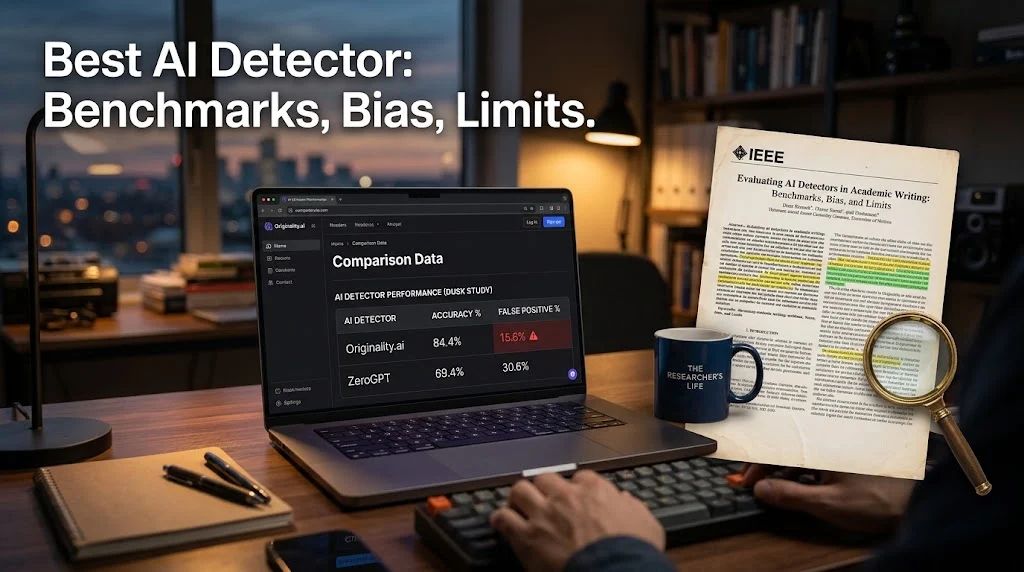
Quick Answer: There is no single “best” AI detector. The 2026 IEEE benchmark found Originality.ai leading at 84.4% accuracy, but a Springer study found Pangram outperforming GPTZero, Copyleaks, and Turnitin on academic texts. Accuracy drops to 54.2%–70.8% on hybrid texts, and false-positive rates of 15.6%–30.6% mean no tool is reliable enough for high-stakes decisions without human review.
At-a-Glance: Key Takeaways
- No detector dominates across all benchmarks. Originality.ai leads the IEEE academic corpus at 84.4%, Pangram leads a Springer study on hybrid texts, and Winston AI claims first place in a small 24-text peer-reviewed study .
- False positives are a systemic problem. The IEEE benchmark found rates of 15.6% to 30.6% across five major tools, raising “substantial concerns for equitable academic integrity enforcement” .
- Hybrid texts defeat every tool. Accuracy collapses to 54.2%–70.8% when human and AI writing mix, the most common real-world scenario .
- Turnitin’s sensitivity is poor. A De Gruyter study found its false-negative rate was “substantially higher” than its false-positive rate, particularly for GPT-5 .
- Scientific writing is the weakest domain. Epoch AI found detectors missed 24%–29% of style-imitated academic AI text, with some model combinations exceeding 48% .
- Pricing ranges from free to $14.95/month, with institutional tools like Turnitin requiring site licenses .
What Makes an AI Detector “Best”?
The “best” AI detector depends entirely on the task, the text type, and the tolerance for error. A tool that excels at detecting raw ChatGPT output may fail on paraphrased or hybrid text. A tool that performs well on academic essays may struggle with scientific abstracts.
The IEEE benchmark, published in May 2026, tested five widely used detectors against 180 academic writing samples: human-written, AI-generated, and hybrid texts . This is the most methodologically rigorous comparison available, and it shows significant variability.
A separate Springer study tested GPTZero, Pangram, Copyleaks, and Turnitin on 160 academic documents. Pangram “consistently performed better than the other tools,” achieving high accuracy on fully AI-generated, hybrid, and humanised texts .
The discrepancy between benchmarks is the point: there is no universal winner.
The Accuracy Problem in Numbers
The IEEE Benchmark
The IEEE study’s most important finding was not which tool won, but how poorly all tools performed on realistic text. False-positive rates of 15.6% to 30.6% mean that for every 100 human-written texts, 15 to 30 could be wrongly flagged as AI-generated .
Hybrid texts, which mix human and AI writing, dropped all tools to 54.2%–70.8% accuracy. This is the scenario most students and professionals actually produce: AI-assisted brainstorming or editing with human-written final drafts .
Turnitin’s Specific Weakness
A De Gruyter study focused on Turnitin found its false-negative rate was “substantially higher” than its false-positive rate, and even more so for GPT-5. The authors emphasized “the need for cautious interpretation of AI-detection scores, particularly as generative models continue to evolve” .
A Springer study of 120 scientific texts found Turnitin’s sensitivity was just 0.27, meaning it caught only 27% of AI-generated texts .
The Epoch AI Style-Imitation Test
Epoch AI tested Pangram, GPTZero, and Originality.ai against AI-generated text that imitated specific authors’ styles. On plain AI output, detectors missed only 0.7%. On style-imitated text, average false negatives rose to 13%. For scientific writing, the failure rate was 24%–29%, with Pangram missing 48% of Gemini-generated scientific passages .
The Vocabulary Attack
University of Florida researchers found that asking an LLM to use more complex vocabulary rendered commercial detectors “basically useless” . A simple lexical adjustment defeated the tools entirely.
Which Detector Fits Which Use Case
For Academic Institutions
Turnitin is the default because it is bundled with existing plagiarism licenses. But its AI detection is unreliable: low sensitivity, poor hybrid text performance, and documented bias against non-native writers . Institutions should use it as one signal among many, never as sole evidence.
Pangram performed best in the Springer academic study, particularly on hybrid and humanised texts . It is not sold to individuals but is available through institutional channels.
For Content Teams and Agencies
Originality.ai leads the IEEE benchmark at 84.4% and bundles plagiarism checking . Its pay-per-use pricing ($14.95/month) suits variable volume. The trade-off is false positives on hybrid text.
GPTZero is the choice for individual educators. It has a free tier (10,000 characters monthly) and education-specific features like LMS integration . Accuracy varies by text type, and it is not designed for enterprise scale.
For Multilingual Content
Copyleaks is the strongest option for multilingual detection, though its overall accuracy in the IEEE study was mid-range . The Springer study found it underestimated AI content, particularly from advanced models .
For Free Testing
ZeroGPT has the lowest accuracy (69.4%) but a free tier with no registration required . It is useful for quick sanity checks, not for consequential decisions.
Pricing Comparison
The Bias Problem
Every detector tested shows some form of bias. The IEEE study found false positives at rates that disproportionately affect non-native English writers and students taught formulaic writing patterns . A Zenodo study of Filipino student essays found detectors inconsistently classified the same set of human-written texts .
The tools are not measuring authorship. They are measuring style, and style correlates with educational background, language proficiency, and writing instruction.
Who Should Use Which Detector
Universities should use Turnitin only as one signal, with clear policies and human review. The false-positive rate of 15.6%–30.6% means hundreds of students could be wrongly flagged at scale .
Content teams should use Originality.ai for its highest overall accuracy and bundled plagiarism checking, accepting the false-positive risk on hybrid text .
Individual educators should use GPTZero’s free tier for quick checks, understanding its limitations on hybrid and scientific text .
Researchers should use Pangram where available, given its strongest performance in the Springer academic study .
Anyone making high-stakes decisions should not rely on any detector alone. The evidence is clear: no tool is reliable enough for sole reliance.
Common Mistakes and Cautions
Assuming one detector is “best” for everything. The IEEE benchmark and the Springer study produced different winners. Accuracy varies by text type, domain, and model version.
Treating the score as proof. A 50% AI score means the model flagged half the text. It does not mean the author cheated. Turnitin itself states its model “may not always be accurate” .
Ignoring the hybrid text problem. Every major study shows accuracy collapses when human and AI writing mix. This is the most common real-world scenario .
Overlooking the scientific writing weakness. Epoch AI found detectors missed 24%–29% of style-imitated scientific AI text, with some combinations exceeding 48% .
Using vendor benchmarks as independent evidence. Winston AI cites a 24-text study where it ranked first . That is a tiny sample. Independent benchmarks with larger samples show different results.
Frequently Asked Questions
What is the best AI detector overall?
There is no universal best. Originality.ai leads the IEEE academic benchmark at 84.4%. Pangram leads the Springer study on hybrid and humanised texts. Winston AI claims first place in a small 24-text peer-reviewed study. The “best” depends on your text type and use case .
Which AI detector is most accurate for academic writing?
Pangram performed best in a Springer study on 160 academic documents, including hybrid and humanised texts . Turnitin is the most widely used but has low sensitivity (27% in one study) .
Are AI detectors reliable enough for academic misconduct decisions?
No. The IEEE benchmark found false-positive rates of 15.6%–30.6%, meaning hundreds of students could be wrongly flagged at scale. Turnitin itself states its model should not be the sole basis for adverse action .
What is the cheapest AI detector?
ZeroGPT is free with no registration. GPTZero offers 10,000 characters monthly free. Originality.ai and Copyleaks offer limited free tiers with paid plans starting under $15/month .
Why do AI detectors fail on scientific writing?
Scientific writing is structured and formulaic, similar to AI-generated text. Epoch AI found detectors missed 24%–29% of style-imitated scientific AI text, with some model combinations exceeding 48% .
Conclusion
The search for the “best” AI detector reveals a fragmented landscape where no single tool dominates. Originality.ai leads the IEEE academic benchmark. Pangram leads the Springer study on hybrid texts. Winston AI claims first place in a smaller peer-reviewed study. Each has different strengths, weaknesses, and error profiles.