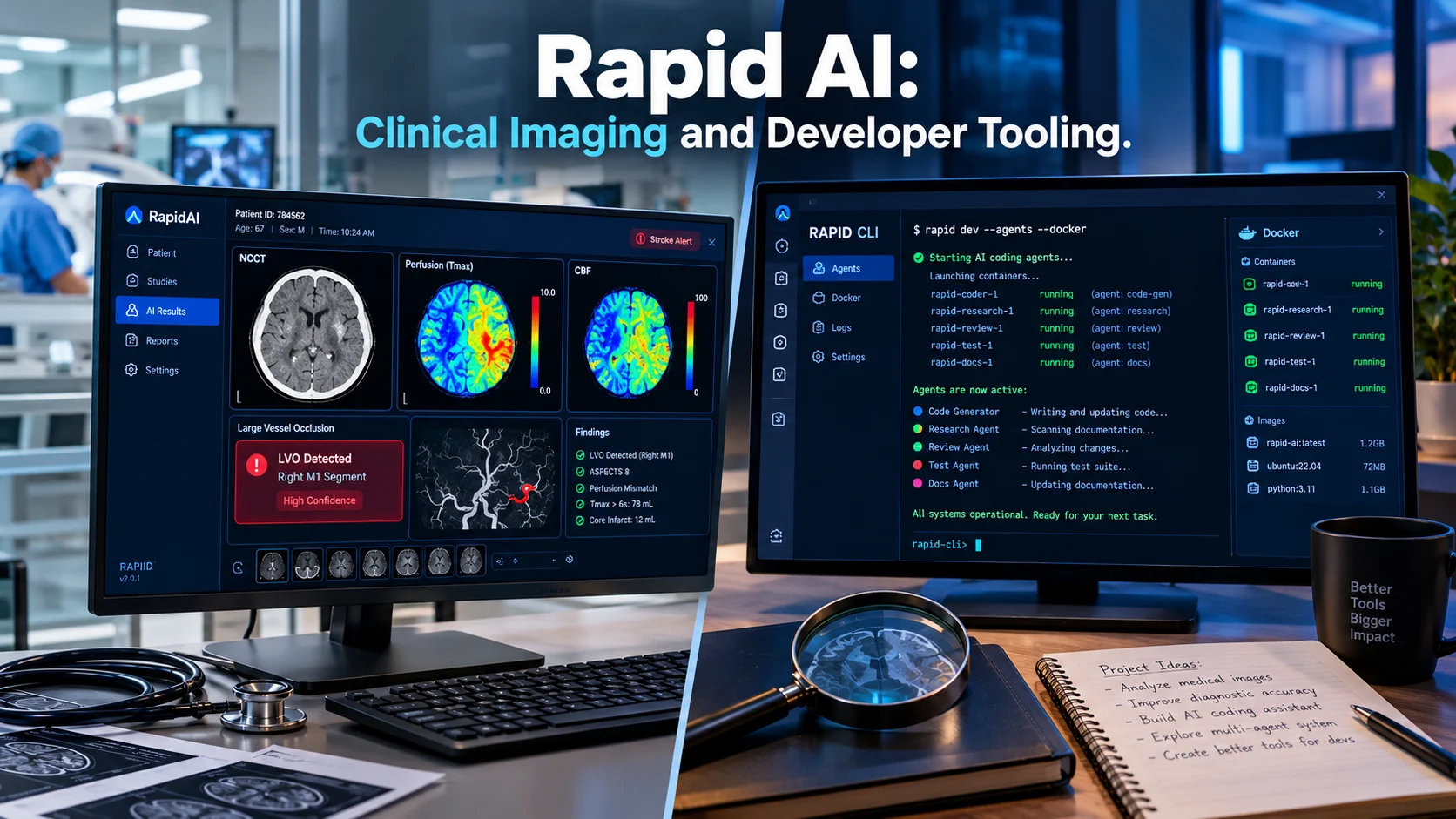
“Rapid AI” is not a single product. The most established use is RapidAI, a clinical AI platform for stroke and neurovascular imaging used by 2,500+ hospitals in 100+ countries. The name also refers to RAPID CLI, an open-source framework for orchestrating AI coding agents in dev containers.
At-a-Glance: Key Takeaways
- RapidAI is a clinical AI platform for stroke and neurovascular imaging, with FDA clearances and validation in landmark trials that expanded stroke treatment windows from 6 to 24 hours .
- It is used by 2,500+ hospitals in 100+ countries, backed by 800+ clinical studies .
- RapidAI holds ISO 13485, ISO 27001, ISO 27701, SOC 2 Type I, HIPAA, and GDPR compliance .
- Pricing is quote-based and not published; hospital contracts are arranged directly with the vendor .
- RAPID CLI is a separate open-source tool for orchestrating AI coding assistants (Claude Code, Aider, OpenCode) in Docker containers .
- Other entities include Rapid AI Bridge (API middleware on RapidAPI) and consumer mobile apps named Rapid AI .
RapidAI: The Clinical Stroke Platform
The dominant result for “Rapid AI” is RapidAI, a medical imaging company founded from Stanford research in 2008. The platform pioneered fully automated image processing for neurology and has become a standard in acute stroke care .
Clinical Impact and Validation
RapidAI’s perfusion imaging was used to select patients in the DAWN and DEFUSE 3 clinical trials. These trials produced evidence that led the American Heart and American Stroke associations to revise guidelines, extending the acute stroke treatment window from 6 hours to 24 hours .
This is a rare example of an AI platform directly influencing clinical guidelines. The company describes itself as the most clinically validated AI platform in healthcare, with 700+ clinical studies .
Product Portfolio
The Rapid Enterprise Platform combines 40+ algorithms spanning neurology, cardiovascular, vascular, oncology, and orthopedic care . Key products include:
- Rapid LVO: Large vessel occlusion detection, demonstrated superior to Viz LVO in comparative testing
- Lumina 3D: Automated 3D CTA head and neck reconstruction
- Rapid Aneurysm and Rapid Aortic: Vascular and cardiovascular applications
Real-World Operational Impact
A midwestern health system using Lumina 3D saved 24 minutes for CT technologists per scan, freeing 72 hours of technologist time monthly and enabling five additional scans per day. This translated to $61,000 per month in incremental imaging revenue .
Competitive Positioning
A 2026 scoping review in Medicina compared RapidAI with Brainomix, Aidoc, and Viz.ai. Key findings :
- RapidAI is perfusion-centric, with outputs not interchangeable with platforms like Viz.ai due to different mathematical models for deriving perfusion parameters
- Aidoc showed faster raw alert generation in direct comparisons, but RapidAI remains a critical decision-support tool due to advanced perfusion analysis and clinical validation
- Volumetric discrepancies across vendors have direct clinical implications because DAWN and DEFUSE 3 thresholds originated from RapidAI software
Security and Compliance
RapidAI publishes extensive security documentation :
- Certifications: ISO 13485, ISO 27001, ISO 27701, SOC 2 Type I
- Compliance: HIPAA, GDPR
- Encryption: AES-256 at rest, TLS in transit
- Architecture: Containerized platform, immutable OS, role-based access control
AWS Partnership
In December 2025, RapidAI and AWS announced a strengthened relationship to accelerate global deployment of clinical AI. The Rapid Edge Cloud platform is built on AWS infrastructure, supporting hospitals in 100+ countries with regional security and compliance requirements .
Funding
RapidAI has raised $125-128M over six rounds, with the latest being a $25M debt round in August 2026. Investors include Vista Equity Partners, Cullenn Capital, Lennertz & Co., and Listwin Ventures .
Pricing
RapidAI does not publish pricing. Hospital contracts are quote-based and arranged directly with the vendor .
RAPID CLI: Developer Tooling for AI Coding Agents
A completely separate entity called RAPID is an open-source CLI for orchestrating AI coding assistants within containerized development environments. It is distributed via npm as @a3t/rapid .
What RAPID CLI Does
RAPID simplifies running AI coding agents like Claude Code, OpenCode, Aider, and GitHub Copilot CLI inside Docker containers. Key features include :
- Simple commands:
rapid devlaunches an AI coding session in the container - Multi-agent support:
--multi claude,aiderlaunches multiple agents in tmux panes - Container orchestration: Automatic Docker container management
- Credential management: 1Password and Vault integration
- Configuration-driven: Single
rapid.jsonfor all settings
Supported Agents
| Claude Code | npm install -g @anthropic-ai/claude-code | Complex reasoning, refactoring |
| OpenCode | npm install -g opencode | Multi-model, cost optimization |
| Aider | pip install aider-chat | Quick iterations, auto-commits |
| GitHub Copilot CLI | gh extension install github/gh-copilot | Shell commands, git operations |
The rapids-ai Framework
A separate but related npm package called rapids-ai provides a portable Claude Code framework with 11 autonomous sub-agents, 5 MCP servers, and CI/CD automation. Its philosophy is explicitly revenue-focused: “Code without revenue is worthless. Ship fast, validate with users, iterate based on data” .
The framework includes agents for Feature Building, Bug Hunting, Test Generation, Refactoring, Performance Analysis, Database Architecture, Security Scanning, Deployment, Design (Material Design 3), and Marketing Strategy .
Pricing
RAPID CLI and rapids-ai are open source and free to use. Costs depend on the underlying AI model providers (Anthropic, OpenAI, Google) that users connect .
Other “Rapid AI” Entities
Rapid AI Bridge (API Middleware)
A listing on RapidAPI for “Rapid AI Bridge” offers a token-based API service with tiered pricing :
| Basic | $0 | 10,000 | 25 |
| Pro | $1 | 10,000,000 | 100,000 |
| Ultra | $5 | 50,000,000 | 400,000 |
| Mega | $10 | 200,000,000 | 800,000 |
This appears to be a middleware service rather than a foundation model provider.
Rapid AI Mobile App
A privacy policy for a mobile app called “Rapid AI” describes an AI chatbot that collects prompts and device information, uses AI to generate responses, and states that content “may occasionally be inaccurate or incomplete and should not be relied upon as professional legal, medical, financial, or other expert advice” .
How to Identify the Right “Rapid AI”
Common Mistakes and Cautions
Confusing RapidAI (clinical) with RAPID CLI (developer). One is a medical imaging platform used in hospitals. The other is an open-source tool for AI coding agents. They share no connection.
Assuming RapidAI pricing is published. Hospital contracts are quote-based and not publicly listed .
Overlooking perfusion output non-interchangeability. Research shows RapidAI and Viz.ai produce different perfusion parameter estimates from the same patient data. DAWN and DEFUSE 3 thresholds originated from RapidAI software and cannot be uncritically applied to other platforms .
Trusting consumer app claims without verification. The Rapid AI mobile app’s privacy policy includes a standard disclaimer that AI content should not be relied upon for professional advice. No independent validation exists .
Frequently Asked Questions
What is Rapid AI?
“Rapid AI” is not a single product. The most established entity is RapidAI, a clinical AI platform for stroke and neurovascular imaging used by 2,500+ hospitals. The name also refers to RAPID CLI (developer tooling), Rapid AI Bridge (API middleware), and consumer mobile apps .
What does RapidAI do?
RapidAI provides AI-powered imaging insights for stroke, cardiovascular, and vascular conditions. Its perfusion analysis was used in the DAWN and DEFUSE 3 trials that expanded the stroke treatment window from 6 to 24 hours. It is used in 2,500+ hospitals across 100+ countries .
Is RapidAI FDA cleared?
RapidAI has multiple FDA clearances. The company reports 800+ clinical studies backing its platform, and its Rapid LVO product demonstrated superiority over Viz LVO in comparative testing .
How much does RapidAI cost?
RapidAI does not publish pricing. Hospital contracts are quote-based and arranged directly with the vendor .
What is RAPID CLI?
RAPID CLI (@a3t/rapid) is an open-source command-line tool for orchestrating AI coding assistants like Claude Code, Aider, and OpenCode within Docker containers. It is unrelated to RapidAI the clinical platform .
Conclusion
“Rapid AI” illustrates the naming fragmentation common in the AI market. A single keyword surfaces a clinical platform used in thousands of hospitals, an open-source developer tool, API middleware, and consumer apps.
What matters most is intent. If you are evaluating stroke imaging AI for a hospital, RapidAI is the relevant entity, with extensive clinical validation, FDA clearances, and security certifications. If you are a developer seeking to orchestrate AI coding agents in containers, RAPID CLI serves that purpose. The two are entirely unrelated.
For clinical buyers, the key considerations are perfusion output non-interchangeability with other vendors and the quote-based pricing model. For developers, RAPID CLI is free but depends on the AI providers you connect.
Before acting on any “Rapid AI” result, verify which entity you are evaluating. Check the domain: rapidai.com for clinical, npm for developer tooling. The name overlaps; the platforms do not.