AI is embedded throughout TikTok, from the Symphony Agent that generates video ads from a single prompt to the automated moderation system that removed 96.7% of violating videos before human review in Q1 2026 . Creators must now label realistic AI-generated content, and TikTok’s Creator Rewards Program excludes unoriginal AI videos from monetization .
At-a-Glance: Key Takeaways
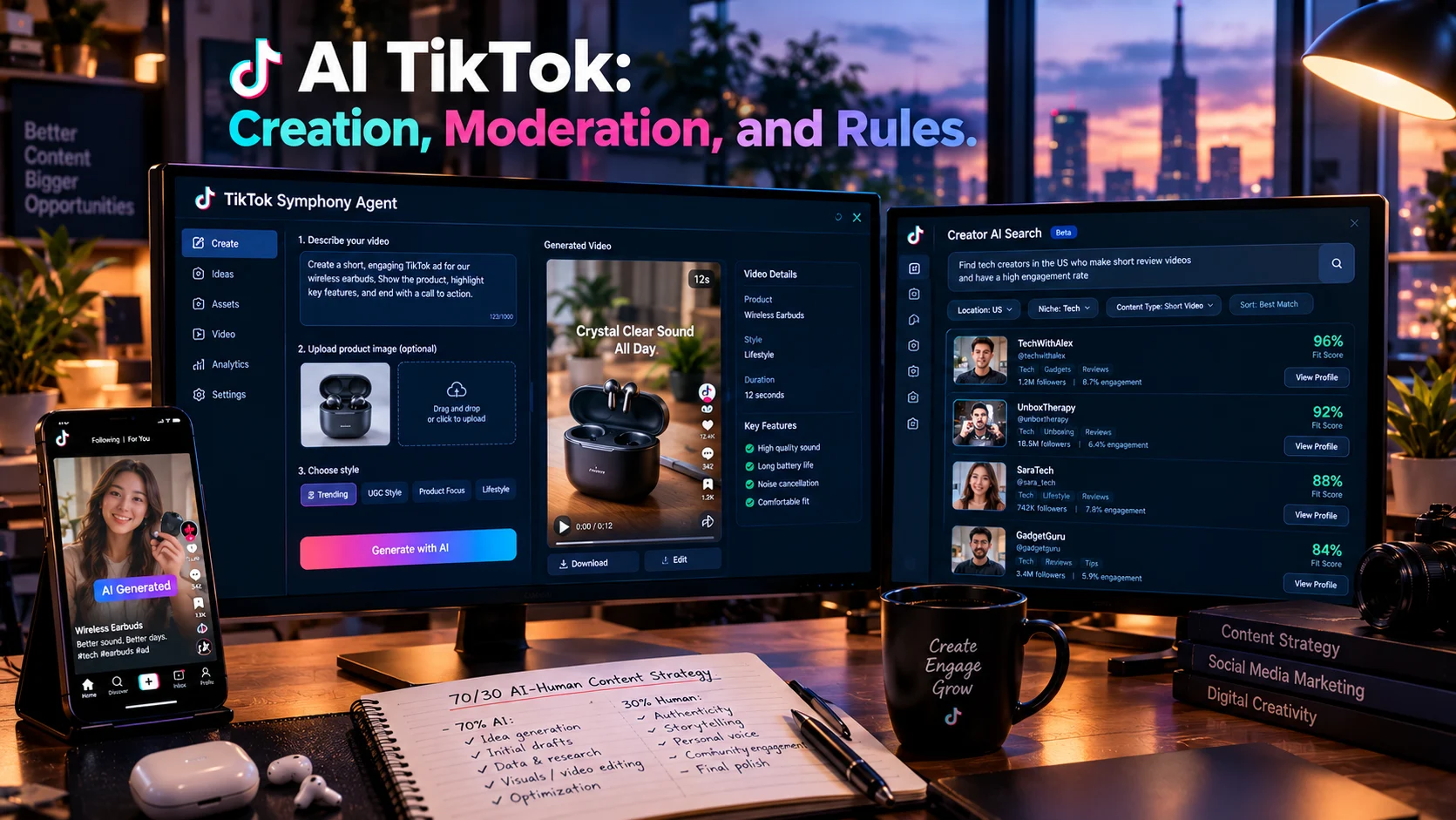
- TikTok’s Symphony Agent is an agentic AI creative engine that generates videos from prompts, trends, and product images, producing a 12-second video in about 3 minutes .
- Creator AI Search helps advertisers find the right creators using natural language instead of keyword filters .
- AI labels are mandatory for realistic synthetic content, with over 3 billion videos labeled using C2PA standards and invisible watermarking .
- Automated systems removed 96.7% of violating videos globally in Q1 2026 before human review .
- The Creator Rewards Program bans AI content from monetization, requiring “original” videos of at least 1 minute .
- ByteDance is training a 10-trillion-parameter AI model, potentially surpassing Western frontier models in scale .
What Is AI TikTok?
“AI TikTok” describes the convergence of artificial intelligence and TikTok across three distinct layers. First, TikTok uses AI internally for content moderation, recommendation, and advertising automation. Second, creators and advertisers use TikTok’s AI tools to produce content. Third, the platform regulates AI-generated content through labeling requirements and monetization rules.
The scale is staggering. TikTok’s automated systems scanned and removed 178 million violating videos globally in Q1 2026 alone, representing 96.7% of all removals . The company has applied AI labels to more than 3 billion videos using technologies including the Coalition for Content Provenance and Authenticity (C2PA) standard, creator labeling tools, and invisible watermarking .
For creators and advertisers, the platform now offers a comprehensive AI creative suite under the Symphony brand, anchored by the Symphony Agent, an agentic AI engine that handles everything from brief to final video .
How TikTok Uses AI Internally
Automated Content Moderation
Before any video reaches the recommendation feed, machine learning systems scan its images, sounds, and signals for potential violations. The systems analyze visual content, audio, keywords, hyperlinks, and even body posture and actions .
The technology combines multiple signals to identify prohibited activity. For example, it can recognize a cigarette combined with a specific hand position to flag smoking content. More ambiguous cases, including misinformation, bullying, and content requiring cultural or linguistic context, are referred to human moderators .
In Korea, automated systems accounted for about 87% of the 254,000+ videos removed in Q1 2026. About 57.4% were removed with zero views, and 84.4% were taken down after receiving 100 views or fewer .
Recommendation and Discovery
Once content clears moderation, TikTok’s recommendation system matches videos with users based on signals including watch time, likes, comments, follows, captions, hashtags, sounds, language settings, and approximate location. The system also limits repetitive content from the same creator and adjusts recommendations when a feed becomes overly focused .
AI Labeling at Scale
TikTok automatically applies “AI-generated” labels to content containing specific technical metadata. The platform uses C2PA Content Credentials, creator self-disclosure tools, and invisible watermarking. Creators cannot remove platform-applied labels .
TikTok’s AI Creative Tools for Advertisers
Symphony Agent
Launched in June 2026, Symphony Agent is TikTok’s AI-powered creative engine that powers Symphony Creative Studio, Content Suite, and TikTok One .
Symphony Creative Studio: Advertisers upload a product image and select a TikTok trend for inspiration. The agent then guides the user through creating a product brief, insight report, storyboard, and final video. A 12-second video generates in about 3 minutes; a 20-second video takes about 5 minutes. Advertisers can request up to 3 variations for A/B testing .
Content Suite AI Search: Instead of manually searching through brand-related videos, advertisers click “AI Search,” input their creative needs, and receive a shortlist of relevant, actionable recommendations .
TikTok One Integration: Symphony Agent transforms campaign goals into refined briefs, delivers precise creator matching, and supports batch invitations. A single input of campaign requirements generates a curated shortlist of 20 recommended creators with fit rationale .
Creator AI Search
TikTok One now includes Creator AI Search, an AI-powered solution for finding creators. Instead of starting with keywords, advertisers can input a campaign brief or describe what they are looking for in natural language. The system returns data-driven indications about creator suitability and past partnership performance .
Dreamina Video Model
TikTok integrated ByteDance’s next-generation Dreamina (Seedance 2.0) model into the Symphony suite. Dreamina generates realistic depictions from text prompts, images, and reference clips, with improved consistency of brand products across video segments. Advertisers can reject any generated videos .
AI Content Rules for Creators
Mandatory Disclosure
Creators must clearly disclose AI use in content that includes synthetic faces, voices, digital humans, or highly realistic virtual figures. Disclosure is also required when content is fully generated or significantly edited by AI in a way that changes meaning or context, or when AI effects are realistic enough to be mistaken for real footage .
Disclosure methods include turning on the “AI-generated content” toggle during posting or labeling within the content itself. Content created using official TikTok AI effects is automatically labeled .
Prohibited AI Content
TikTok prohibits several categories of AI-generated content :
| Impersonation of Celebrities/Public Figures | AI avatars of Kanye West selling shoes, Kim Kardashian endorsing capsules |
| Impersonation of Authorities | AI police officers recommending safety products, virtual soldiers promoting supplements |
| Fear-Based Health Imagery | AI-generated diseased organs used to pressure health product purchases |
| Exaggerated Product Claims | AI showing toothpaste eliminating cavities or shampoo instantly growing hair |
| Inaccurate Product Attributes | AI altering product size, inventing features, or misrepresenting packaging |
Monetization Restrictions
TikTok’s Creator Rewards Program requires “original” videos of at least 1 minute. While AI materials are not explicitly banned, videos lacking originality are excluded from rewards. This mirrors YouTube’s approach to AI content .
Agencies recommend a 70/30 split: 70% human-created published content (fully monetizable) and 30% AI-powered intelligence and testing. AI should drive creative strategy, not content production .
ByteDance’s AI Ambitions
TikTok’s parent company is investing heavily in AI infrastructure. ByteDance is training an AI model with up to 10 trillion parameters, potentially surpassing Western frontier models like Anthropic’s Claude Mythos 5 (estimated at 8 trillion parameters) .
The company’s Seed team, comprising about 2,000 employees led by former Google DeepMind research VP Wu Yonghui, has developed models including Seedance 2.0 (video generation) and Seed2.1 (multimodal reasoning) .
ByteDance has reportedly secured a $30 billion loan to fund AI growth, with spending potentially reaching $100 billion by 2027. The company is also pursuing partnerships with MediaTek for custom AI chips to work around US export restrictions .
TikTok CEO Shou Zi Chew predicted major scientific breakthroughs from AI within three years, particularly in physics, biotech, chemistry, and material science. “I think in the short term we are probably overestimating it, but in the long term we are probably underestimating it,” he said .
Common Mistakes and Cautions
Failing to label AI content. C2PA Content Credentials have tagged 1.3 billion videos. TikTok’s detection is production-grade, and penalties escalate from content removal to permanent monetization bans .
Assuming AI content monetizes equally. The Creator Rewards Program excludes unoriginal AI videos. One brand reportedly saw its TikTok Shop score drop from 4.8 to 4.2 after shifting to majority AI content .
Using AI to impersonate professionals. AI-generated “doctors,” “nutritionists,” or “experts” promoting health products are strictly prohibited and face enforcement .
Over-relying on AI-generated effects for product demos. AI showing impossible results, such as instant cleaning of industrial grease or immediate cavity repair, violates platform rules .
Ignoring the quality gap. Research shows AI UGC gets higher raw engagement but scores 18 points lower on authenticity trust (63% vs 81% for human content) .
Frequently Asked Questions
What is AI TikTok?
AI TikTok describes the integration of artificial intelligence across TikTok’s platform, including internal moderation and recommendation systems, creative tools like Symphony Agent for advertisers, and content rules for creators using AI generation .
How does TikTok detect AI content?
TikTok uses C2PA Content Credentials, invisible watermarking, and automated detection systems. The platform has applied AI labels to over 3 billion videos and uses production-grade detection to identify synthetic media .
Can AI-generated content be monetized on TikTok?
The Creator Rewards Program requires original content of at least 1 minute. AI content that lacks originality is excluded from rewards. Leading agencies recommend a 70/30 split with AI driving strategy rather than final production .
What is Symphony Agent?
Symphony Agent is TikTok’s AI-powered creative engine for advertisers. It generates videos from prompts, product images, and trends, creates campaign briefs, and matches brands with creators. A 12-second video generates in about 3 minutes .
What happens if I don’t label AI content?
Failing to disclose AI use when required is a violation. Penalties escalate from content removal to posting restrictions and eventual account termination. Platform-applied labels cannot be removed .
Conclusion
AI TikTok is not a single product but a multifaceted integration of artificial intelligence into every layer of the platform. Internally, AI moderates 96.7% of violating content and powers recommendations. For advertisers, Symphony Agent transforms campaign briefs into finished videos in minutes. For creators, AI tools offer production capabilities alongside strict disclosure rules.
What matters most is understanding the rules. AI content is permitted but must be labeled when realistic. Monetization excludes unoriginal AI videos. Impersonation of professionals and authorities is strictly prohibited. Exaggerated product claims face enforcement.
AI TikTok may suit advertisers seeking rapid creative production at scale, creators using AI for strategy and testing while keeping final content human-led, and researchers studying platform AI governance. It may not suit those seeking frictionless AI content monetization, creators unwilling to comply with labeling requirements, or advertisers relying on AI-generated health claims.
Before publishing AI content on TikTok, disclose it. Before building an AI content strategy, understand the 70/30 framework. And before assuming AI can replace human creativity, consider that authenticity still scores higher with audiences than synthetic polish.