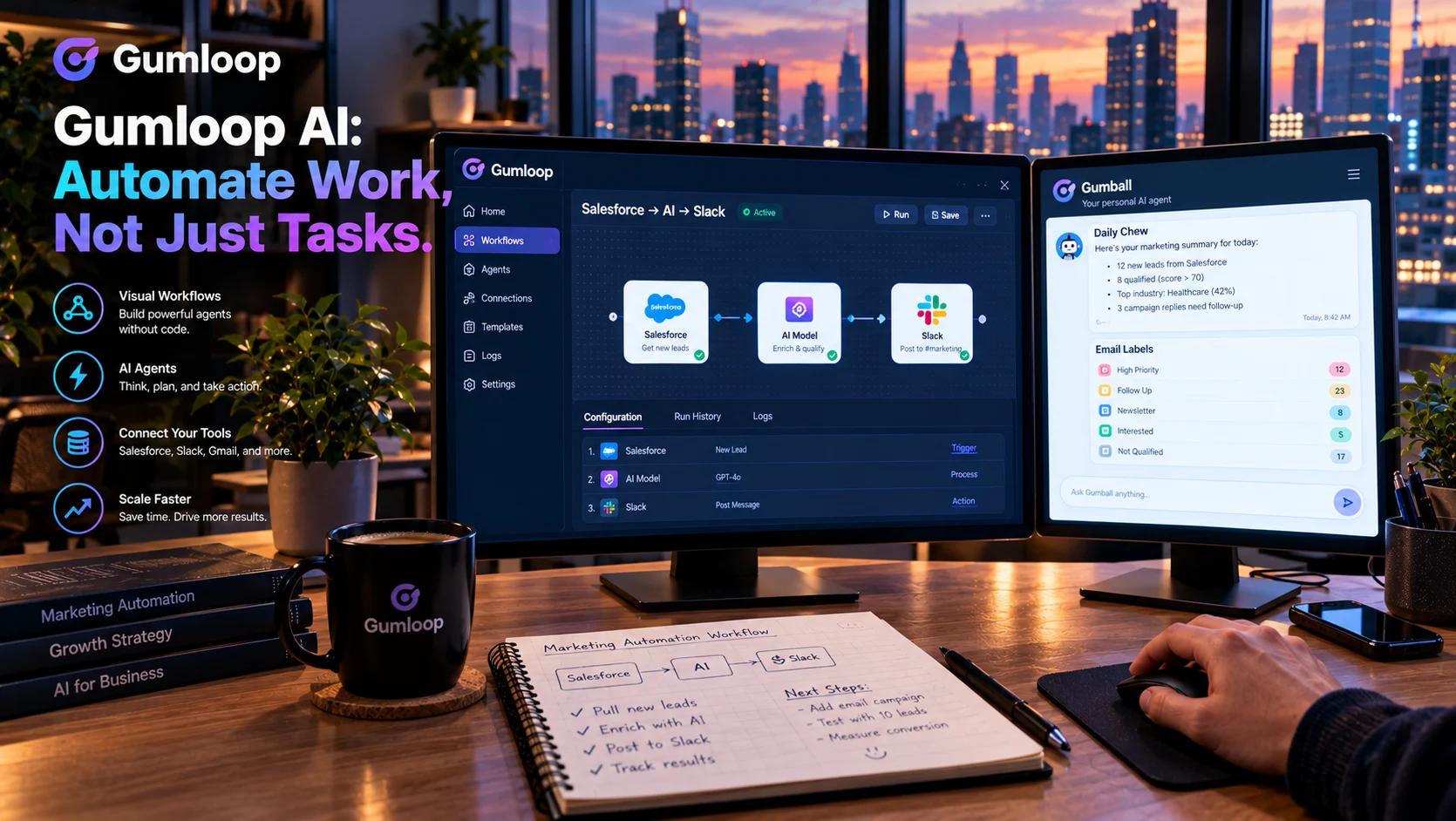
Gumloop AI is a no-code automation and agent platform that lets non-technical employees build AI workflows through a visual drag-and-drop interface. It has raised $70 million in total funding, serves enterprise customers including Shopify, Ramp, and Instacart, and offers a generous free tier with 5,000 monthly credits alongside paid plans starting at $37 per month.
At-a-Glance: Key Takeaways
- **Gumloop raised $50 million in Series B funding** in March 2026, led by Benchmark with participation from Shopify Ventures and Y Combinator, bringing total funding to $70 million .
- The platform evolved from a drag-and-drop workflow builder into a full agent platform with Gumloop Agents, the core orchestration platform, and Gumstack for enterprise security monitoring .
- Pricing starts free with 5,000 monthly credits, then $37 per month for Pro with 240,000 annual credits. Enterprise pricing is custom .
- SOC 2 Type II certified as of January 2026, with HIPAA compliance, GDPR adherence, and an Incognito Mode for sensitive workflows that prevents data persistence .
- Real users report strong satisfaction, with 100% ratings on Capterra and Software Advice, praising the intuitive interface and responsive community support .
- Credit-based pricing can be difficult to predict, with costs varying from 1 credit for simple actions to 30+ credits for expert AI model calls .
What Is Gumloop AI?
Gumloop AI is a no-code platform for building AI-powered automations and agents. Founded in 2023, the company positions itself as the tool that lets anyone in an organization, from marketing interns to CEOs, build and deploy AI agents without engineering support .
The platform began as a visual workflow builder with drag-and-drop nodes. It has since evolved into a comprehensive AI automation platform that serves enterprise customers including Shopify, Ramp, Gusto, Samsara, Instacart, and Opendoor .
Gumloop’s core premise is simple: understanding a task should be the only prerequisite to automating it. Users connect their apps, describe what they want to accomplish, and the platform handles the orchestration. The company’s form factor has evolved alongside foundation model improvements, but the core tenets remain consistent: intuitive user experience, access to every model provider, data connectivity, and enterprise-grade security .
How Gumloop AI Works
The Three Core Products
Gumloop organizes its offering into three distinct layers :
Gumloop Agents are proactive AI agents that employees can build in minutes. They connect to hundreds of apps and deploy natively across Slack, Microsoft Teams, and email. Agents can use MCP servers, Gumloop workflows, and system context to solve open-ended tasks .
The Gumloop Platform is the core workspace for collaboration. Teams build, share, and orchestrate agents and automations across their business. The platform includes a visual editor, a template library, and shared ownership features .
Gumstack is the security layer built specifically for security teams. It monitors and controls data use across an organization’s agents, tracking tool calls from not just Gumloop but also Claude Code, ChatGPT, Cursor, and internal custom agents. This addresses a critical enterprise concern: visibility into how AI tools access and use company data .
Building an Agent
Creating an agent follows a simple three-step process :
- Create a new agent in the Agents tab
- Connect tools including MCP servers, Gumloop workflows, and app integrations
- Start chatting with the agent in Gumloop or Slack
Once connected, the agent reasons through tasks and selects the appropriate tools. For example, an agent with Apollo MCP, Gmail MCP, and a customer data workflow can take a LinkedIn profile, find the person’s email, check their product activity, and draft a personalized outreach message, all from a single request .
The Command Center Chat
A February 2026 update transformed the Gumloop experience by placing a chat window at the center of the workspace. Users can now start working immediately, asking questions or giving tasks without any setup. The chat connects to over 100 apps and data sources on demand .
The chat also knows which tools to recommend. If a user asks about keyword research, Gumloop surfaces Semrush. If they need to check their calendar, it connects to Google Calendar and uses Apollo to research meeting attendees. Users may not realize they have access to tools like Apollo, Google Maps, Semrush, and Exa without separate subscriptions. Gumloop does .
Gumball: The Personal Agent
In September 2026, Gumloop introduced Gumball, a personal agent that works in the cloud rather than on a local machine. Gumball checks emails, prepares meeting briefs, manages a Smart Inbox with automatic labeling, and delivers a daily “Chew” summary of priorities and highlights .
Gumball includes model routing, automatically selecting the right AI model for each task based on complexity and cost. Organizations can restrict which models are available. The agent also learns the user’s tone and design preferences by analyzing sent emails and website materials .
Key Features
Visual Workflow Builder
The drag-and-drop interface remains a core capability. Users chain nodes representing AI calls, data processing, app integrations, and logic to create multi-step workflows. Over 115 pre-built blocks accelerate workflow creation .
Agent-Native Slack Integration
Gumloop agents work natively in Slack. Building an agent and adding it to a team channel creates a shared learning environment. Team members see how others interact with agents, and each thread becomes a separate conversation. This exposes the “art of the possible” by default .
Template Library and Marketplace
Gumloop offers community templates that users can copy and customize. Non-technical users have published their own agents and workflows to the marketplace, including a blog performance analysis agent and a content classification workflow .
Model Flexibility
Gumloop provides access to every major model provider, allowing users to select the right model for each task. Gumball adds automatic model routing for cost optimization .
Pricing and Plans
Gumloop has simplified its pricing structure over time, combining previous Solo and Team tiers into a single Pro plan .
Credit Consumption Details
Every workflow has a base cost of 1 credit plus node costs. Costs vary significantly by task type :
- Free nodes (0 credits): Logic, filters, loops, and many integrations like Google Sheets or Slack
- Simple actions (1-3 credits): Basic app connections, lightweight AI steps
- Standard AI models (2 credits per call): Quick summaries, simple classification
- Advanced AI models (20 credits per call): Detailed reasoning, content generation
- Expert AI models (30+ credits per call): Deep analysis, complex decisions
- Heavy operations (10-60+ credits): Data enrichment, large prompts, multi-page scraping
Important caution: Credit-based pricing can be difficult to predict. A polling trigger checking for updates every few minutes can accumulate hundreds of credit charges per day. Accidental loops or large enrichment workflows can exhaust monthly allocations quickly .
Privacy and Security
Gumloop has invested heavily in enterprise security, a critical requirement for the companies it serves.
Certifications and Compliance
- SOC 2 Type II: Certified January 15, 2026
- HIPAA: Compliant
- GDPR: Compliant
- Data encryption: TLS 1.2+ in transit, AES-256 at rest
Incognito Mode
Enterprise users can toggle Incognito Mode on any workflow. When enabled, Gumloop does not store inputs or outputs of nodes. Data is processed and passed through without persistence. This is designed for legal, operations, and other teams handling highly sensitive information who need limited retention .
Data Handling Commitments
Gumloop states that customer data is stored in the United States and is not transferred to third-party sub-processors. Data is not retained after account termination . The platform’s no-training promise covers premium users, though it is unclear whether it extends to the free trial .
Enterprise Deployment Options
Gumstack provides security teams with visibility into data usage across the organization’s agents, including tools outside Gumloop. Enterprise customers can deploy in a virtual private cloud (VPC), ensuring no data leaves the company’s infrastructure .
Important distinction: SOC 2 certification does not automatically mean Zero Data Retention. Gumloop’s standard operations retain data to enable debugging and run history. Incognito Mode provides ZDR-like behavior but requires manual activation per workflow .
Real-World Results and User Feedback
Enterprise Adoption
Gumloop reports adoption at some of the most AI-forward companies, including Shopify, Ramp, Gusto, Samsara, Instacart, and Opendoor. The company attributes this to a balance between powerful capabilities and ease of use, along with obsessive customer service .
User Reviews
Reviews on Capterra and Software Advice give Gumloop a perfect 5.0 rating. Users consistently praise the intuitive interface and responsive support .
One user described it as “the most intuitive platform to do no-code automations,” noting that setting up connections to Google, Zendesk, and other services was a breeze. The same user noted a minor drawback: “While the platform is intuitive, it can be daunting at first when setting up Gumloop. There are so much things that can be done that it leads to choice paralysis” .
Another user highlighted the community support: “I can easily just go in the community Slack or on their forums and ask questions. Then I get answers quite fast. I mean, sometimes within 15 minutes or within two hours” .
A non-technical LinkedIn user shared their experience building their first agent: “As a non-technical person who does not mind automating some parts of her tasks, Gumloop is a breeze. It’s easy to use, and the drag-and-drop interface makes it quicker for people like us who want to get the workflow started” .
How Gumloop Compares to Alternatives
| Gumloop | $37/month | 5,000 credits/month | No-code visual builder, agent platform, enterprise security | Credit pricing unpredictable, limited integrations vs Zapier |
| Zapier | $29.99/month | 100 tasks/month | 9,000+ app integrations, established ecosystem | AI is bolted on, not native |
| Make | $9/month | 1,000 ops/month | Visual builder, strong for complex logic | Steeper learning curve |
| Lindy | Subscription | No | Personal assistant focus, Slack integration | Less visual workflow control |
| Dust | $24/user/month | 500 lifetime credits | Collaborative multi-model agents | Smaller connector catalog |
| Glean | Custom | No | Enterprise search, permissions-aware governance | No self-serve pricing, enterprise-only |
Editorial interpretation: Gumloop’s differentiation is its AI-native design and focus on making agents accessible to non-technical users while maintaining enterprise security. Zapier offers broader app coverage but treats AI as an add-on. Make provides more complex logic capabilities but has a steeper learning curve. Glean is the stronger choice for organizations prioritizing governed knowledge and permissions inheritance over self-serve visual building .
Who Should Use Gumloop AI
Non-technical employees who want to automate repetitive tasks without learning to code. The drag-and-drop interface and natural language agent building lower the barrier significantly .
Enterprise teams at companies like Shopify and Ramp that need to deploy AI agents across departments while maintaining security oversight. Gumstack addresses the governance gap that often blocks AI adoption .
Teams already using Slack heavily benefit from native agent integration. Building an agent and adding it to a channel creates visibility and enables organizational learning .
Organizations with strict data governance requirements can use Incognito Mode for sensitive workflows and VPC deployment for complete data isolation .
Small teams or individuals may find the free tier sufficient for initial automation needs, though credit limits will eventually constrain more intensive use .
Organizations needing the broadest possible app coverage should evaluate Zapier, which has a larger integration catalog .
Common Mistakes and Cautions
Underestimating credit consumption. Credit-based pricing is not flat. Expert AI model calls cost 30+ credits each. A workflow with multiple AI steps can consume significant credits per run. Model the cost of a single workflow run, not just the monthly plan price .
Assuming Incognito Mode is default. Enterprise users must toggle Incognito Mode per workflow to prevent data persistence. Standard operations store inputs and outputs for debugging .
Ignoring the free trial training policy. Gumloop’s no-training promise covers premium users. It is unclear whether it covers the 14-day free trial, so users handling sensitive data should verify .
Overlooking choice paralysis. Multiple users noted that the platform’s breadth can be daunting initially. Starting with a simple workflow before building complex agents reduces overwhelm .
Assuming all integrations are equal. While Gumloop supports 125+ apps, some integrations may have limited functionality compared to native connectors in specialized tools .
Frequently Asked Questions
What is Gumloop AI?
Gumloop AI is a no-code platform for building AI agents and automations. It lets non-technical employees create agents through a visual interface, connect them to hundreds of apps, and deploy them across Slack, Teams, and email. The company has raised $70 million and serves enterprise customers including Shopify and Ramp .
How much does Gumloop AI cost?
The Free plan includes 5,000 monthly credits. Pro costs $37/month with 240,000 annual credits. Enterprise pricing is custom. Credit consumption varies by task, from 0 credits for logic nodes to 30+ credits for expert AI model calls .
Is Gumloop AI secure?
Gumloop is SOC 2 Type II certified, HIPAA compliant, and GDPR compliant. Data is encrypted in transit and at rest. Enterprise users can enable Incognito Mode to prevent data persistence per workflow, and VPC deployment keeps data within company infrastructure .
Does Gumloop AI train on my data?
Gumloop states that its no-training promise covers premium users. The policy for free trial users is unclear. Organizations with sensitive data should verify current terms before use .
What are the best Gumloop AI alternatives?
Alternatives include Zapier for broader app coverage, Make for complex logic, Lindy for personal assistant work, Dust for collaborative multi-model agents, and Glean for enterprise search with permissions-aware governance .
Conclusion
Gumloop AI has built a compelling position in the crowded automation market. Its focus on making AI agents accessible to non-technical employees, combined with serious enterprise security investments, has attracted customers like Shopify and Ramp and $70 million in venture funding.
What matters most is understanding the pricing model and the platform’s evolution. Gumloop is not just a workflow builder anymore. It is an agent platform with a personal assistant in Gumball, an enterprise security layer in Gumstack, and native Slack integration that turns individual automation into organizational learning. The credit-based pricing is transparent in structure but variable in practice, requiring careful modeling.
Gumloop may suit non-technical employees wanting to automate their work, enterprise teams needing governed AI agents, and organizations already embedded in the Slack ecosystem. It may not suit teams needing the broadest possible app coverage, individuals on tight budgets where credits deplete quickly, or organizations requiring Zero Data Retention by default.
Before adopting, test the free tier with a real workflow to understand credit consumption. Review the data handling policies if handling sensitive information. Evaluate whether Incognito Mode or VPC deployment addresses your compliance requirements. And consider whether Gumloop’s AI-native approach delivers value over established automation platforms. The company’s bet is that ease of use and enterprise security will win. The funding and customer list suggest that bet is paying off.