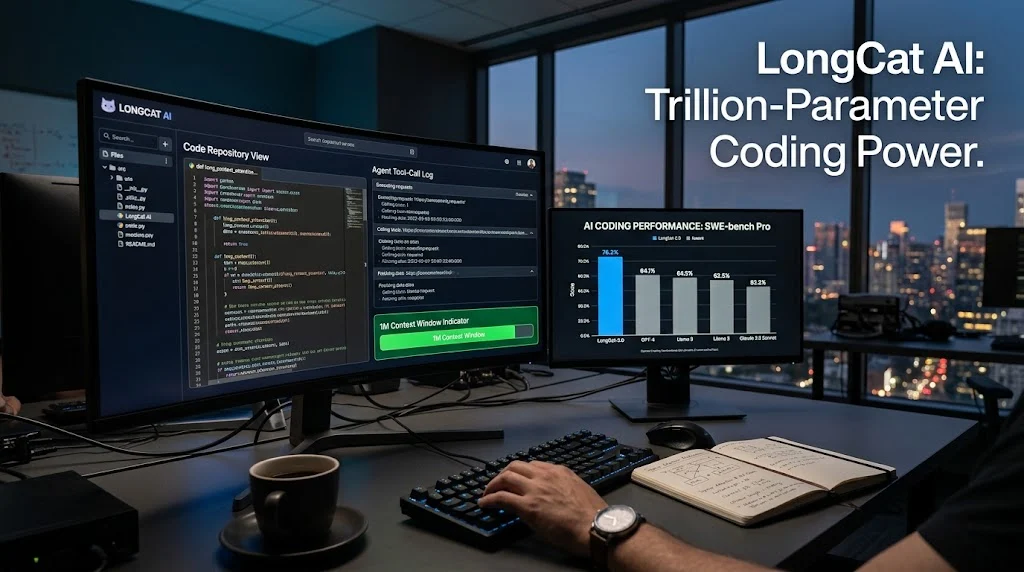
LongCat AI is a family of large language models developed by Meituan, with LongCat-2.0 being a trillion-parameter open-source model trained entirely on domestic Chinese compute. It features a 1M-token context window, sparse attention architecture, and benchmarks that rival or exceed GPT-5.5 and Claude Opus 4.6 on coding tasks .
At-a-Glance: Key Takeaways
- LongCat-2.0 is a 1.6 trillion parameter MoE model with approximately 48 billion active parameters per token, trained end-to-end on 50,000 domestic Chinese compute cards .
- It was the first trillion-parameter model fully trained and inferred on domestic Chinese compute, consuming over 30 trillion tokens with zero rollbacks .
- LongCat-2.0 leads on SWE-bench Pro with 59.5, surpassing Gemini 3.1 Pro (54.2), GPT-5.5 (58.6), and Claude Opus 4.6 (57.3) .
- API pricing starts at $0.30 per million input tokens and $1.20 per million output tokens under limited-time discounts, with cached inputs at $0.006 per million .
- LongCat-2.5-Preview adds multimodal image understanding to the coding and agentic workflow capabilities .
- The model is available on OpenRouter and via the LongCat API platform, with OpenAI and Anthropic-compatible endpoints .
What Is LongCat AI?
LongCat AI is a series of large language models developed by Meituan, the Chinese technology company best known for its food delivery platform. The LongCat team began exploring large-scale model training in 2023, scaling from thousands of compute cards to 50,000 .
The current flagship, LongCat-2.0, is a trillion-parameter mixture-of-experts (MoE) model designed specifically for agentic coding tasks. Unlike general-purpose models that treat code as one of many capabilities, LongCat-2.0’s architecture was built from the ground up around a single goal: enabling models to complete code understanding, generation, and execution more efficiently and reliably in real agentic coding workflows .
The model is fully open-source, with inference code optimized for domestic Chinese hardware released alongside the model weights. This positions LongCat as a significant entry in the sovereign AI ecosystem, demonstrating that frontier-scale models can be trained without reliance on Western compute infrastructure .
How LongCat AI Works
Training on Domestic Compute
LongCat-2.0’s pretraining corpus exceeds 30 trillion tokens, covering Chinese, English, multilingual, and code data. The full training run consumed over 35 trillion tokens without a single rollback or unrecoverable loss spike, a notable stability achievement at trillion-parameter scale .
The team addressed training challenges across three dimensions: stability (reducing monthly daily fault rate by over 70%), correctness (deterministic operators and bitwise consistency verification), and efficiency (1.5x training MFU improvement, exceeding 1 trillion tokens per day steady-state throughput) .
LongCat Sparse Attention (LSA)
Traditional attention mechanisms scale quadratically with sequence length, making million-token contexts computationally prohibitive. LongCat-2.0 introduces LongCat Sparse Attention (LSA), which intelligently selects key information rather than attending to every token sequentially .
LSA evolved from DeepSeek Sparse Attention (DSA) and adds three orthogonal efficiency optimizations: streaming-aware indexing (converting fragmented memory access into sequential reads), cross-layer indexing (reusing index computations across adjacent layers), and hierarchical indexing (coarse-to-fine scoring for candidate selection) .
This architecture enables native support for a 1M-token context window, allowing agents to process entire code repositories without losing earlier content to context overflow .
Zero-Computation Experts and ScMoE
Code tasks vary dramatically in computational complexity. Defining a variable name and deriving a recursive algorithm require completely different resources. LongCat-2.0 achieves token-level dynamic activation (33B to 56B parameters) through zero-computation experts. Simple tokens consume no compute; complex tokens automatically receive more resources .
This ScMoE (Scalable Mixture of Experts) architecture is described as an industry first, enabling efficient resource allocation across heterogeneous token types .
MOPD: Multi-Teacher On-Policy Distillation
LongCat-2.0 fuses three specialized expert groups through Multi-Teacher On-Policy Distillation (MOPD): Agent Experts (tool use, API parsing, self-correction), Reasoning Experts (multi-hop reasoning, STEM, adaptive computation), and Interaction Experts (instruction following, human alignment, hallucination suppression) .
At inference time, a gating network dynamically dispatches the most capable experts based on task type, rather than simply merging parameters .
Key Features and Capabilities
Benchmark Performance
LongCat-2.0’s benchmark results position it competitively against leading frontier models:
LongCat-DeepResearch
Built on LongCat-2.0, LongCat-DeepResearch combines the model with a research harness for deep-research capabilities. It achieves 55.25 on DeepResearchBench, 51.35 on DeepResearchBench II, and 79.83 on ResearchRubrics, leading all three public benchmarks compared against ChatGPT-DeepResearch, Claude-DeepResearch, and Gemini-DeepResearch .
Multimodal Capabilities (LongCat-2.5-Preview)
LongCat-2.5-Preview adds image understanding to the core coding and agentic capabilities. It can parse image content, supporting cross-modal Q&A, content summarization, and complex visual reasoning .
Ecosystem Integration
LongCat-2.0 is deeply adapted for mainstream agent harnesses including Claude Code, OpenClaw, Hermes, OpenCode, and Kilo Code. Before its official release, the preview version ranked among the top three models globally by call volume on OpenRouter, and became one of the most popular models among agent developers worldwide .
Pricing and API Access
LongCat AI offers pay-as-you-go API pricing with limited-time discounts.
| LongCat-2.0 | $0.30/M (was $0.75) | $0.006/M (was $0.015) | $1.20/M (was $2.95) |
| LongCat-2.5-Preview | $0.30/M | $0.006/M | $1.20/M |
Billing mechanics: Charges are calculated per request based on uncached input, cached input, and output tokens. Successful calls (HTTP 200) are deducted in real time. Failed requests are not billed .
Balance and top-up: The platform uses a prepaid balance model. Funds never expire. Promotional credits are consumed before paid balance. Unused prepaid balance is eligible for refunds, though consumed amounts are non-refundable .
Token Packs: One-time purchases of fixed token quotas, valid for 30 days from purchase, ideal for short-term high-volume usage .
Free credits: Vercel AI Gateway notes that free users receive $5 in credits every 30 days .
API Compatibility
The LongCat API platform is compatible with both OpenAI and Anthropic API formats. The base URL is https://api.longcat.chat, with endpoints including /openai/v1/chat/completions and /openai/v1/responses .
Privacy and Security Considerations
Available public documentation does not reference SOC 2 certification, ISO 27001, or Zero Data Retention guarantees for the LongCat API platform. Meituan, as the parent company, is a major Chinese technology firm subject to Chinese data regulations.
Important distinction: SOC 2 certification does not automatically mean Zero Data Retention. Organizations with strict compliance requirements should conduct independent due diligence on data handling practices before processing sensitive information through the LongCat API.
The platform supports enterprise verification with tiered discounts and self-service invoicing for verified enterprise users .
Who Should Use LongCat AI
Developers building agentic coding workflows who need a model with strong tool-use capabilities and a 1M context window. The deep integration with Claude Code and similar harnesses makes it a drop-in option for existing agent frameworks .
Organizations with domestic Chinese compute requirements that need to deploy frontier-scale models on domestic hardware. The open-source release includes inference code optimized for Chinese accelerators .
Cost-conscious teams evaluating alternatives to Western frontier models. At $0.30 per million input tokens and $1.20 per million output tokens, LongCat-2.0 undercuts most comparable models significantly .
Researchers studying MoE architectures and sparse attention can examine the open-source implementation of LSA, zero-computation experts, and MOPD .
Users with strict data compliance requirements should evaluate the data handling implications of using a Chinese-developed API before deployment.
Common Mistakes and Cautions
Assuming “open-source” means fully self-hostable. LongCat-2.0 is open-source, but running a 1.6 trillion parameter model requires substantial infrastructure. The API is the practical access path for most users .
Overlooking the limited-time discount pricing. The current API prices are explicitly labeled as limited-time discounts. Standard pricing may apply later .
Ignoring the model’s Chinese origins for compliance. Meituan is a Chinese company. Organizations with data sovereignty requirements should assess whether routing data through LongCat’s API aligns with their obligations.
Confusing LongCat with the unrelated “Longcat” model. The name “Longcat” has appeared in other AI projects. This article covers Meituan’s LongCat series specifically.
Frequently Asked Questions
What is LongCat AI?
LongCat AI is a series of large language models developed by Meituan, with LongCat-2.0 as the current flagship. It is a 1.6 trillion parameter mixture-of-experts model designed for agentic coding tasks, trained entirely on domestic Chinese compute .
How much does LongCat AI cost?
API pricing for LongCat-2.0 is $0.30 per million uncached input tokens, $0.006 per million cached input tokens, and $1.20 per million output tokens under limited-time discounts. A prepaid balance model is used, and funds never expire .
Is LongCat AI open source?
Yes. LongCat-2.0 is open-source, with model weights and inference code optimized for domestic Chinese hardware released alongside the model .
How does LongCat-2.0 compare to GPT-5.5 and Claude Opus?
On SWE-bench Pro, LongCat-2.0 scores 59.5, exceeding GPT-5.5 (58.6) and Claude Opus 4.6 (57.3). On SWE-bench Multilingual, it scores 77.3, on par with Claude Opus 4.6 (77.8) .
What is LongCat-2.5-Preview?
LongCat-2.5-Preview is a multimodal reasoning model that adds image understanding to the coding and agentic capabilities of LongCat-2.0. It supports text and image inputs with the same 1M-token context window .
Conclusion
LongCat AI represents a significant milestone in the global AI landscape. LongCat-2.0 is the first trillion-parameter model trained and inferred entirely on domestic Chinese compute, demonstrating that frontier-scale AI development is no longer limited to Western infrastructure .
What matters most is the combination of scale, efficiency, and open access. The sparse attention architecture, zero-computation experts, and multi-teacher distillation are genuine technical innovations that address real challenges in agentic coding: context limits, computational efficiency, and task specialization. The benchmark results, particularly on SWE-bench Pro, validate that these architectural choices translate into competitive performance .
LongCat AI may suit developers building agentic coding workflows who need strong tool-use capabilities and long context windows. It may suit organizations with domestic Chinese compute requirements or those seeking cost-effective alternatives to Western frontier models. It may not suit users with strict data sovereignty requirements that preclude routing data through Chinese infrastructure, or those needing extensive third-party security certifications.
Before adopting, evaluate the API pricing against your usage patterns, confirm the model meets your specific coding and agentic requirements, and review the data handling implications for your organization’s compliance posture. LongCat-2.0 offers a compelling combination of capability and cost, but the decision depends on your specific constraints and requirements.