D-ID AI is a generative AI video platform that transforms a single still image into a lifelike, talking digital human. It powers interactive visual agents that can see, hear, and respond in real time, and has been recognized for industry-leading lip-sync accuracy on the SyncNet benchmark .
At-a-Glance: Key Takeaways
- D-ID is a pioneer in generative AI for video, founded in 2017 by Israeli Defense Forces veterans with a mission to protect privacy before pivoting to synthetic media creation .
- The platform’s V4 Expressive Visual Agents ranked #1 in lip-sync accuracy on the SyncNet benchmark, outperforming HeyGen, Tavus, and Anam .
- Pricing scales from a free trial to Enterprise, with Lite plans starting around $5.90/month and Pro plans unlocking commercial licensing and voice cloning .
- D-ID supports over 120 languages and offers capabilities for both pre-scripted videos and real-time, interactive conversations .
- A 14-day free trial is available with full-screen watermarks and personal-use restrictions, making it suitable for testing but not commercial deployment .
- The platform offers Canva, PowerPoint, and Google Slides integrations, embedding digital humans directly into existing workflows .
What Is D-ID AI?
D-ID AI is a generative artificial intelligence platform specializing in the creation of digital humans and talking avatars. The company was founded in 2017 and is headquartered in the United States, with roots in Israel . Its name is an abbreviation of “de-identification,” reflecting its original mission: building technology to protect against facial recognition and deepfake misuse .
The company’s founders, Gil Perry, Eliran Kuta, and Sela Brondheim, all served in the Israeli Defense Forces’ special forces unit. Their initial product focused on privacy protection—essentially an “ad blocker for deepfakes”—and attracted Fortune 100 clients like BlackRock. The pivot to generative AI came when they recognized the coming disruption in media creation. As Gil Perry noted, they realized they had both the technical expertise and the responsibility to ensure synthetic media technology “goes to the right place” .
Today, D-ID positions itself as a leading digital human platform, serving marketing, content creation, learning and development, sales, and customer experience teams. Its technology powers lifelike digital presenters for Fortune 500 companies and mission-driven organizations alike .
How D-ID AI Works
From Photo to Talking Avatar
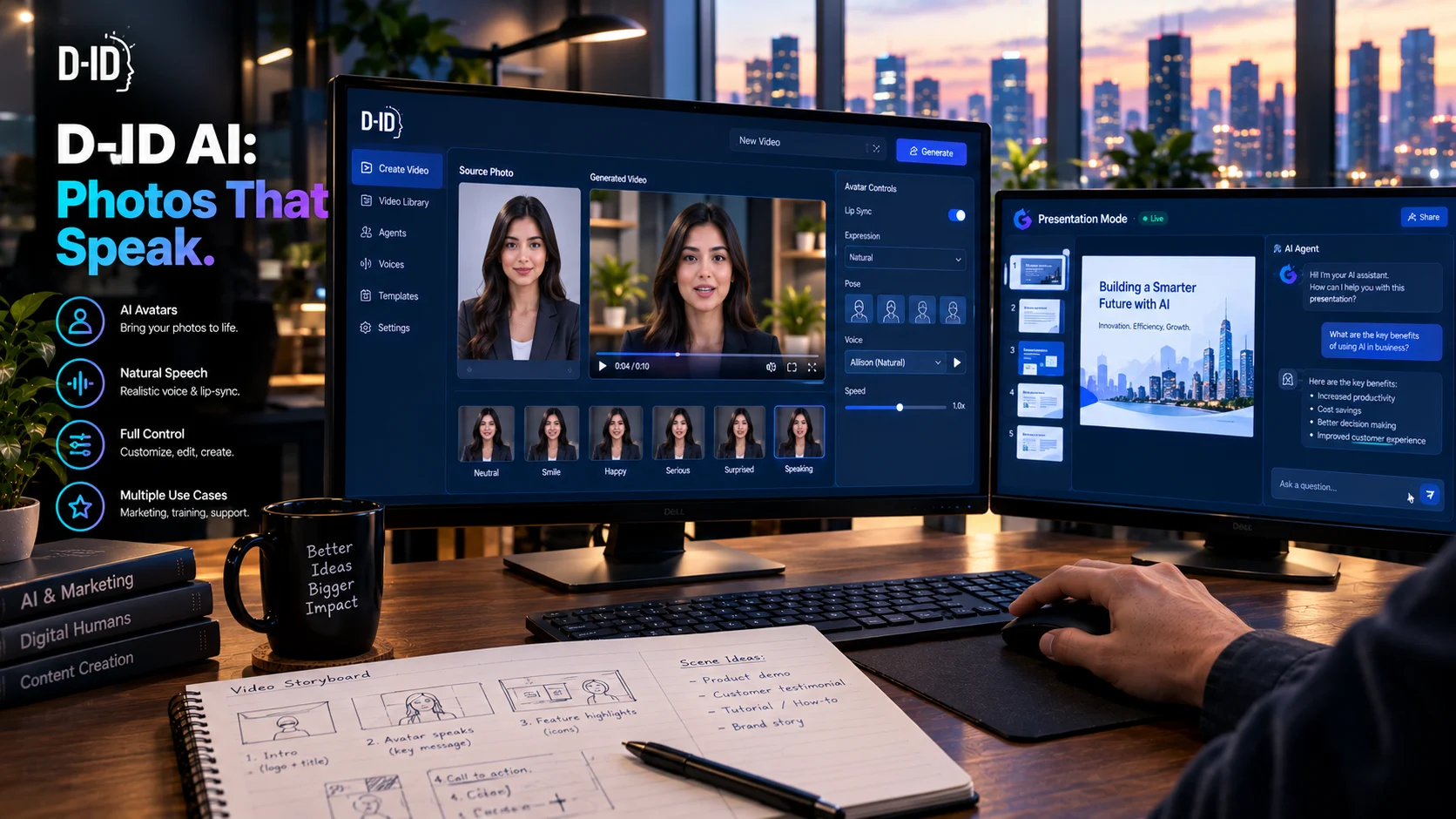
The core D-ID workflow is deceptively simple: upload a single photo, type or upload a script, and receive a video of that person speaking. The AI animates the face, generates accurate lip-sync, and produces natural facial expressions. No camera, crew, or traditional production workflow is required .
Users can choose from a library of ready-made presenters, create a personal avatar from their own image, or use a short video recording for higher fidelity. The platform supports text-to-speech, recorded audio, and AI voice cloning to give avatars a consistent voice across campaigns and languages .
Real-Time Visual Agents
Beyond pre-scripted videos, D-ID’s V4 Expressive Visual Agents enable real-time, two-way interactions. These agents can listen to spoken or written input and respond in real time through voice, facial expressions, and natural conversational behavior. They connect to approved documents, websites, and business systems to provide context-aware answers and can trigger workflows or display contextual media during conversations .
The company’s V4 Expressive Visual Agents are powered by an ultra-fast diffusion model, enabling low-latency streaming through WebRTC-based infrastructure. A June 2026 evaluation using the SyncNet benchmark, the industry-standard academic measure for audio-visual synchronization, ranked D-ID first in lip-sync accuracy with an LSE-D of 7.16, ahead of Anam (7.84), HeyGen (7.93), and Tavus (8.42) .
Presentation Mode
Launched in October 2026, Presentation Mode transforms static slide decks into interactive AI-led conversations. Users upload a PDF, PowerPoint, or Google Slides link (up to 100 slides or 100 MB), and D-ID generates speaker notes for every slide automatically. The AI Agent presents the deck and lets viewers interrupt at any point with questions, answering them in real time before resuming the presentation .
The feature includes audience insights, with every session saved as a full transcript on the Agent’s Insights page, capturing every question asked and answer given. This is designed for sales teams, product marketing, training, and internal communications .
Key Features and Capabilities
Avatar and Voice Creation
D-ID offers multiple avatar creation paths. Stock avatars provide a diverse library of ready-made presenters. Personal avatars are created from a single image, with guidelines specifying front-facing, neutral expression, closed mouth, and good lighting for optimal results. For higher fidelity, users can upload a short video recording .
Voice capabilities include text-to-speech in 119+ languages, recorded audio uploads, and AI voice cloning. Pro and API Launch plans receive one cloned voice; Advanced and API Scale plans receive three. Enterprise plans offer customizable voice quotas .
Video Translation and Localization
D-ID can translate existing videos into multiple languages while preserving the speaker’s voice and visual identity. Automatic voice cloning and lip-sync create localized versions without requiring new recordings . Trial users can translate up to 30 seconds; Lite users up to 5 minutes .
Knowledge Grounding and Agent Memory
Visual AI agents can connect to approved documents, websites, and business information. The agent uses these sources to provide relevant, context-aware answers. A “Knowledge Grounding” feature ensures responses are anchored in verified data rather than general model knowledge .
Agent Memory allows the AI to retain selected user preferences, goals, and relevant context across interactions. Trial, Lite, Pro, and Advanced plans include 1,000 memory entries .
Enterprise Integration
D-ID offers APIs, SDKs, and embeddable components for integrating AI video and visual agents into websites, applications, and internal tools. Real-time streaming infrastructure uses WebRTC for low-latency, two-way visual interactions. The platform integrates with Canva, Microsoft PowerPoint, and Google Slides .
For organizations with strict data requirements, D-ID offers self-hosting options, allowing Expressive Avatars to run inside the customer’s own cloud infrastructure .
Pricing and Plans
D-ID offers a range of subscription tiers, with both Studio (visual interface) and API (developer-focused) plans. Credits are used across both plans, with each credit worth up to 15 seconds of video .
Important pricing details: Credits do not accumulate; they renew monthly and unused credits become void. Video length is rounded up to the nearest 15-second interval when deducting from quota. API streaming customers pay half the credit price of studio customers .
For API-specific plans, D-ID offers Build ($14.4/month), Launch ($35/month), and Scale ($138.6/month) tiers with varying video and streaming minutes .
Privacy and Security Considerations
D-ID emphasizes enterprise-grade security and responsible AI use. The platform includes built-in moderation to prevent inappropriate content generation, and its ethical manifesto commits to transparency about the synthetic nature of generated videos .
Watermarking is mandatory across all plans. Trial and Lite users receive a D-ID logo (full-screen for trial), Pro and Advanced users receive a generic AI watermark, and Enterprise users can customize but not remove the watermark. This reflects the company’s commitment to preventing misuse .
The platform adheres to privacy and security standards with compliance protocols and advanced technology for data protection. For enterprise customers, self-hosting options allow deployment within the organization’s own infrastructure .
Important caveat: Available documentation does not specify SOC 2 certification, ISO 27001, or Zero Data Retention guarantees. Organizations with strict compliance requirements should conduct independent due diligence.
Who Should Use D-ID AI
Marketing teams can create personalized video content at scale in any language, boosting engagement across the funnel. Interactive agents nurture leads and provide product information .
Content creators can scale video production with a digital twin, enabling 24/7 engagement with their community without continuous filming .
Learning and development teams can produce video lessons with lifelike, lip-synced avatars localized for global learners. AI Agents serve as personal tutors tailored to the organization’s knowledge base .
Sales enablement teams can deploy AI Agents to guide prospects through the sales journey, answering questions and providing personalized assistance on demand. Presentation Mode allows prospects to explore pitch decks on their own time .
Customer experience teams can create multilingual support videos and deploy AI Agents for instant, personalized 24/7 customer service .
Developers can use D-ID’s API to build products with AI avatars for offline videos or real-time interactive experiences .
Common Mistakes and Cautions
Assuming all images work. D-ID requires front-facing, medium-shot images with neutral expressions and closed mouths. Hands raised, occlusions (hats, sunglasses, masks), or unclear faces will fail moderation or produce poor results .
Underestimating credit consumption. A 40-second video consumes 3 credits. Longer videos consume more. Credits expire monthly and do not roll over .
Expecting commercial use on lower tiers. The Free Trial and Lite plans are restricted to personal use. Commercial licensing begins with the Pro plan .
Ignoring watermark requirements. All plans include mandatory watermarks. Enterprise users can customize but not remove them .
Confusing D-ID with Dify.AI. Dify.AI is an unrelated open-source platform for building AI agents and workflows. The names are similar but the products are entirely different .
Frequently Asked Questions
What is D-ID AI?
D-ID AI is a generative AI video platform that creates lifelike, talking digital humans from a single still image. It offers pre-scripted avatar videos, real-time interactive visual agents, video translation, and Presentation Mode for interactive slide decks .
How much does D-ID cost?
D-ID offers a free 14-day trial with 3 minutes of video. Paid plans start around $5.90/month for Lite (10 minutes), with Pro at ~$16/month (15 minutes, commercial license) and Advanced at ~$108/month (100 minutes). Enterprise pricing is custom .
Is D-ID safe and private?
D-ID emphasizes enterprise-grade security and responsible AI use, with built-in moderation and mandatory watermarks. The platform offers self-hosting for enterprise customers. However, specific security certifications like SOC 2 are not documented in available materials .
What makes D-ID different from other AI video tools?
D-ID ranked #1 in lip-sync accuracy on the SyncNet benchmark, outperforming HeyGen, Tavus, and Anam. The platform also offers real-time interactive visual agents and Presentation Mode, which turns static slides into conversational experiences .
What are the best D-ID alternatives?
Alternatives include HeyGen, Synthesia, and Visla. D-ID is rated higher than HeyGen and Meta for service and support, and higher than Visla for its integration and deployment ease .
Conclusion
D-ID AI represents a significant evolution in how organizations create and deliver video content. From its origins as a privacy-protection tool, the company has become a leader in generative AI for digital humans, with technology that turns a single photo into a lifelike, speaking avatar in minutes.
What matters most is the platform’s combination of accuracy and accessibility. The #1 ranking on SyncNet for lip-sync accuracy validates the technical foundation. The range of plans, from a free trial to enterprise deployment, makes the technology accessible to individuals and large organizations alike. And the evolution from pre-scripted videos to real-time interactive agents and Presentation Mode shows a platform that continues to push into new use cases.
D-ID AI may suit marketing teams needing scalable video personalization, content creators scaling production, L&D teams localizing training, sales teams enabling self-service presentations, and developers building interactive avatar experiences. It may not suit users needing completely free solutions, those uncomfortable with mandatory watermarks, or organizations requiring specific security certifications not documented.
Before adopting, test the free trial with your specific use case. Review image guidelines to ensure your source photos will work. Evaluate whether the watermark and licensing terms fit your needs. And consider whether D-ID’s strengths in lip-sync accuracy and real-time interaction align with your requirements. The platform offers powerful capabilities, but the value depends on your specific content strategy and constraints.