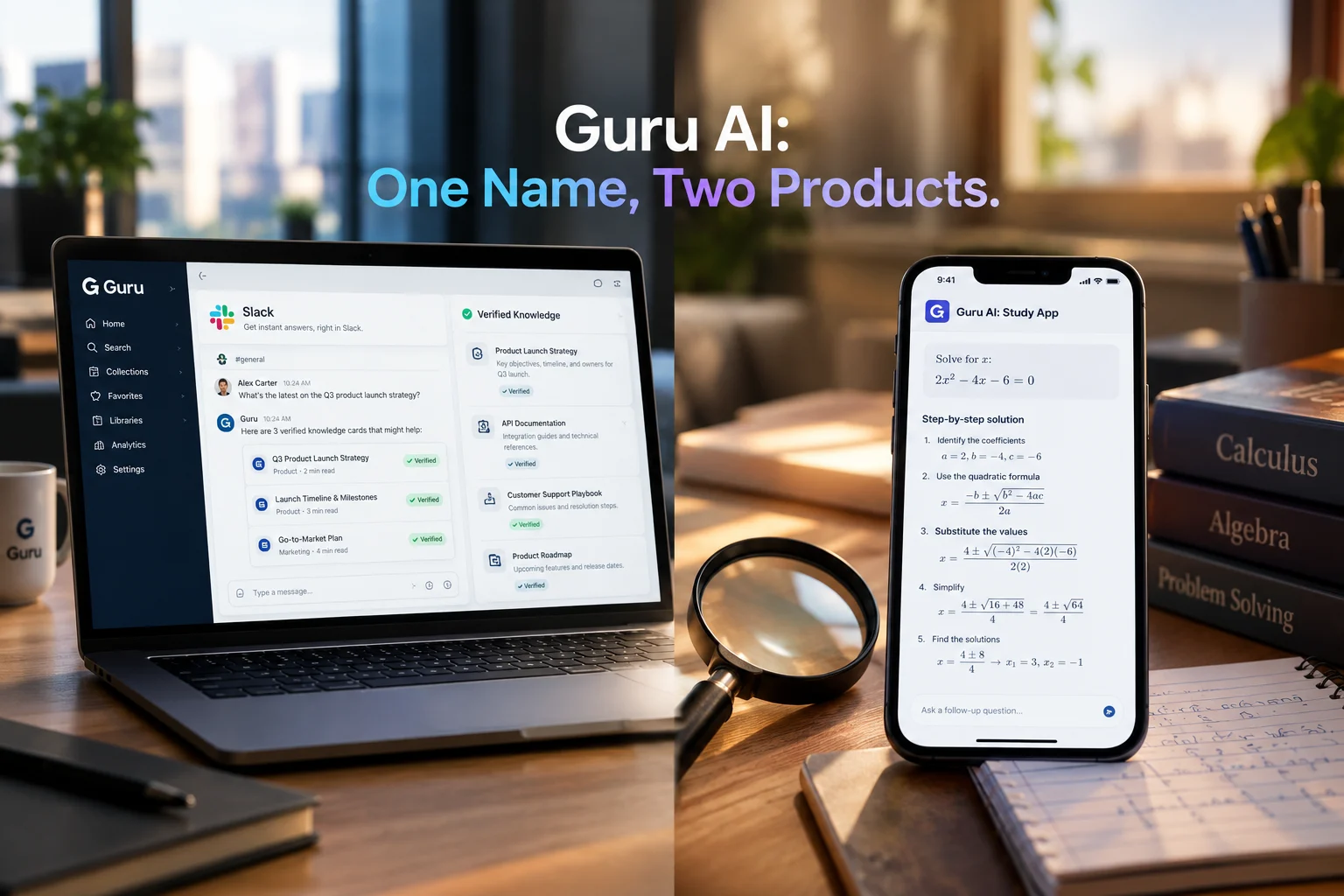
“Guru AI” refers to two unrelated products. The first is Guru, an enterprise AI knowledge platform that surfaces verified company information inside Slack, Teams, and Chrome . The second is Guru AI: Study App, a college-focused homework solver and flashcard tool with in-app purchases ranging from $1.99 to $39.99 .
At-a-Glance: Key Takeaways
- Two distinct products share the “Guru AI” name. Guru is enterprise knowledge software for companies; Guru AI: Study App is a consumer education tool for college students .
- Enterprise Guru uses a credit-based model. Most AI actions cost 1 credit, and credits are shared across the entire organization rather than assigned per user .
- Guru’s enterprise security posture includes zero-day retention from OpenAI for AI-generated answers, with data not used for training public models .
- Guru AI: Study App claims 97% accuracy on university-level questions and serves over 8 million students, but it is a separate product with separate pricing .
- Enterprise Guru requires a 10-seat minimum and uses custom pricing with no published plans .
- Guru AI: Study App subscriptions range from $1.99 to $39.99 depending on plan and region .
What Is Guru AI?
The search term “Guru AI” surfaces two completely unrelated products. This is a common problem with short, appealing brand names. “Guru” means teacher or expert, making it attractive for both enterprise software and educational tools.
Enterprise Guru is an AI-powered knowledge management platform. It connects to your company’s existing tools—Slack, Google Drive, Salesforce, Zendesk—and uses AI to surface verified answers without switching tabs . It was founded in 2013 and is headquartered in Philadelphia .
Guru AI: Study App is a mobile application for college students. It solves assignments, records lectures, generates flashcards, and connects users with human tutors when AI is not enough . It is published by a Brazil-based company and operates on a subscription model .
The two products share nothing but a name. Understanding which one you need depends entirely on whether you are looking for enterprise software or a study companion.
Enterprise Guru: The Knowledge Platform
What It Does
Guru positions itself as an “AI-powered single source of truth” for organizations. Its core function is surfacing verified company knowledge inside the tools employees already use . The platform integrates with Slack, Microsoft Teams, Chrome, Salesforce, Zendesk, and other workplace applications .
When an employee asks a question in Slack, a Knowledge Agent can automatically detect and answer it using verified company content. Users can also @mention Guru directly for on-demand answers .
How Knowledge Agents Work
Knowledge Agents are AI-powered assistants configured to search specific sources and respond in particular ways. Your workspace might have different agents for HR, IT, or product questions .
The system organizes knowledge into Cards, which function like individual documents. Collections group Cards with shared permissions. Verification is a process where subject matter experts review Cards and add a green checkmark. Unverified Cards show a gray badge with a question mark .
This verification system is central to Guru’s value proposition. It addresses a common enterprise AI problem: models that surface outdated or incorrect information with equal confidence. Guru’s design forces a review cycle that keeps content current .
The Credit System
Guru uses a credit-based model for AI work. Every workspace receives a shared pool of credits available to everyone in the organization .
Most individual AI actions consume 1 credit:
- AI search across Guru and connected sources: 1 credit per search
- Generated answer: 1 credit per answer
- Knowledge Agent creating a Card: 3 credits (search, draft, publish)
Manual work in Guru does not consume credits. Writing a Card, browsing content, and editing by hand are all included with the seat .
Important distinction: Guru credits are not tokens. Tokens measure information passing to an LLM. Guru credits measure work performed. The pricing model is based on credit consumption without separate token costs .
Pricing
Guru does not publish straightforward pricing. It uses custom enterprise pricing with three bundled components: The Platform, Expertise (AI & KM Strategy Team), and Infrastructure (enterprise governance) .
There is a 10-seat minimum to convert to a paid plan. TrustRadius reviewers describe Guru as “somewhat expensive” . A Guru for Good program offers reduced pricing for nonprofits.
Security and Compliance
Guru’s security documentation states that customer data is never shared with other customers, never used to train public LLMs, and never stored in LLM infrastructure .
For AI-generated answers, Guru uses OpenAI’s GPT via API. Data is filtered within Guru first—only text from selected sources is sent. OpenAI immediately deletes submitted data and output (zero-day retention) and does not use it for training .
Important caveat: VerifyWise’s privacy analysis gave Guru a B grade (62/100), noting that while it prohibits training on public models and grants data deletion 90 days after termination, it lacks specificity on breach notification, special category data governance, and named security certifications. Security is described only in adjectives like “commercially reasonable” with no specific standards named .
Clarification: SOC 2 certification does not automatically mean Zero Data Retention. Guru’s documentation states zero-day retention for OpenAI API calls specifically, not necessarily for all data processing.
Guru AI: Study App
What It Does
Guru AI: Study App targets college students specifically. The app claims over 1 billion assignments solved by more than 8 million students, with a stated 97% accuracy rate on university-level questions .
Core features include:
- Assignment Solver: Take a photo of an exercise and receive step-by-step explanations
- Human Tutoring: Connect with real teachers when AI is not enough, with responses within minutes
- Lecture Recorder: Record classes and receive transcripts, summaries, and automatic flashcards
- Mock Exams: AI-generated practice exams in your institution’s style
- Smart Flashcards: Automatically created from PDFs, lectures, or notes with spaced repetition
Pricing
The app offers several subscription tiers with regional pricing variations. US App Store listings show:
| Plan | Price |
|---|---|
| Guru AI Monthly | $9.99 |
| Guru AI Annual | $39.99 |
| Quarterly Guru AI | $22.99 |
| Infinity Monthly | $9.99 |
| Infinity Annual | $14.99-$22.99 |
| Infinity Weekly | $3.99 |
A Brazilian plan is listed at $1.99 . German pricing shows similar tiers with slight variations .
Privacy
The Guru iOS app privacy policy states it does not show third-party ads, sell personal information, or track users across other apps and websites. Some documents and notes are stored locally on the device. When AI features are used, selected content is sent to servers and AI service providers .
Data collected includes purchases, user content, and identifiers. Diagnostics may also be collected but not linked to identity .
Who Should Use Which Product
Common Mistakes and Cautions
Assuming both products are related. Enterprise Guru and Guru AI: Study App are entirely separate companies with no connection.
Ignoring the 10-seat minimum for Enterprise Guru. The platform is not designed for individuals or very small teams. If you need a personal knowledge tool, look elsewhere .
Expecting published pricing from Enterprise Guru. All pricing is custom and negotiated through sales. There is no self-serve option .
Overlooking verification requirements. Guru works best when someone actively maintains and verifies Cards. If your knowledge base is unstructured documents, the setup effort is significant .
Trusting accuracy claims without verification. Guru AI: Study App claims 97% accuracy. The app’s own description does not specify error rates by subject. Verify critical solutions independently.
Frequently Asked Questions
What is Guru AI?
“Guru AI” is not one product. It refers to two unrelated tools: Guru, an enterprise knowledge management platform for companies , and Guru AI: Study App, a college homework and flashcard app .
How much does Guru AI cost?
Enterprise Guru uses custom pricing with no published plans and a 10-seat minimum . Guru AI: Study App offers subscriptions from $1.99 to $39.99 depending on plan and region .
Is Guru AI safe for company data?
Guru’s documentation states customer data is never shared with other customers, never used to train public LLMs, and never stored in LLM infrastructure. OpenAI API calls have zero-day retention . However, VerifyWise notes the policy lacks specificity on breach notification and named security certifications .
What is the difference between Guru and Guru AI: Study App?
Guru is enterprise software for company knowledge management. Guru AI: Study App is a consumer mobile app for college students. They are made by different companies and serve entirely different purposes.
Does Guru AI: Study App actually work?
The app claims 97% accuracy on university questions and reports 8 million users . Independent verification of these claims is not available. The app includes human tutoring as a backup when AI is insufficient .
Conclusion
The “Guru AI” search term illustrates a persistent problem in the AI tool market: short, appealing names get reused across unrelated products. One Guru is enterprise infrastructure for company knowledge. The other is a mobile study app for college students.
What matters most is identifying your actual need. If you are looking for a way to surface verified company information inside Slack or Chrome, Enterprise Guru may fit. It requires a 10-seat minimum, custom pricing, and a commitment to maintaining verified content. If you are a college student seeking homework help and study tools, Guru AI: Study App serves that purpose with subscription pricing from $1.99.
Enterprise Guru may suit mid-to-large organizations with structured knowledge bases and a need for governed AI answers. Guru AI: Study App may suit individual students willing to pay for AI-assisted study tools.
Before committing, verify which product you are evaluating. Read reviews. Understand the pricing model. And remember that a shared name does not imply a shared company or shared quality.