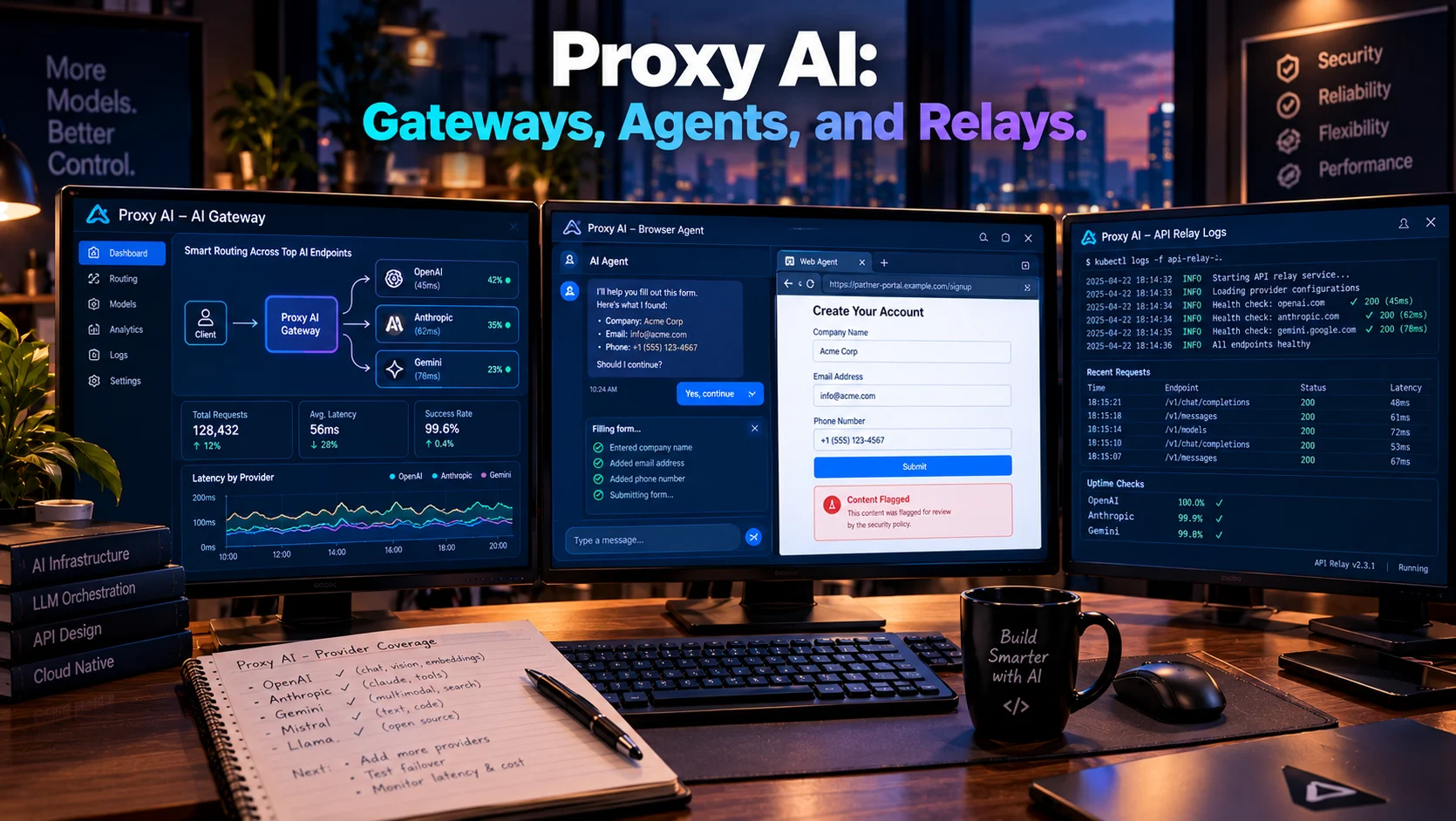
“Proxy AI” is not a single product. The term describes three distinct infrastructure categories: AI gateways that route requests across multiple LLM providers (LiteLLM, ai-proxy), browser agents that act on the web on a user’s behalf (Proxy by Praising Harris, Convergence Proxy), and API relay services that resell access to models like Claude (Proxyai relay). Each serves a different technical need.
At-a-Glance: Key Takeaways
- AI gateways solve multi-provider access. Tools like LiteLLM and ai-proxy provide a single endpoint for OpenAI, Anthropic, Gemini, and 100+ other providers .
- Browser agents automate web tasks. Proxy by Praising Harris completes benefits applications with a three-layer security gate, while Convergence Proxy offers an open-weights alternative .
- API relay services resell model access. “Proxyai” is a Claude API relay found through Claude Code domain lists, with 96.9% endpoint uptime but no public pricing .
- JetBrains developers use “ProxyAI” as an IDE plugin. This open-source copilot connects to any model and holds a 4.6 rating on the Chrome Web Store .
- Pricing ranges from free open-source to $49/month for security-focused proxies like Vibe Proxy .
- Privacy varies dramatically. Local-first tools like Kimi WebBridge keep data on-device, while relay services route through third-party infrastructure .
The Three Categories of Proxy AI
The search term “Proxy AI” surfaces results across three unrelated infrastructure domains. Understanding which category matches your need prevents wasted evaluation time.
AI gateways are reverse proxies that sit between your application and multiple LLM providers. They solve provider sprawl: instead of managing separate API keys, endpoints, and billing relationships for OpenAI, Anthropic, and Google, you route everything through one gateway .
Browser agents are AI systems that control a web browser to complete tasks. They perceive pages, reason about next actions, and execute clicks and form fills. The “proxy” in this context refers to the browser acting as the user’s proxy on the web .
API relay services are commercial intermediaries that resell access to models like Claude or GPT. They are sometimes called “中转站” (relay stations) in Chinese developer communities and are found through reverse-engineering domain lists from tools like Claude Code .
AI Gateways: Single Endpoint for Multiple Providers
How They Work
An AI gateway exposes an OpenAI-compatible API that your application calls. The gateway handles authentication, routing, retries, and provider-specific format conversions. Your code sends a request to /v1/chat/completions, and the gateway forwards it to the appropriate provider based on your configuration .
The ai-proxy project, for example, uses environment variables to define providers. Each provider becomes a URL path segment: /gemini/..., /openai/..., /anthropic/.... API keys pass through the gateway without storage, and the same Docker image can be deployed in different regions for geo-routing .
Key Tools
LiteLLM is the most feature-complete open-source option. It ships as both a Python SDK and a proxy server, with virtual keys, budgets, spend tracking, semantic caching, and an MCP gateway included in the open-source tier .
Who Needs an AI Gateway
Development teams building applications that use multiple LLM providers. The gateway abstracts provider differences, so switching from GPT to Claude requires a configuration change, not a code rewrite.
Organizations with cost optimization needs. Gateways can route requests to cheaper models based on complexity, track spending per team or project, and enforce budgets .
Teams with network restrictions. Self-hosted gateways can run in jurisdictions where direct provider access is blocked, with requests leaving from an allowed network .
Browser Agents: AI That Acts on the Web
How They Work
Browser agents run a perceive → reason → act loop. They capture the page state (screenshots, DOM structure), use an LLM to decide the next action, and execute that action through browser automation tools like Playwright .
Proxy by Praising Harris demonstrates a security-first design. Its gate has three layers: a heuristic + LLM-judge scanner detects prompt injection hidden in page content, a strict allowlist contains what the agent can do even if detection fails, and uncertain actions escalate to a human. Sensitive fields like SSNs never enter the LLM’s context; the human types them directly .
Convergence Proxy takes a different approach with an open-weights model. Proxy Lite is a 3B browser agent and Python framework available under Apache 2.0. Developers can self-host the model or use a rate-limited public demo. The hosted full service returned 403 errors when last checked, so present-day availability is unconfirmed .
Key Tools
Kimi WebBridge from Moonshot AI is notable for its local-first architecture. Browser sessions, authenticated pages, and sensitive data remain on the user’s machine instead of routing through cloud infrastructure. It supports Claude Code, Cursor, and other AI ecosystems as an agent-agnostic layer .
Who Needs a Browser Agent
Accessibility use cases. Proxy by Praising Harris was built for elderly and disabled Americans who leave $30 billion in benefits unclaimed because application forms are the barrier .
Repetitive web workflows. Tasks like checking prices across retailers, filling out forms, or extracting data from authenticated portals.
Developers building automation. The open-source Convergence Proxy Lite provides a starting point for custom browser agents .
API Relay Services: Reselling Model Access
What They Are
API relay services resell access to models like Claude, GPT, or Gemini. They are typically cheaper than official pricing, may offer domestic accessibility in regions where direct access is blocked, and often require no formal registration .
Proxyai is one such relay, discovered through Claude Code reverse-engineering domain lists. TokenAPI Scan monitors its Claude, OpenAI, and Gemini endpoints with keyless connectivity checks. As of September 2026, the service showed 96.9% endpoint uptime and 100% pass rate on the Claude API relay check .
The Risks
TokenAPI Scan’s analysis is blunt about relay services generally: “Third-party relays = usually discounted pricing + domestic accessibility + but compounded availability, content moderation, SLA, and service shutdown risks.” The recommendation is to “use official for critical paths + relays as backup” .
The service does not publish a unified price list. Pricing requires login to the backend. TokenAPI Scan notes it has fewer than 3 real tests logged, meaning the detection data is thin .
Who Uses Relay Services
Developers in regions with provider restrictions who need access to Claude or GPT for development or API consumption.
Cost-sensitive users willing to trade stability and content moderation guarantees for lower pricing.
Not recommended for production systems where downtime or account suspension would cause material harm.
The JetBrains “ProxyAI” Plugin
A separate entity sharing the name is ProxyAI, an open-source AI copilot for JetBrains IDEs. It connects to OpenAI, Anthropic, Azure, Mistral, or self-hosted models, offering chat, autocomplete, next-edit suggestions, and natural language code editing .
The plugin has a 4.6 rating on the Chrome Web Store with 8,000 users. It is free under Apache 2.0. The developer states it does not collect or store sensitive information, though anonymous usage data is collected with consent .
Who should use it: JetBrains users seeking a GitHub Copilot alternative with model flexibility and on-premise options.
Common Mistakes and Cautions
Confusing gateways with browser agents. A gateway routes API requests; a browser agent controls a web browser. They solve different problems.
Assuming relay services are interchangeable with official APIs. TokenAPI Scan warns of “compounded availability, content moderation, SLA, and service shutdown risks.” Use official for critical paths .
Overlooking the security model of browser agents. Proxy by Praising Harris keeps sensitive fields out of the LLM’s context entirely. Other agents may not. Verify how credentials and PII are handled before delegating form submissions .
Ignoring geo-routing requirements. AI agents that research products or prices need to see what a local user sees. Proxy infrastructure with country and city targeting is essential for accurate results .
Frequently Asked Questions
What is Proxy AI?
“Proxy AI” describes three infrastructure categories: AI gateways that route requests across multiple LLM providers, browser agents that act on the web on a user’s behalf, and API relay services that resell model access. It is not a single product .
How does an AI gateway work?
An AI gateway exposes an OpenAI-compatible endpoint. Your application sends requests to the gateway, which routes them to the appropriate provider based on configuration. The gateway handles authentication, format conversion, retries, and logging .
Are API relay services safe?
Relay services carry compounded risks including availability instability, content moderation differences, and service shutdown. TokenAPI Scan recommends using official APIs for critical paths and relays only as backup .
What is ProxyAI for JetBrains?
ProxyAI is an open-source AI copilot plugin for JetBrains IDEs. It connects to any model provider and offers chat, autocomplete, and code editing features. It is free under Apache 2.0 .
Do browser agents need proxies?
Yes, for many web automation tasks. Anti-bot systems flag datacenter IPs and show CAPTCHAs. Residential or mobile proxies let agents appear as real users. Sticky sessions maintain consistent IPs across multi-step workflows like login → checkout .
Conclusion
“Proxy AI” is a fragmented keyword that surfaces three distinct infrastructure layers. AI gateways solve provider sprawl by offering a single endpoint for multiple LLMs. Browser agents automate web tasks with varying security models. API relay services resell model access with compounded risks.
What matters most is matching the tool to the problem. If you are building an application that calls multiple LLMs, a gateway like LiteLLM or ai-proxy eliminates integration overhead. If you need to automate web workflows for users who cannot supervise an AI, a browser agent with a strong security gate is the right category. If you need cheaper access to Claude in a restricted region, relay services exist but carry real risks.
Before adopting any “Proxy AI” tool, verify which category you are evaluating. Check the security model for browser agents handling sensitive data. Confirm the provider coverage for gateways. And for relay services, understand that discounted pricing comes with availability and compliance trade-offs.