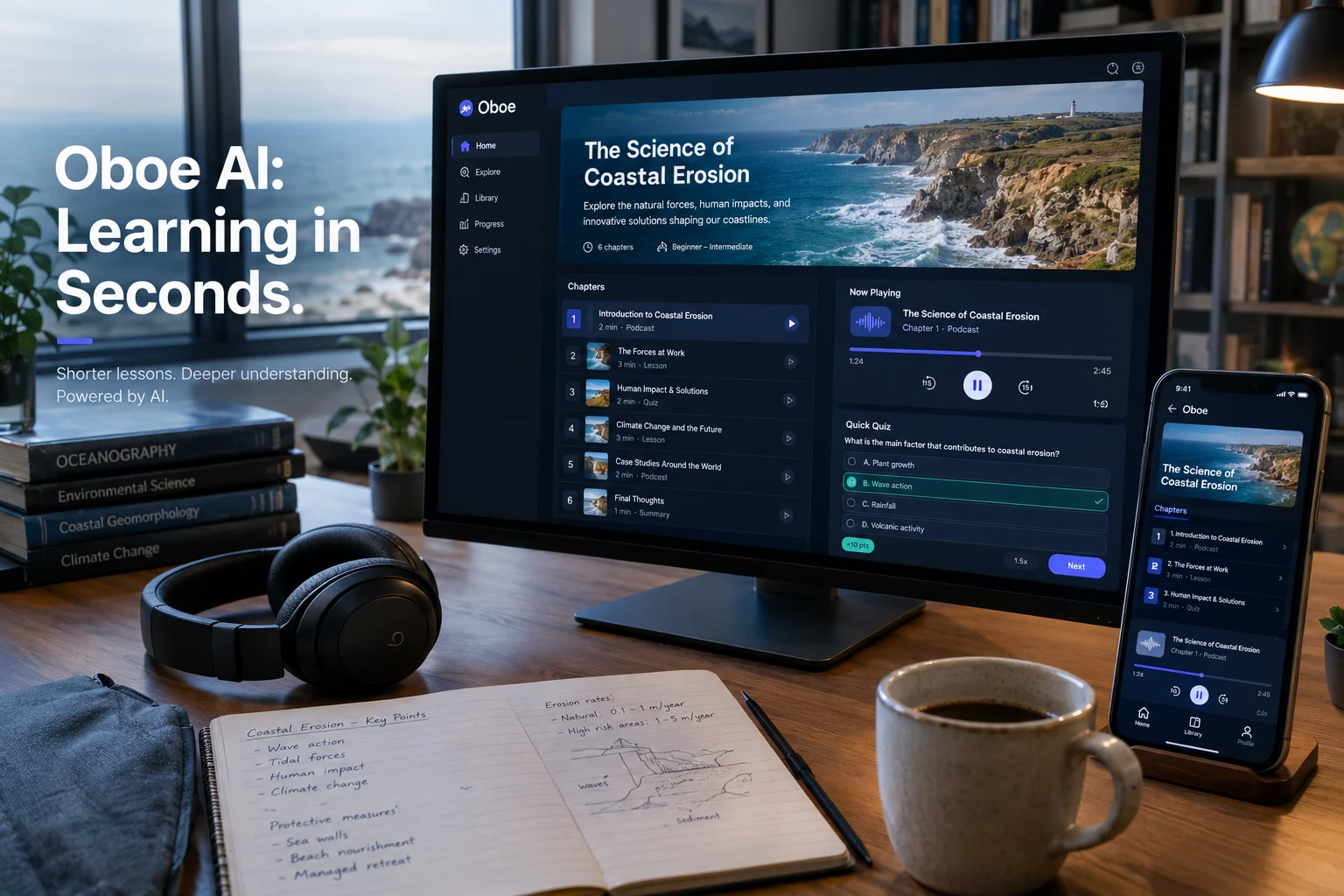
Oboe AI is an AI-powered learning platform that transforms any prompt into a structured, multimodal course within seconds. Founded by Anchor co-founders Nir Zicherman and Michael Mignano, it generates text lessons, AI podcasts, quizzes, flashcards, and games without requiring back-and-forth chat interactions .
At-a-Glance: Key Takeaways
- Oboe AI is a generalized learning platform that generates complete courses from a single text prompt, covering topics from STEM to pop culture .
- It raised $16 million in Series A funding led by Andreessen Horowitz in December 2025, just three months after launch .
- The platform uses a multi-agent architecture where specialized AI agents work in parallel to generate content, fact-check material, and pull real images from the internet .
- Free users can generate courses, but the free tier limits course creation per month. Paid plans start at $15 monthly .
- Oboe differs from NotebookLM by searching the internet for sources rather than requiring users to upload existing documents .
- Current limitations include English-only content, no course editing capability, and web-only access at launch .
What Is Oboe AI?
Oboe AI represents a distinct approach in the crowded AI learning space. Unlike chatbots that require conversational back-and-forth, Oboe generates complete educational courses from a single prompt. Type “the history of Jazz in America” or “preparing for my move to Japan,” and the platform produces a structured curriculum within seconds .
The name draws from the root of a Japanese word meaning “to learn” . The platform was created by Nir Zicherman and Michael Mignano, the founders who previously built Anchor, the podcasting tool Spotify acquired in 2019 .
Founder background matters here. Zicherman and Mignano bring deep experience in consumer products, audio content, and creator tools. Their intuition for narrative and distribution shaped Oboe’s design philosophy: learning should feel engaging, not like a formal academic exercise .
Oboe launched publicly in September 2025. Within three months, it attracted $16 million in Series A funding led by Andreessen Horowitz, with participation from Eniac, Haystack, Offline, and Factorial .
How Oboe AI Works
Oboe AI operates through a complex multi-agent architecture built from scratch. This architecture is central to how the platform delivers courses quickly and with quality control .
The Multi-Agent System
When a user enters a prompt, multiple AI agents activate simultaneously. Each agent handles a specific task:
- Course architecture agents design the overall structure and chapter breakdown
- Content generation agents write the base material for each section
- Fact-checking agents audit output for accuracy and correct errors
- Script agents write podcast dialogue and lecture narration
- Visual agents pull real images from the internet rather than generating AI images
According to Zicherman, the parallel orchestration is what makes Oboe fast. The entire course generation happens within seconds, not minutes .
Content Verification
Oboe’s team acknowledges the hallucination risk inherent to AI-generated content. Their response involves layers of auditing. Some agents verify the work of other agents, creating a check-and-balance system .
Zicherman stated that Oboe has “invested heavily in building systems that fact check, via agents that audit and correct the output of other agents” . He expressed optimism that this approach can make Oboe “more reliable than so much of the disinformation that perpetuates in other corners of the internet” .
Important context: This is a company claim. Independent verification of Oboe’s fact-checking accuracy is not available. No published benchmarks or third-party audits confirm the reliability of AI-generated course content.
Key Features of Oboe AI
Nine Course Formats
At launch, Oboe offered nine distinct learning modalities :
- Long-form reading with tables, images, and links to further reading
- AI-generated podcast with two hosts discussing the topic conversationally
- Lecture-style audio that mimics a university recording
- Key takeaways in condensed format
- Flashcards for memorization
- Quizzes to test comprehension
- Games for interactive engagement
- FAQ sections addressing common questions
Audio Innovation
Oboe’s podcast format resembles Google’s NotebookLM but with a critical difference. NotebookLM requires users to upload source documents. Oboe searches the internet independently to build its knowledge base .
The lecture format has received particular praise from reviewers. One tester noted forgetting the voice wasn’t real during extended listening sessions . The podcast format, with its dual-host banter, feels less natural according to the same review .
Structured Chapters
With the December 2025 update, Oboe generates courses as structured chapters rather than disconnected formats. Quizzes and flashcards appear seamlessly within the learning flow. The platform adapts audio tone based on the material and user signals .
Real Images
Oboe pulls actual images from the web rather than generating AI visuals. This choice improves factual accuracy for topics where visual representation matters .
Oboe AI Pricing and Plans
Oboe revamped its pricing model alongside the Series A announcement. The new structure offers unlimited course generation with paid tiers for deeper access .
| Plan | Price | What You Get |
|---|---|---|
| Free | $0 | Unlimited course generation, limited chapter depth |
| Plus | $15/month ($144/year) | Access to more course chapters |
| Pro | $40/month ($384/year) | Unlimited chapters, course export and download |
Information gain note: The Pro plan’s export feature addresses a practical need. Students who want printable study materials or offline access can download courses for consumption outside the platform .
Earlier pricing (before December 2025) capped course creation rather than chapter depth. Some third-party sources still list outdated pricing, including a misleading $259/month figure from one pricing tracker that appears unrelated to Oboe AI’s actual consumer product . Verify current pricing directly at oboe.com.
Oboe AI vs. Alternatives
Understanding how Oboe compares to competing tools helps clarify its positioning.
Privacy and Security Considerations
Oboe AI’s privacy posture requires careful examination. The platform generates courses based on user prompts, which means user input informs the output. Whether those prompts are retained for model improvement or other purposes is not clearly documented in available materials.
Key questions for prospective users:
- Does Oboe store user prompts and generated courses indefinitely?
- Can users delete their course history?
- What data do the fact-checking agents access during generation?
The platform pulls images from the internet, which introduces copyright considerations for generated courses. Whether Oboe has licensing arrangements for these images or relies on fair use is unclear.
Verification note: Oboe’s website and public materials do not reference SOC 2 certification, Zero Data Retention commitments, or third-party security audits. Users with strict data governance requirements should seek clarification directly from the company.
Who Should Use Oboe AI?
Oboe AI suits specific learner profiles.
Lifelong learners exploring new topics benefit from the quick course generation and variety of formats. The platform excels when you want structured exposure to a subject without committing to a full course or textbook .
Professionals needing rapid upskilling can generate focused courses on programming, business concepts, or industry topics. Zicherman noted high demand for STEM content on the platform .
Educators supplementing curriculum may find Oboe useful for creating shareable learning pathways on niche topics. One high school culinary teacher reported using Oboe to create courses on sanitation and ServSafe exam preparation .
Casual users wanting to learn about random curiosities fit Oboe’s design philosophy. Early usage data showed people prompting topics like Brazilian tax law and cow farming .
Oboe may not suit users who want:
- Content in languages other than English
- To edit or customize generated course structure
- Mobile app access (web-only at present)
- Video-based learning formats (on roadmap but not available)
Technical Considerations
Multi-Agent Architecture Complexity
Oboe’s parallel agent system is technically ambitious. Running multiple AI agents simultaneously requires significant inference infrastructure and careful orchestration to avoid conflicts or race conditions. The fact that Oboe generates courses in seconds rather than minutes suggests efficient model routing and possibly smaller, specialized models rather than relying solely on frontier LLMs .
Source Quality
Oboe searches the internet for course material. The quality of sources therefore depends on what the agents retrieve and how they evaluate credibility. This differs from NotebookLM, where users control source quality by uploading specific documents .
Hallucination Risk
Despite fact-checking agents, AI-generated educational content carries inherent hallucination risk. The auditing agents themselves are AI models, creating a potential single point of failure if the audit model shares biases or knowledge gaps with the generation model.
Context Window Limitations
Generating comprehensive courses on complex topics requires processing substantial information. Whether Oboe’s architecture handles context window constraints through retrieval-augmented generation (RAG) or other techniques is not publicly documented.
Common Mistakes When Using Oboe AI
Expecting editing capabilities. Oboe does not currently allow users to modify generated course structure or content. The founder confirmed this is on the roadmap but unavailable at present .
Assuming content is always accurate. While Oboe employs fact-checking agents, AI-generated educational content should be verified against authoritative sources for high-stakes learning. One educator noted that a requested high school biology course generated university-level reading difficulty .
Requesting non-English courses. Oboe currently operates in English only. Localization is planned but not yet available .
Confusing Oboe AI with other similarly named products. A separate product called oboe.chat offers pay-as-you-go access to multiple AI models . This is unrelated to Oboe AI, the learning platform.
Overlooking the Pro plan for offline access. Users who need printable or downloadable course materials should consider whether the Pro tier’s export feature justifies the higher cost .
Real-World Examples
The High School Culinary Teacher
A culinary instructor tested Oboe to create a course on sanitation and ServSafe exam preparation. The generated course proved useful, and the teacher began exploring classroom integration .
The Curious Explorer
One of Zicherman’s favorite early prompts was simply “hi.” Oboe responded by building a course on how to make a good first impression .
The Unexpected Topic Range
Early usage data revealed genuine curiosity-driven learning. Prompts included Brazilian tax law and cow farming, demonstrating that Oboe users seek knowledge beyond typical online course platforms .
Latest Developments
Series A Funding: Oboe raised $16 million in December 2025, led by a16z with participation from existing investors and notable angels including Adam D’Angelo, Garry Tan, and Lenny Rachitsky .
Product Redesign: The same announcement introduced chapter-based course generation, dynamic audio tone adjustment, and the revamped pricing model .
Mobile Apps: Native iOS and Android applications are in development. The platform currently operates on web and mobile web only .
Language Expansion: Oboe plans to add localized courses and language support beyond English, though no timeline has been announced .
Video Format: Video lessons are on the roadmap according to founder comments on Product Hunt, though cost considerations may affect implementation .
Frequently Asked Questions
What is Oboe AI used for?
Oboe AI generates personalized educational courses from text prompts. Users type a topic they want to learn about, and the platform creates a structured course with multiple formats: text lessons, AI podcasts, quizzes, flashcards, and games. It is designed for lifelong learners, students, and professionals seeking quick, structured exposure to new subjects .
Is Oboe AI free to use?
Oboe offers a free tier that allows unlimited course generation but limits access to deeper chapter content. The Plus plan at $15 per month provides more chapters, and the Pro plan at $40 per month adds unlimited chapters and course export capability. The platform previously offered a more restrictive free tier but changed its model in December 2025 .
How does Oboe AI differ from ChatGPT?
Oboe generates complete structured courses with multiple learning formats rather than engaging in conversational back-and-forth. ChatGPT excels at question-answering and exploratory dialogue. Oboe provides chapters, quizzes, flashcards, and AI-generated audio content in a single output. For systematic learning of a topic, Oboe offers more structure. For quick questions or brainstorming, ChatGPT remains more flexible .
Does Oboe AI replace teachers or traditional courses?
No. Oboe is a supplementary learning tool, not a replacement for structured education or human instruction. Its courses lack accreditation and may contain AI-generated inaccuracies despite fact-checking systems. Educators have reported using Oboe as a supplemental resource, not a primary teaching tool .
What are the main limitations of Oboe AI?
Key limitations include English-only content, no ability to edit generated courses, web-only access without native mobile apps, and limited verification of content accuracy. The platform also does not currently support video formats. Users should evaluate whether these constraints matter for their specific learning needs .
Conclusion
Oboe AI represents a notable experiment in AI-powered education. The platform transforms a single prompt into a structured, multimodal course within seconds, leveraging a multi-agent architecture that generates text, audio, quizzes, and visual content in parallel. Its founders bring proven experience from Anchor and Spotify, and the $16 million Series A from Andreessen Horowitz signals strong investor confidence.
What matters most is understanding what Oboe is and what it is not. It is a tool for rapid, structured exploration of topics. It is not a replacement for accredited courses, expert instruction, or careful source evaluation. The AI-generated content carries hallucination risk despite fact-checking agents, and independent verification of accuracy claims is not yet available.
Oboe may suit lifelong learners, professionals seeking quick upskilling, and educators looking for supplemental content generation. It suits users comfortable with English-language, web-based learning who value speed and format variety over deep customization or verified accuracy.
Before adopting Oboe, evaluate whether its limitations align with your needs. Consider the English-only constraint, the lack of course editing, and the absence of native mobile apps. If offline study or printable materials matter, assess whether the Pro plan’s export feature justifies the cost. Most importantly, treat AI-generated courses as starting points for learning, not authoritative final sources.