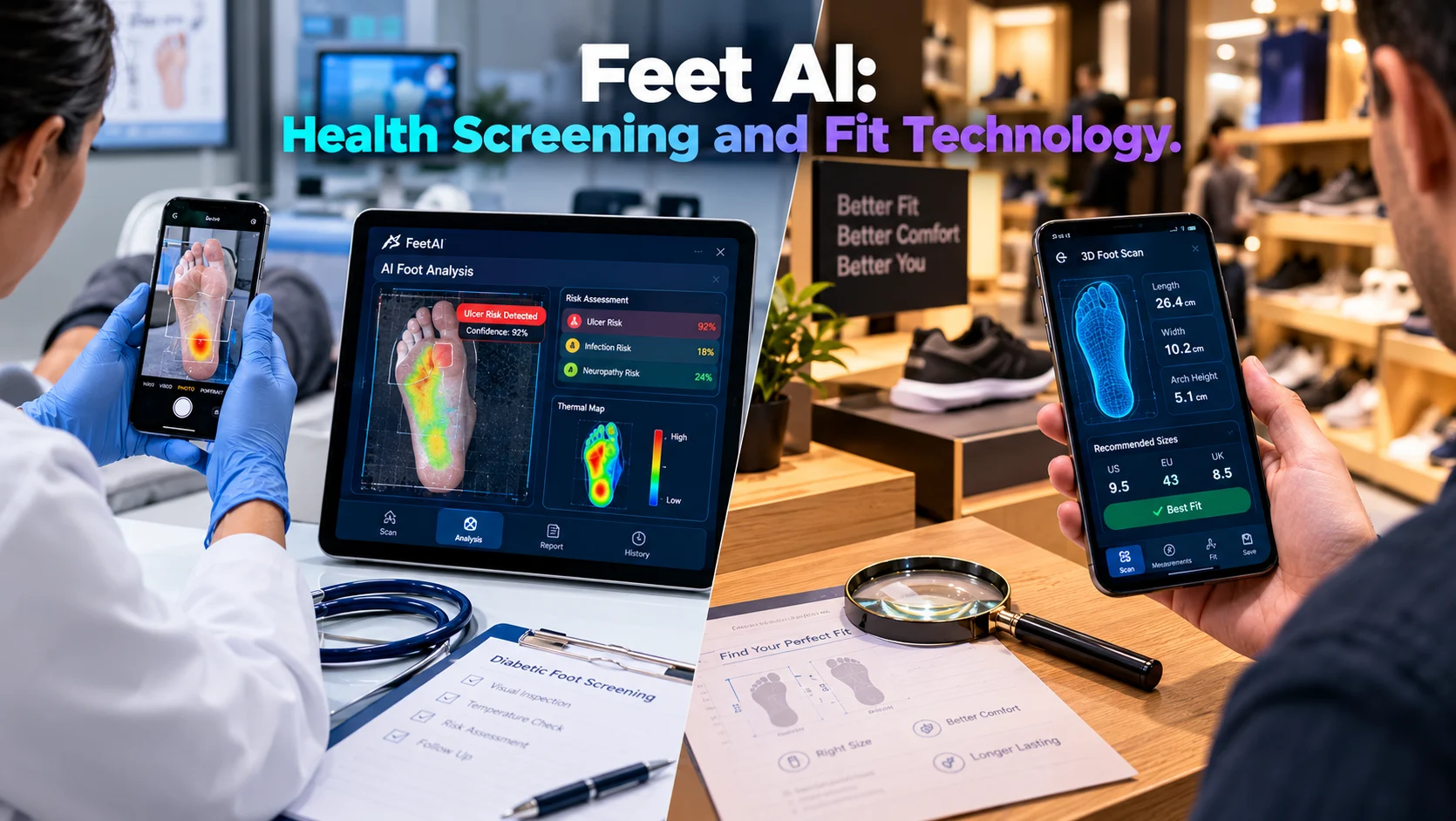
“Feet AI” refers to artificial intelligence applications for foot health and footwear, primarily AI-powered diabetic foot screening that detects ulcers and neuropathy from smartphone photos, and footwear fit technology that scans feet for accurate sizing. Clinical studies show AI foot screening achieving up to 95% accuracy for ulcer detection in research settings.
At-a-Glance: Key Takeaways
- AI diabetic foot screening detects ulcers, calluses, and deformities from smartphone or thermal camera images, with research accuracy reaching 95% .
- Thermal imaging combined with AI identifies pre-ulcer inflammation before visible skin breakdown, enabling earlier intervention .
- Footwear fit technology uses 3D scanning and computer vision to recommend correct shoe sizes, addressing the 60-70% of people wearing wrong-sized shoes .
- Major footwear brands have integrated AI fit tools, including Nike Fit and Amazon’s 3D foot scanning experiments.
- Clinical deployment remains limited. Most AI foot screening tools are in research or pilot stages, not routine clinical use.
- Privacy considerations are significant. Foot images can be biometric identifiers, and consumer footwear apps may share data with retailers.
What Is Feet AI?
“Feet AI” describes artificial intelligence applications targeting the human foot, spanning two primary categories with distinct purposes and audiences.
The first is clinical foot health screening, where AI analyzes images to detect conditions associated with diabetes, peripheral neuropathy, and vascular disease. Diabetic foot ulcers affect approximately 15-25% of people with diabetes and precede 85% of diabetes-related amputations. Early detection is critical, and AI offers a way to screen at scale using smartphone cameras .
The second is footwear fit technology, where AI and 3D scanning determine accurate shoe sizing and recommend footwear. Studies consistently show that 60-70% of people wear incorrectly sized shoes, contributing to foot pain, blisters, and long-term deformities. AI fit tools aim to solve this by measuring feet precisely rather than relying on self-reported sizes .
A third, separate category involves adult content generation using AI foot imagery. This falls outside legitimate clinical and commercial applications and is not covered here.
How AI Foot Screening Works
The Imaging Pipeline
Clinical AI foot screening typically operates through a structured pipeline. A smartphone or dedicated camera captures images of the foot, sometimes including multiple angles or plantar (sole) views. Computer vision models then analyze the images for specific markers .
The models detect features including:
- Ulcers and open wounds
- Calluses and corns (which can precede ulcers)
- Deformities such as Charcot foot or hammer toes
- Skin discoloration indicating vascular compromise
- Temperature asymmetry when thermal imaging is used
Deep learning architectures, particularly convolutional neural networks (CNNs), are trained on labeled datasets of foot images to classify these conditions .
Thermal Imaging for Pre-Ulcer Detection
A significant advance involves thermal imaging combined with AI. Inflammation precedes visible skin breakdown by days or weeks, and inflamed tissue radiates more heat. Thermal cameras capture this temperature differential, and AI identifies regions of abnormal heat that signal impending ulceration .
Research from the University of Toronto and others has demonstrated that AI analysis of thermal foot images can predict ulcer development before clinical signs appear. This shifts screening from reactive detection to proactive prevention .
Validation and Accuracy
Published research reports varying accuracy rates depending on the specific task and dataset. Detection of existing ulcers from smartphone images has reached approximately 95% sensitivity in controlled studies. Identification of neuropathy through plantar pressure patterns and gait analysis has shown comparable performance .
Important caveat: These results come from research settings with curated datasets. Real-world deployment introduces variable lighting, camera quality, patient positioning, and skin tone diversity that can degrade performance. No AI foot screening tool has achieved regulatory clearance for autonomous diagnosis without clinician review.
AI in Footwear Fit Technology
3D Foot Scanning
Footwear fit AI typically begins with 3D foot scanning. Smartphone apps or dedicated hardware capture the foot’s geometry, measuring length, width, arch height, instep, and heel width. AI models then match the scan against shoe lasts and recommend appropriate sizes .
Nike’s Fit technology used smartphone cameras to map feet in 3D, generating a personal size recommendation per shoe model rather than a single generic size. Amazon experimented with similar technology for its shoe categories .
The Fit Problem
The business case is significant. E-commerce return rates for shoes range from 30% to 50%, driven largely by fit issues. AI fitting tools aim to reduce returns by improving first-purchase accuracy. For retailers, this reduces logistics costs and improves customer satisfaction .
Beyond Size: Style and Comfort Prediction
Advanced systems go beyond size to predict comfort based on foot shape. Wide feet, high arches, and narrow heels all affect which shoes will fit well. AI models can recommend specific styles and brands that suit a user’s foot geometry, not just the nominal size .
Clinical Applications and Deployment
Diabetic Foot Screening Programs
Several health systems and research institutions have piloted AI foot screening programs. The typical workflow involves nurses or community health workers capturing foot images with smartphones, uploading them to a cloud platform, and receiving AI-generated risk scores .
The advantages are clear: low cost, no specialized equipment beyond a smartphone, and potential for screening outside clinical settings. In regions with limited podiatry access, AI screening could reach patients who would otherwise go unscreened until complications arise .
Barriers to Clinical Adoption
Despite promising research, adoption faces real obstacles:
- Regulatory clearance: AI foot screening tools require regulatory approval for clinical use. Most research systems have not completed this pathway.
- Workflow integration: Adding AI screening to clinical workflows requires training staff, establishing referral pathways, and defining responsibility for AI-flagged cases.
- Reimbursement: There is no established payment model for AI foot screening in most health systems.
- Data quality: Real-world images vary dramatically in quality, and models trained on curated data may underperform.
Editorial interpretation: The clinical promise of AI foot screening is real, but deployment is early. Organizations exploring it should pilot carefully, validate on their own patient populations, and treat AI outputs as screening signals, not diagnoses.
Pricing and Access
Clinical AI Foot Screening
Most clinical AI foot screening systems are not sold as standalone products with published pricing. They are deployed through:
- Research collaborations with universities and health systems
- Enterprise health platform integrations where foot screening is one module among many
- Custom pilot programs with negotiated terms
Organizations interested in AI foot screening typically engage vendors directly for pilots rather than purchasing off-the-shelf.
Footwear Fit Technology
Footwear fit AI reaches consumers through:
- Retailer apps (often free to consumers, monetized through conversion improvement)
- Brand-specific tools like Nike Fit, provided at no charge
- Third-party sizing platforms licensed to retailers, with costs embedded in retail operations
For consumers, the tools are generally free. For retailers, costs range from per-scan fees to enterprise licensing depending on provider and volume.
Privacy and Security Considerations
Foot Images as Biometric Data
Foot geometry is increasingly recognized as a biometric identifier. Gait patterns and foot shape can identify individuals, raising privacy concerns when images are collected and stored .
Clinical deployments must comply with healthcare privacy regulations such as HIPAA in the US and GDPR in Europe. Foot images captured in clinical settings carry the same obligations as other medical imaging.
Consumer Footwear Apps
Consumer footwear fit apps operate under different rules. Privacy policies vary widely. Some apps process scans locally on the device; others upload to cloud servers and may share data with retail partners .
Users evaluating these apps should check:
- Whether images are processed on-device or in the cloud
- Whether data is shared with retailers or third parties
- How long data is retained
- Whether users can delete their scans
Important distinction: No SOC 2 certification or similar compliance framework is uniformly applied to consumer footwear fit apps. They are generally not healthcare-grade products.
Who Should Use Feet AI Applications
Healthcare organizations and diabetes care programs exploring scalable foot screening for at-risk patients. AI screening can extend reach where podiatry access is limited, provided it supplements rather than replaces clinical assessment.
Researchers in diabetic foot complications studying early detection and prevention. Thermal imaging combined with AI represents a promising research direction for pre-ulcer detection .
Footwear retailers and brands seeking to reduce returns and improve fit satisfaction. AI sizing tools address a measurable business problem in e-commerce.
Podiatrists and foot health professionals can use AI screening as a triage aid, though clinical judgment remains essential.
Consumers may benefit from footwear fit apps for better sizing, with appropriate privacy awareness.
Anyone seeking adult AI foot content falls outside legitimate clinical and commercial applications and is not served by the tools discussed here.
Common Mistakes and Cautions
Overestimating clinical readiness. Most AI foot screening research has not completed regulatory pathways. Treat research results as promising but not deployment-ready .
Assuming smartphone images replace clinical assessment. AI screening flags risk. It does not diagnose. Clinical evaluation remains necessary for any positive finding.
Ignoring skin tone diversity in training data. Models trained primarily on lighter skin tones may underperform on darker skin, a documented problem in medical imaging AI generally.
Sharing foot scans without reviewing privacy terms. Foot geometry can function as a biometric identifier. Consumer apps may share data with retailers or partners.
Confusing fit tools with medical devices. Footwear sizing apps are consumer products, not diagnostic tools. They should not be used to assess foot health.
Frequently Asked Questions
What is Feet AI?
“Feet AI” refers to AI applications for foot health and footwear. This includes clinical diabetic foot screening that detects ulcers and neuropathy from images, and footwear fit technology that scans feet for accurate sizing. A separate adult content category falls outside legitimate applications.
How accurate is AI foot screening?
Published research reports up to 95% sensitivity for ulcer detection in controlled studies. Real-world accuracy depends on image quality, lighting, and patient diversity. No AI foot screening tool has regulatory clearance for autonomous diagnosis without clinician review.
Can AI detect diabetic foot problems early?
Yes. Thermal imaging combined with AI can identify pre-ulcer inflammation before visible skin breakdown, enabling earlier intervention. This shifts screening from reactive detection to proactive prevention .
Is AI foot screening available to patients?
Availability is limited. Most tools are in research or pilot stages within health systems, not routine clinical use. Patients interested in AI foot screening should ask their healthcare provider about participation in screening programs.
What is AI footwear fit technology?
AI footwear fit tools use 3D scanning and computer vision to measure feet and recommend correct shoe sizes. They address the 60-70% of people wearing wrong-sized shoes and aim to reduce e-commerce returns. Nike Fit and similar tools are examples.
Conclusion
Feet AI spans two legitimate and promising domains. In clinical care, AI-powered foot screening offers a path to earlier detection of diabetic complications, particularly when combined with thermal imaging for pre-ulcer inflammation. In commerce, footwear fit technology addresses a measurable problem in sizing accuracy and returns.
What matters most is realistic expectations. Clinical AI foot screening has strong research results but limited real-world deployment. Regulatory clearance, workflow integration, and reimbursement remain unresolved. Footwear fit tools are more mature commercially but serve a different purpose: sizing, not health assessment.
Feet AI applications may suit healthcare organizations exploring scalable screening, researchers studying diabetic foot complications, footwear retailers seeking to reduce returns, and consumers wanting better shoe sizing. They may not suit anyone expecting immediate clinical-grade diagnosis from consumer apps or autonomous AI assessment without clinician review.
Before adopting any feet AI tool, understand its intended use. Clinical tools are screening aids, not diagnostic devices. Consumer tools are sizing aids, not health assessments. And review privacy practices carefully, since foot images can function as biometric identifiers.